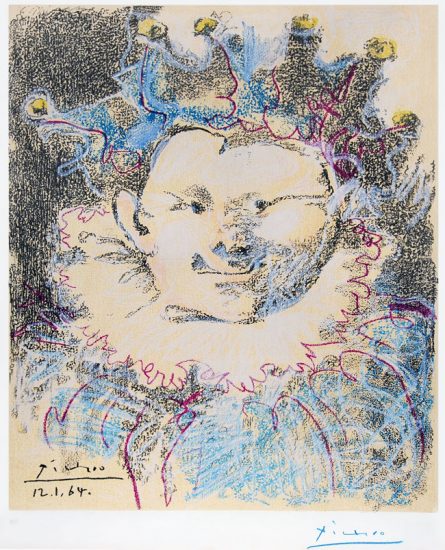
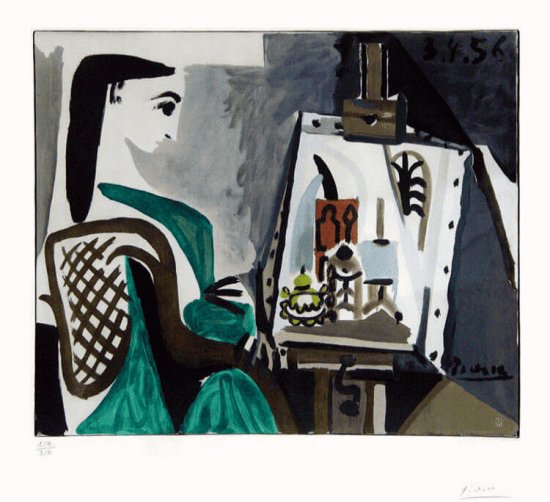
Pablo Picasso (Spanish, 1881–1973) was one of the most influential and prolific artists of the twentieth century, working across painting, drawing, sculpture, ceramics, lithography, etching, linocut, drypoint and other printmaking techniques. His work encompasses many of the subjects most closely associated with his career, including portraits, women, Jacqueline Roque, animals, bulls, mythology, musicians and still lifes. Explore our collection of authentic Pablo Picasso works for sale, including original prints, ceramics and other works documented through recognized catalogues raisonnés, edition information, provenance and scholarly references.
Whether you are looking to buy an original Pablo Picasso artwork or sell a Picasso from your collection, Masterworks Fine Art provides expert guidance based on authenticity research, catalogue raisonné references, edition details, condition, provenance and current market activity.
Buy Original Pablo Picasso Signed and Edition Numbered Artwork For Sale
Shop original hand-signed Pablo Picasso lithographs, ceramics, and prints for sale.
Pablo Picasso (Spanish, 1881–1973) was one of the most influential and prolific artists of the twentieth century, working across painting, drawing, sculpture, ceramics, lithography, etching, linocut, drypoint and other printmaking techniques. His work encompasses many of the subjects most closely associated with his career, including portraits, women, Jacqueline Roque, animals, bulls, mythology, musicians and still lifes. Explore our collection of authentic Pablo Picasso works for sale, including original prints, ceramics and other works documented through recognized catalogues raisonnés, edition information, provenance and scholarly references.
Whether you are looking to buy an original Pablo Picasso artwork or sell a Picasso from your collection, Masterworks Fine Art provides expert guidance based on authenticity research, catalogue raisonné references, edition details, condition, provenance and current market activity.
Have one to sell? Sell Pablo Picasso fine art with us
Sell Pablo Picasso artwork with us. We specialize in buying and selling original hand-signed numbered edition prints. We will research its value and popularity for you.
“Yet Cubism and Modern art weren’t either scientific or intellectual; they were visual and came from the eye and mind of one of the greatest geniuses in art history.”
Pablo Picasso’s Early Life and Artistic Training
Pablo Ruiz Picasso was born on October 25, 1881, in Málaga, Spain. His father, José Ruiz Blasco, was a painter and art teacher who recognized Picasso’s ability at an early age and played an important role in his initial artistic training.
Picasso studied in Spain, including in Barcelona, where he became involved with the city’s artistic and intellectual circles. By the end of the nineteenth century he was moving between Spain and Paris, absorbing the work of artists including Henri de Toulouse-Lautrec, Edgar Degas and other figures associated with modern French painting.
These early years established the remarkable technical foundation that Picasso would repeatedly challenge and reinvent throughout his career.
Pablo Picasso’s Blue Period
Picasso’s Blue Period, generally dated from 1901 to 1904, is characterized by a predominantly blue and blue-green palette and by subjects drawn from poverty, isolation and marginal life.
Figures such as beggars, prisoners, mothers, musicians and other socially displaced individuals appear frequently in works from this period.
One of the best-known paintings of the Blue Period is La Vie (1903), now in the Cleveland Museum of Art. The emotional intensity and restricted palette of these works helped establish Picasso as an important young artist in the emerging modern movement.
Around 1904, Picasso’s palette began to shift toward warmer pinks, reds, ochres and earth tones.
During the Rose Period, he frequently depicted circus performers, acrobats, harlequins and saltimbanques. These figures became recurring symbols in his art and marked an important transition between the emotional restraint of the Blue Period and the radical formal experimentation that followed.
Family of Saltimbanques (1905), now in the National Gallery of Art in Washington, D.C., is among the best-known works from this period.
Picasso’s 1907 painting Les Demoiselles d’Avignon marked a decisive break from conventional representation and became one of the foundational works of modern art.
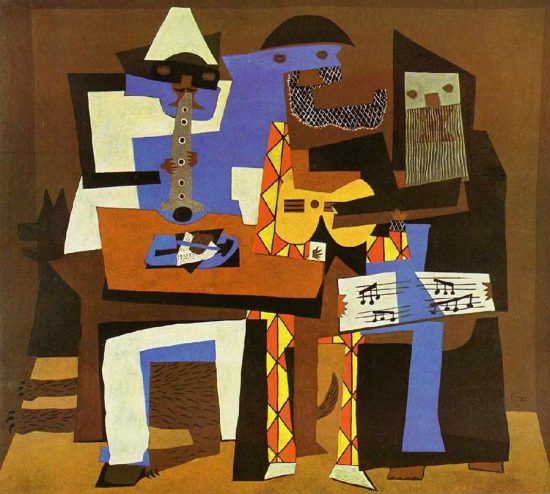
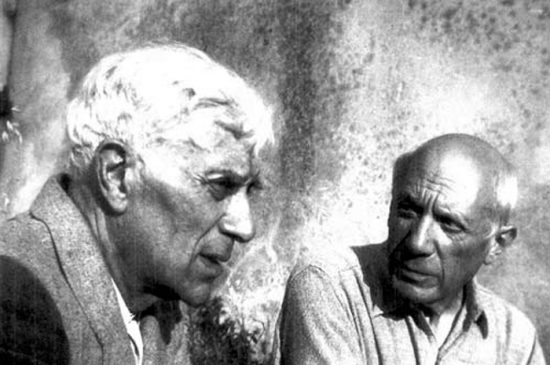
Working closely with Georges Braque, Picasso developed Cubism, an approach that rejected traditional single-point perspective and instead represented subjects through fragmented planes and multiple viewpoints.
Analytic Cubism broke forms into increasingly complex geometric structures, while Synthetic Cubism introduced collage, printed materials, text and simplified shapes.
Cubism transformed painting and had a profound influence on sculpture, printmaking, design and the broader development of twentieth-century art. Picasso continued revisiting its visual language throughout his career even after moving into other styles and media.
Pablo Picasso’s Neoclassical and Surrealist Periods
Following the First World War, Picasso returned to a more monumental and classically inspired figure style while continuing to experiment with Cubism.
During the 1920s and 1930s, his work moved freely between classical figuration, abstraction and imagery associated with Surrealism. Distorted bodies, mythological figures, minotaurs, bulls and dramatically transformed human forms became increasingly important.
Rather than abandoning earlier approaches, Picasso often worked in several visual languages simultaneously, a pattern that would continue throughout the rest of his career.
Pablo Picasso and Guernica
Picasso’s work also responded directly to political conflict.
His monumental painting Guernica was created in 1937 in response to the bombing of the Basque town of Guernica during the Spanish Civil War.
The work became one of the most recognizable anti-war images of the twentieth century and demonstrated how Picasso’s fragmented forms and expressive distortions could communicate violence, suffering and political trauma.
Themes of war, violence and peace continued to appear in his work in later decades.
Pablo Picasso Paintings
Painting remained central to Picasso’s practice throughout his life.
His paintings range from the emotional monochromatic works of the Blue Period and the circus subjects of the Rose Period to the radical experiments of Cubism, the monumental figures of his Neoclassical period and the highly expressive paintings of his final decades.
Important recurring subjects include portraits, women, still lifes, musicians, bulls, war, mythology and reinterpretations of works by earlier masters.
Picasso repeatedly revisited historic artists including Velázquez, Delacroix and Manet, using their compositions as starting points for his own experiments with form, color and interpretation.
Drawing formed the foundation of Picasso’s artistic practice from childhood through the final years of his life.
He worked in pencil, ink, charcoal, crayon and other drawing materials, producing everything from rapid studies to highly resolved compositions.
His drawings reveal both his remarkable technical skill and his ability to reduce a figure, animal or face to a few highly controlled lines. Many themes that later appeared in paintings, prints, sculptures and ceramics were first explored through drawing.
Printmaking was central to Pablo Picasso’s career and provided him with a medium for continual experimentation. Across etching, lithography, linocut, drypoint and aquatint, Picasso explored many of the same subjects that appeared throughout his paintings and drawings, including portraiture, mythology, bullfighting, artists and models, women, animals and still lifes.
His graphic work spans decades and includes both individual prints and major series, making Picasso one of the most prolific and important printmakers of the twentieth century.
Picasso used etching and other intaglio techniques throughout his career, creating some of his most important graphic works in the medium.
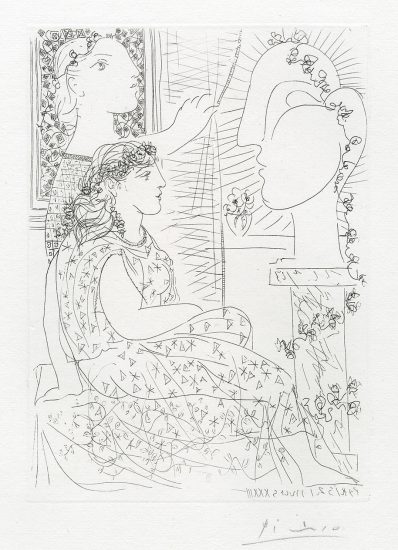
The Vollard Suite, created during the 1930s, is among his best-known print projects and explores themes including the artist and model, mythology, the Minotaur and the creative process. Picasso continued working with etching, drypoint and related techniques later in life, producing increasingly expressive and technically adventurous graphic works.
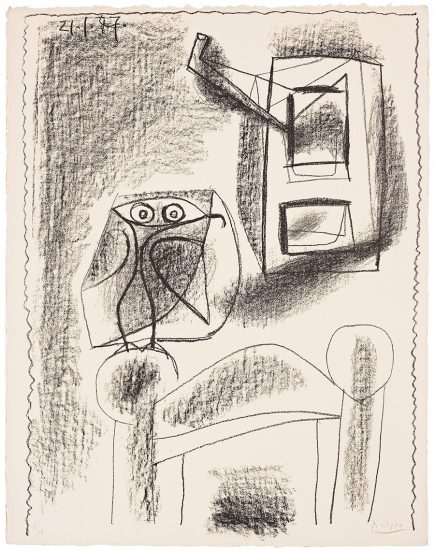
Picasso became deeply engaged with lithography after World War II, particularly through his collaboration with master printer Fernand Mourlot in Paris.
The medium allowed Picasso to experiment with drawing directly on lithographic stone, transfer paper and other surfaces while repeatedly revising images through successive states. His lithographs include portraits, still lifes, animals, women and many of the recurring subjects of his postwar work.
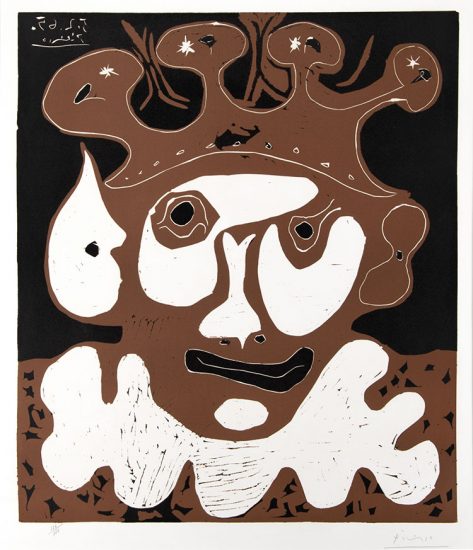
Picasso’s linocuts are closely associated with Vallauris and his collaboration with printer Hidalgo Arnéra.
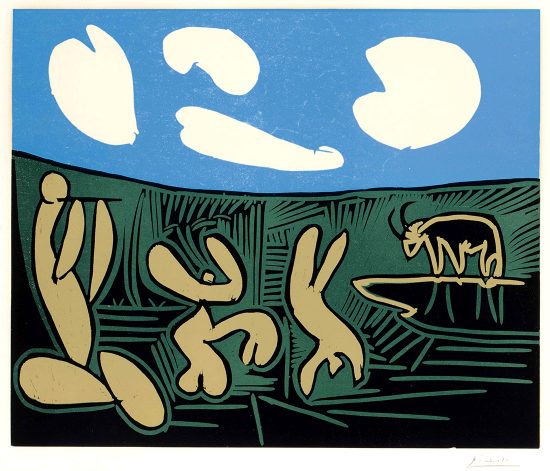
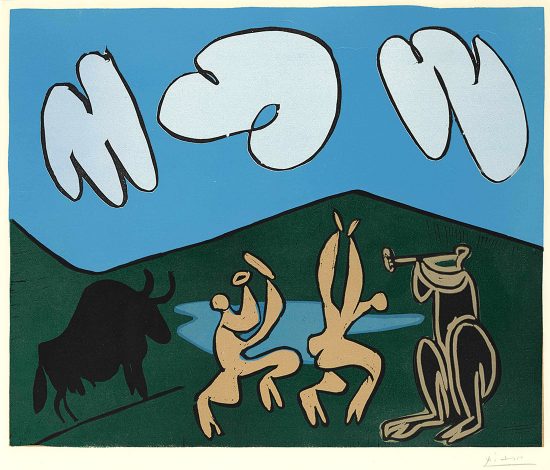
During the 1950s and 1960s, Picasso transformed linocut into a highly sophisticated medium. He developed an innovative reduction method in which multiple colors could be printed from a single block by progressively cutting away the surface between impressions.
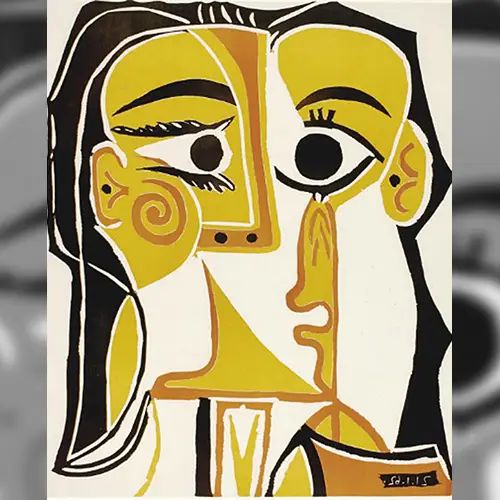
His linocuts are particularly admired for their bold color, simplified forms and subjects including portraits, bullfighting, mythology and Jacqueline Roque.
Sculpture was another major component of Picasso’s career.
He worked in bronze, plaster, wood, metal, found objects and constructed assemblage, often challenging conventional distinctions between painting and sculpture.
His sculptures range from modeled figures to radical constructions assembled from everyday materials.
Picasso’s willingness to transform ordinary objects into unexpected forms became particularly influential for later twentieth-century sculpture and assemblage.
Pablo Picasso Ceramics
Picasso began working seriously with ceramics after visiting Vallauris in the south of France in 1946.
He developed a close relationship with Suzanne and Georges Ramié at Madoura Pottery, where he was able to experiment with clay, glazes, slips, oxides, engraving and firing techniques.
Ceramics allowed Picasso to combine drawing, painting and sculpture within a single medium. Plates became faces, pitchers became birds or human figures, and traditional pottery forms were transformed through painted decoration and changes to their physical structure.
His ceramic production includes both unique works and authorized Madoura editions. Many editioned ceramics are documented in Alain Ramié’s catalogue raisonné and identified by A.R. catalogue numbers.
Vallauris became one of the most important places in Picasso’s later career.
The town’s pottery tradition introduced him to ceramics, but his years in the south of France also influenced his painting, sculpture, printmaking and linocuts.
The Mediterranean environment, local pottery traditions, bullfighting culture and his relationship with Madoura all contributed to the development of the imagery and techniques that defined much of his postwar work.
Jacqueline Roque became one of the most important figures in Picasso’s late life and art.
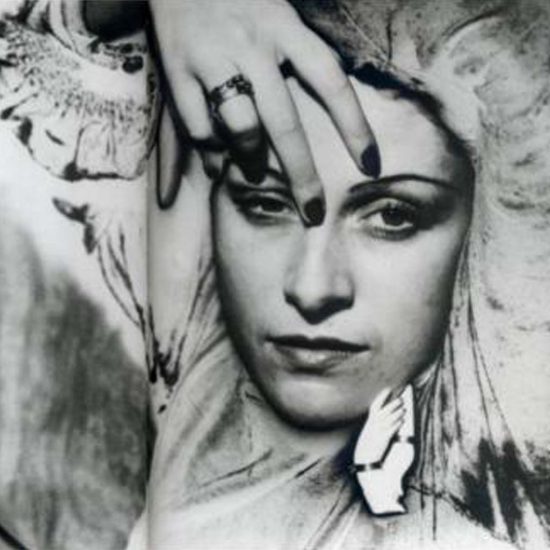
The two met at Madoura Pottery in Vallauris and married in 1961. Jacqueline became one of Picasso’s most frequently depicted subjects, appearing in paintings, drawings, lithographs, linocuts and other works.
Her profile, dark hair and distinctive features became central to the visual language of Picasso’s final decades.
Picasso repeatedly returned to certain subjects throughout his career.
These include:
Women and portraiture
Jacqueline Roque
Bulls and bullfighting
Minotaurs and mythology
Harlequins and circus performers
Musicians
Still lifes
Animals
The artist and model
Musketeers
Old Master reinterpretations
Pablo Picasso’s Late Career
Picasso remained extraordinarily productive during the final decades of his life.
He continued painting, drawing, making prints, producing ceramics and revisiting themes from art history.
His late paintings often feature musketeers, painters, models and dramatically simplified faces, while his late printmaking became increasingly prolific and experimental.
Far from representing a quiet conclusion to his career, Picasso’s late work demonstrates his continuing desire to challenge established artistic conventions.
Pablo Picasso’s Death
Pablo Picasso died on April 8, 1973, in Mougins, France, at the age of 91.
He left behind an enormous body of work spanning painting, drawing, sculpture, ceramics and virtually every major form of printmaking.
Pablo Picasso’s Legacy
Picasso’s influence on modern and contemporary art is difficult to overstate.
His role in the development of Cubism alone transformed the history of twentieth-century art, but his importance extends far beyond a single movement.
He continually moved between media, styles and techniques, treating painting, sculpture, drawing, ceramics and printmaking as interconnected areas of experimentation.
His willingness to reinvent his own visual language throughout a career lasting more than seventy years remains one of the defining characteristics of his work.
Today Picasso’s works are held in major museums and private collections around the world, and his paintings, prints, ceramics, drawings and sculptures remain central to the study and collecting of modern art.
Pablo Picasso Authentication and Catalogue Raisonné Research
Researching a Picasso work may involve different scholarly resources depending on the medium. Collectors may consult catalogue raisonné references, edition documentation, printer or publisher information, provenance, dimensions, signatures, workshop markings and other supporting records.