Details
| Artist: | Frank Stella (1936 - 2024) |
|---|---|
| Title: | Imola Three II, State I, from the Circuits Series, 1984 |
| Reference: | Axsom 142.1a |
| Series: | Circuits Series 1982-1984 |
| Medium: | Relief, woodcut, stencil, screenprint on white TGL handmade, hand-colored paper |
| Image Size: | 66 in x 52 in (167.6 cm x 132.1 cm) |
| Sheet Size: | 66 in x 52 in (167.6 cm x 132.1 cm) |
| Framed Size: | 70 in x 56 in (177.8 cm x 142.24 cm) |
| Edition: | Numbered from the edition of 10 in pencil in the lower right image. |
| Signature: | This work is hand-signed by Frank Stella (Massachusetts, 1936 – New York, 2024) in pencil in the lower right image. |
| Price: | $38,000 |
| Availability | This Frank Stella Relief is for sale |
| Item # | W-7067 |
Historical Description
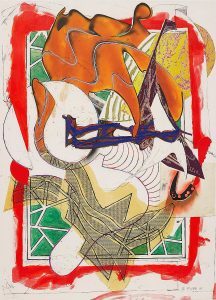
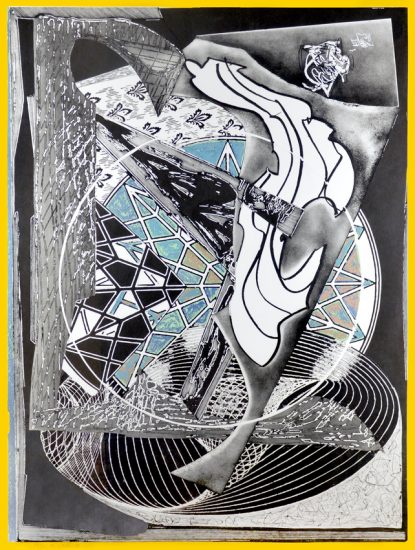
Frank Stella’s Imola Three II, State I, from the Circuits Series, 1984, is a monumental and intensely energetic work that transforms the twisting movement of an automobile racetrack into an extraordinary field of color, line, texture, and overlapping form. Against a heavily worked silver-gray ground, a brilliant blue geometric structure dominates the upper and left portions of the composition, while a large gold-and-black form expands dramatically through its center. Sweeping red, orange, pink, green, and black lines travel across and around these larger shapes, repeatedly changing direction as though tracing different routes through the image. Most striking is the broad pink-and-black serpentine form that enters from the upper left, descends through the composition, and curls dramatically across the bottom before turning back upon itself. Surrounding these monumental elements is an extraordinary accumulation of smaller red, purple, green, blue, orange, and white symbols and drawing-like marks. Some resemble mechanical diagrams or fragments of drafting templates, while others appear spontaneous and almost calligraphic. Rather than allowing any single form to remain visually isolated, Stella continually overlaps one element with another, creating an image in which the eye is always moving. The relatively subdued gray background makes the saturated blue, gold, pink, red, and orange appear especially vivid, while its distressed texture gives the work an unexpected physicality. Particularly compelling is the tension between the composition’s underlying structure and its apparent spontaneity. What initially appears chaotic gradually reveals a remarkably sophisticated organization of curves, geometric forms, repeated symbols, and intersecting trajectories. The result is unmistakably Frank Stella: ambitious, technically complex, visually restless, and filled with the sensation of speed and movement that defines his celebrated Circuits Series.
The combination of printmaking techniques is particularly effective in Imola Three II, State I. Stella uses relief, woodcut, stencil, screenprint, and hand-coloring not to create a mechanically uniform image, but to preserve the irregularity and immediacy of drawing and painting. The subdued gray field is essential to the composition, providing a textured surface against which the brilliant blue, gold, pink, red, orange, green, and purple become dramatically intensified. Stella’s additional drawing-like markings transform the surface into something active and unpredictable, while the overlapping printed forms create a sensation of depth despite the fundamentally flat sheet of paper. The composition revisits imagery Stella had previously explored in Imola Three I, while the subdued background suggests a ghostlike impression of forms beneath the more assertive foreground imagery. The additional markings radically alter that foundation, however, giving this state an impression of its own distinct visual identity. The result demonstrates Stella’s remarkable ability to push printmaking beyond straightforward reproduction and toward the physical presence, spontaneity, and complexity more commonly associated with a unique painting or drawing.
Imagine living with Frank Stella’s Imola Three II, State I, every day. This is not an artwork that simply hangs on a wall—it has the visual authority to transform the room around it. From across a space, the saturated blue structure, commanding gold-and-black central form, and enormous looping pink-red trajectory immediately establish the composition and give it tremendous architectural presence. The eye instinctively follows Stella’s sweeping lines as they race around the image, disappear behind other forms, and unexpectedly reemerge elsewhere. As you move closer, however, the experience changes completely. The seemingly straightforward gray field reveals an extraordinary assortment of scratches, textures, irregular printing, small colored symbols, overlapping lines, and hand-colored details. Forms that initially appeared secondary begin to compete for attention, making the composition feel different each time it is viewed. That contrast between immediate visual impact and almost obsessive detail makes Imola Three II, State I, particularly rewarding to live with. In a large contemporary interior, it could become the defining visual element of a living room, entry hall, library, or office, while in a more restrained or traditional environment its raw energy and brilliant color could create a dramatic dialogue with the surrounding architecture and furnishings. Despite the density of the composition, the silver-gray ground gives the colors room to breathe, allowing the work to remain sophisticated rather than overwhelming. It is a work with enough presence to command a space and enough complexity to continue revealing something new long after its initial impact.
Created in 1984, Imola Three II, State I, from the Circuits Series is an original relief, woodcut, stencil, and screenprint on white TGL handmade, hand-colored paper. This impression is numbered from the edition of only 10 in pencil in the lower right image and is hand-signed by Frank Stella in pencil in the lower right image. The unusually small edition, technically demanding combination of printing processes, and extensive hand-coloring contribute to the distinctive character of each impression and underscore the ambitious nature of Stella’s printmaking during this period.
Frank Stella Imola Three II, State I, 1984 is part of a portfolio of 16 works in the artist's Circuits Series from 1982-84. This body of work is inspired by his interest in race tracks that he visited all over the world. Also featured in this portfolio are Talladega Three I , Talladega Three II , Talladega Three III , Talladega Five I , Estoril Three II , Estoril Five I , Estoril Five II , Imola Three I , Imola Three II, State I , Imola Three IV, Imola Five II , Imola Five II, State I, Pergusa Three, Pergusa Three, State I, and Pergusa Three Double.
Catalogue Raisonné & COA:
Frank Stella Imola Three II, from the Circuits Series, 1984, is fully documented and referenced in the below catalogue raisonnés and texts (copies will be enclosed as added documentation with the invoices that will accompany the sale of the work).
1. Axsom, Richard. The Prints of Frank Stella: A Catalogue Raisonné 1967–1984. Hudson Hills Press: New York, 1983. Listed and illustrated as catalogue raisonné no. 142.1a on pg. 231.
2. A Certificate of Authenticity will accompany this artwork.
About the Framing:
Frank Stella’s Imola Three II, State I, is presented in museum-grade conservation framing with a complementary molding and optical-grade Plexiglas. The restrained presentation gives the extraordinarily complex composition room to breathe while allowing Stella’s brilliant blue, gold, red, pink, orange, green, and purple to remain the visual focus. The silk-wrapped mats provide an elegant visual separation between the densely worked sheet and its surroundings, allowing the intricate edges, layered forms, and expressive surface to be appreciated without competing with the artwork itself. The conservation presentation also respects the physical qualities of the handmade, hand-colored paper and the extraordinary variety of printing techniques Stella employed. The finished presentation gives Imola Three II, State I, the sophisticated presence appropriate for such an ambitious Stella while maintaining the rawness, movement, and visual intensity that make the work so compelling.
Frank Stella (American, 1936–2024) was one of the most influential American artists of the postwar period, continually redefining the possibilities of abstraction across painting, printmaking, sculpture, and architectural form. Emerging in the late 1950s with his radically reductive paintings, Stella initially became known for compositions that challenged the expressive conventions of Abstract Expressionism through repetition, geometry, and carefully organized structures. Over the following decades, however, his work became increasingly complex, colorful, dimensional, and visually exuberant. By the 1970s and 1980s, the restrained geometry associated with his earliest work had developed into elaborate compositions filled with curving forms, overlapping planes, brilliant colors, and increasingly physical surfaces. Printmaking played an essential role in this evolution, allowing Stella to experiment with combinations of techniques capable of producing effects ranging from precise mechanical structures to spontaneous drawing and painterly gesture. His Circuits Series, created between 1982 and 1984, represents this transformation particularly well. Inspired by automobile racing circuits Stella encountered around the world, the series translated the shapes, movement, and directional energy of racetracks into complex abstract compositions. Imola Three II, State I reflects this mature approach, transforming the configuration and sensation of the Imola circuit into a dynamic network of color, line, texture, and movement.
About the Series: Circuits Series 1982-1984
Frank Stella's Circuits, 1982-84 is a series of 16 prints, each of which is conceived using a different form of printmaking and hail from editions of varying sizes. The titles of each of the works in this series are derived from auto-racing tracks that the artist visited in the late 1970s. The shaped featured in this series are an extension of Stella's exploration into the rendering of forms derived from mechanical-drawing templates. Browse Frank Stella, Circuits Series 1982-1984.
Frank Stella (1936 - 2024)
Explore original Frank Stella prints and artwork for sale, including signed and editioned screenprints, lithographs, etchings, woodcuts, reliefs and mixed-media works. Masterworks Fine Art specializes in important Frank Stella series such as Imaginary Places, Circuits, The Waves, Moby Dick, Italian Folktales and Had Gadya, with detailed edition information, provenance and catalogue raisonné references provided for collectors.
Availability
This Frank Stella Relief is for sale. Collectors can buy this work immediately. Upon purchase, we ship as soon as overnight or your preferred shipping method. Learn more about shipping.
Selling
If you are looking for where to sell Frank Stella Circuits Series 1982-1984 original works, we are interested in buying from collections of private sellers. As seasoned fine art dealers of 30+ years, we will research the current value and guide you in our simple online selling process.
-
Step 1:
Send Photos -
Step 2:
Receive Offer -
Step 3:
Get Paid
Frank StellaImola Three II, State I, from the Circuits Series, 1984 |
|
| Relief, woodcut, stencil, screenprint on white TGL handmade, hand-colored paper | |
| from the edition of 10 in pencil in the lower right image. | |
| hand-signed by Frank Stella (Massachusetts, 1936 – New York, 2024) in pencil in the lower right image. | |
|
$38,000
|
|
|
|
|