Keith Haring’s Free South Africa series, created in 1985, is a group of three lithographs addressing apartheid and racial injustice in South Africa. Using stark black-and-white imagery, Haring transformed his instantly recognizable figures into a direct visual statement about oppression, inequality and resistance.
The three Free South Africa lithographs were produced in editions of 60. Their bold monochromatic compositions differ from many of Haring’s brightly colored prints, using simplified figures and dramatic contrasts to communicate an imbalance of power. The series demonstrates Haring’s ability to use his accessible visual language to address urgent political and social issues.
Created during the international anti-apartheid movement, Free South Africa occupies an important place within Haring’s socially engaged work of the 1980s. Haring frequently used his art to respond to issues including racism, AIDS, nuclear disarmament and inequality, and the Free South Africa prints are among his clearest statements against racial oppression.
Individual Free South Africa prints are sought after for their historical significance, recognizable imagery and relatively small edition size. Value can vary depending on the individual image, condition, signature, provenance and documentation.
Masterworks Fine Art specializes in original Keith Haring prints, including signed and numbered Free South Africa lithographs. Explore our available Keith Haring Free South Africa prints below.
Buy Original Keith Haring Signed and Edition Numbered Artwork For Sale
Discover and acquire Keith Haring's screen print art for sale. Browse our selection of Keith Haring pop art, including Keith Haring's Statue of Liberty, Andy Mouse, Pop Shop, Dogs, Hearts, and Retrospect.
Explore original Keith Haring prints and art for sale, including signed screenprints, lithographs and limited editions. Learn about important series, catalogue raisonné references, authentication, signatures, edition numbers, values and collecting Keith Haring.
Have one to sell? Sell Keith Haring fine art with us
Sell Keith Haring artwork with us. We specialize in buying and selling original hand-signed numbered edition prints. We will research its value and popularity for you.
Keith Haring (1958–1990) was an American artist whose bold line drawings, public murals, paintings, sculptures and prints became some of the most recognizable images of the late twentieth century. Emerging from New York’s downtown art scene in the early 1980s, Haring developed a distinctive visual language built around simplified human figures, babies, dogs, hearts and other recurring symbols.
His art combined the immediacy of graffiti and street culture with influences from modern art, popular culture, advertising and social activism. Haring became especially known for his New York subway drawings, public murals, the Pop Shop, and images such as the Radiant Baby and Barking Dog.
Today, Keith Haring’s artwork is held in major museum collections worldwide, while his original drawings, paintings, sculptures and limited-edition prints remain actively collected.
Keith Haring’s Early Life
Keith Allen Haring was born on May 4, 1958, in Reading, Pennsylvania, and grew up in nearby Kutztown. He developed an interest in drawing at an early age and was exposed to cartooning through his father as well as popular visual culture, including Walt Disney and Dr. Seuss.
After graduating from high school in 1976, Haring attended the Ivy School of Professional Art in Pittsburgh. He initially studied commercial art but soon realized that he wanted to pursue a more experimental artistic path.
He left the school after two semesters and continued developing his work independently. In 1978, Haring presented a solo exhibition at the Pittsburgh Arts and Crafts Center.
Later that year, he moved to New York City and enrolled at the School of Visual Arts.
Keith Haring in New York City
New York transformed Haring’s artistic development.
During the late 1970s and early 1980s, he became part of the city’s emerging downtown art community, which brought together painters, graffiti artists, musicians, performers and experimental artists working outside traditional galleries and museums.
Haring developed friendships and creative relationships with figures including Jean-Michel Basquiat, Kenny Scharf and Andy Warhol. He also participated in exhibitions and performances at alternative spaces such as Club 57.
His influences extended well beyond the downtown scene. Haring studied the work of artists and writers including Jean Dubuffet, Pierre Alechinsky, William Burroughs and Brion Gysin, while also responding to the public art of Christo and the intersection of art and popular culture embodied by Warhol.
These influences helped Haring develop the bold, rhythmic line that became central to his style.
Keith Haring’s Subway Drawings
One of the most important developments in Haring’s career began around 1980, when he noticed unused advertising panels in New York subway stations that had been covered with matte black paper.
Haring began drawing directly on these surfaces with white chalk.
Between 1980 and 1985, he created hundreds of these Keith Haring subway drawings, often working quickly while commuters passed nearby. The subway gave Haring access to an enormous public audience and allowed him to experiment repeatedly with symbols, figures and compositions.
He later described the subway as a kind of laboratory for his ideas.
The drawings helped establish many of the recurring images associated with Haring, including crawling babies, barking dogs, dancing figures, radiant lines, hearts and human bodies in motion.
Unlike traditional gallery exhibitions, the subway drawings allowed Haring’s work to exist directly within everyday public life.
Keith Haring’s Rise to International Recognition
By the early 1980s, Haring’s work had moved rapidly from subway stations and alternative art spaces into galleries and major international exhibitions.
In 1982, he had an important solo exhibition at the Tony Shafrazi Gallery in New York. During the decade, he also participated in major exhibitions including Documenta 7, the São Paulo Biennial and the Whitney Biennial.
As his reputation grew, Haring worked across an increasingly wide range of media, including:
drawings
paintings
screenprints
lithographs
woodcuts
sculptures
murals
posters
public installations
He also collaborated with musicians, fashion designers, performers and other artists.
Despite his success in the commercial art world, Haring remained committed to making his work accessible outside conventional museums and galleries.
The Keith Haring Pop Shop
In 1986, Haring opened the Pop Shop in New York’s SoHo neighborhood.
The store sold T-shirts, posters, buttons, toys and other objects featuring Haring’s imagery. Haring painted the interior of the shop with his signature black-and-white line work, transforming the retail space into an extension of his art.
The Pop Shop reflected Haring’s belief that art could reach a broad audience rather than remain limited to collectors and institutions.
Some critics questioned the commercialization of his work, but Haring viewed the shop as consistent with his larger goal of making art widely available. Andy Warhol was among those who supported the project.
Haring created a visual vocabulary based on simple, instantly recognizable symbols.
Among the images most closely associated with Keith Haring are:
the Radiant Baby
the Barking Dog
dancing and running figures
hearts
crawling babies
interconnected human bodies
figures surrounded by radiating lines
Haring used these symbols repeatedly but changed their meanings according to context.
His imagery could appear playful and celebratory in one work while addressing violence, political power, sexuality, racism or illness in another.
The Barking Dog, for example, became one of the most recognizable motifs in Haring’s work and appeared across drawings, prints, paintings and public projects.
His editioned works helped extend his imagery to a broader collecting audience while preserving the strong graphic qualities of his drawings and paintings.
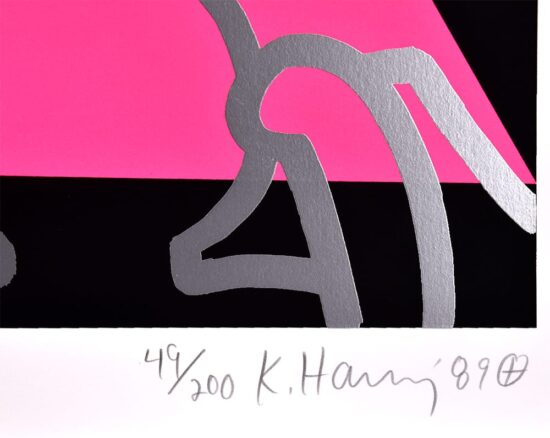
Haring’s prints are documented in Keith Haring: Editions on Paper 1982–1990, The Complete Printed Works, edited by Klaus Littmann, an important reference for collectors researching Haring editions.
Keith Haring and Andy Warhol
Andy Warhol became an important friend and influence in Haring’s life and career.
Haring admired Warhol’s ability to dissolve boundaries between fine art, popular culture and commerce, and the two artists moved within overlapping New York social and artistic circles.
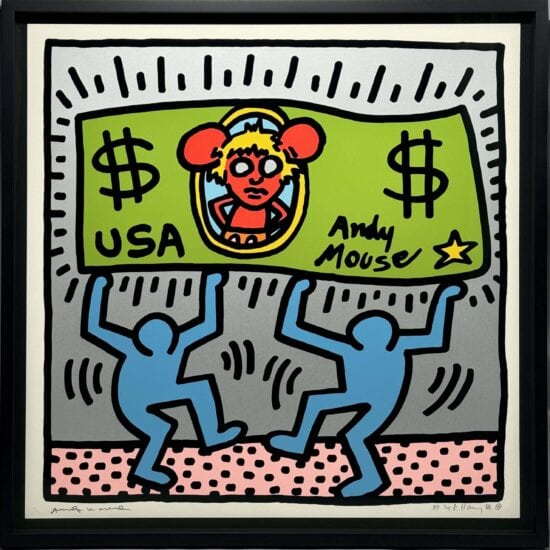
Haring paid direct tribute to Warhol in his celebrated Andy Mouse portfolio of 1986, which combines Warhol’s appearance with the recognizable silhouette of Mickey Mouse.
The series has become one of Haring’s best-known bodies of editioned work.
Between 1982 and 1989, he completed dozens of murals and public projects around the world, often working with children, schools, hospitals and charitable organizations.
Among his best-known public works was Crack is Wack, painted in New York in 1986 as a response to the crack cocaine epidemic.
Also in 1986, Haring collaborated with children through CityKids on a large-scale Statue of Liberty image created in connection with the monument’s centennial.
Other major public projects included a mural at Necker Children’s Hospital in Paris and a mural painted on the Berlin Wall in 1986, several years before the wall fell.
Haring frequently viewed public art as a means of reaching audiences who might never enter a gallery or museum.
Keith Haring’s Social and Political Art
Social activism became increasingly important in Haring’s work.
His imagery addressed subjects including:
apartheid
racism
nuclear anxiety
drug abuse
sexuality
childhood
illness
HIV/AIDS
His Free South Africa works confronted apartheid, while Crack is Wack addressed drug addiction.
Following his AIDS diagnosis, Haring increasingly used his work to encourage awareness and activism surrounding HIV/AIDS.
One of the best-known examples is Keith Haring’s Silence = Death, 1989, which incorporates the pink triangle associated with AIDS activism.
In 1989, he established the Keith Haring Foundation to preserve his artistic legacy while providing support to organizations involved with HIV/AIDS education, care and children’s programs.
During the final years of his life, Haring continued working at an extraordinary pace while using his public profile to advocate for greater awareness of the AIDS epidemic.
The foundation continues to oversee his legacy and support charitable initiatives connected with the causes that were important to him.
Keith Haring’s Death
Keith Haring died from AIDS-related complications in New York on February 16, 1990.
He was only 31 years old.
Despite a professional career lasting little more than a decade, Haring created an enormous body of drawings, paintings, prints, sculptures and public works.
A memorial service was held on May 4, 1990, at the Cathedral of St. John the Divine in New York and was attended by more than 1,000 people.
Keith Haring’s Legacy
Keith Haring remains one of the most recognizable American artists of the late twentieth century.
His work helped bridge the worlds of street art, contemporary art, popular culture and social activism. His ability to reduce complex ideas to a bold and immediately recognizable visual language allowed his imagery to reach audiences far beyond traditional art institutions.
Haring’s influence can be seen in contemporary street art, graphic design, fashion and popular culture, while his paintings, drawings, sculptures and prints are represented in major museums and private collections internationally.
Important Keith Haring works and limited-edition prints continue to be actively researched, exhibited and collected.
For available works, collector guides and information about buying or selling original Keith Haring art, visit the Keith Haring artist page.