Explore original Roy Lichtenstein prints for sale, including hand-signed lithographs, screenprints, woodcuts and mixed-media editions. Masterworks Fine Art specializes in documented works by Lichtenstein from important periods and series, with catalogue raisonné references, edition information and historical documentation when applicable.
Buy Original Roy Lichtenstein Signed and Edition Numbered Artwork For Sale
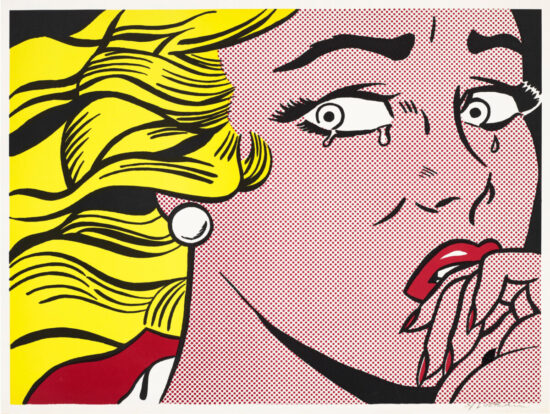
Explore our collection of hand-signed Roy Lichtenstein Pop Art Screen Prints and Paintings for sale. Popular Lichtenstein prints include Crying Girl (1963), Reflections on Crash (1990), and Wallpaper (1992). Price available upon request.
Explore original Roy Lichtenstein prints for sale, including hand-signed lithographs, screenprints, woodcuts and mixed-media editions. Masterworks Fine Art specializes in documented works by Lichtenstein from important periods and series, with catalogue raisonné references, edition information and historical documentation when applicable.
Have one to sell? Sell Roy Lichtenstein fine art with us
Sell Roy Lichtenstein artwork with us. We specialize in buying and selling original hand-signed numbered edition prints. We will research its value and popularity for you.
Roy Lichtenstein was an American painter, printmaker, sculptor, and one of the defining figures of Pop Art. Born in New York City on October 27, 1923, Lichtenstein developed a highly recognizable visual language based on bold outlines, flat areas of color, Ben-Day dots, commercial printing conventions, and imagery drawn from comics, advertising, art history, and mass culture.
Although he became best known for his comic-inspired paintings of the 1960s, Lichtenstein's career extended far beyond that period. Over more than four decades, he produced paintings, prints, drawings, sculptures, murals, and public commissions while repeatedly reinterpreting subjects from both popular culture and the history of art.
Early Life and Education
Lichtenstein showed an interest in art and music from an early age. As a teenager, he drew, painted, sculpted, and developed a strong interest in jazz. In 1940, he studied painting and drawing at the Art Students League of New York with Reginald Marsh before enrolling at Ohio State University.
His studies were interrupted by World War II when he was drafted into the United States Army in 1943. He served in Europe and continued to sketch during his military service. After returning to the United States in 1946, Lichtenstein resumed his studies at Ohio State, completing his undergraduate degree and later receiving his master's degree in 1949.
At Ohio State, Lichtenstein was particularly influenced by the teaching of Hoyt L. Sherman, whose emphasis on perception and visual organization would remain important to his understanding of composition throughout his career.
Early Paintings and the Move Toward Pop Art
During the late 1940s and 1950s, Lichtenstein experimented with a wide range of styles and subjects. His early works included images inspired by medieval knights, American history, folklore, mechanical objects, and reinterpretations of nineteenth-century paintings.
After leaving Ohio State, Lichtenstein lived in Cleveland and worked at several jobs while continuing to paint and exhibit. In 1951, he held his first solo exhibition in New York at the Carlebach Gallery.
In 1957, Lichtenstein began teaching at the State University of New York at Oswego. During this period, his paintings became increasingly abstract, reflecting the influence of Abstract Expressionism, although he also began inserting recognizable cartoon figures into gestural compositions.
In 1960, Lichtenstein joined the faculty of Douglass College at Rutgers University in New Jersey. The artistic environment there brought him into contact with artists including Allan Kaprow, George Segal, Robert Watts, and others engaged with emerging forms of contemporary art.
Roy Lichtenstein and Pop Art
In 1961, Lichtenstein began creating paintings based directly on imagery from comic strips and advertisements. Rather than imitating the expressive brushwork of Abstract Expressionism, he adopted a deliberately mechanical-looking style that reproduced the visual conventions of commercial printing.
One of the most important works from this transition was Look Mickey (1961), which helped establish the approach that would define his early Pop paintings.
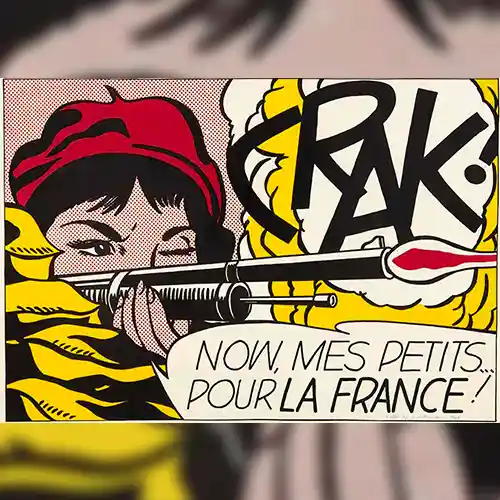
Lichtenstein enlarged and transformed source images using strong black outlines, simplified forms, primary colors, speech balloons, and patterns of Ben-Day dots. These dots, originally associated with inexpensive commercial printing, became one of the most recognizable elements of his art.
His paintings did not simply reproduce comic-book panels. Lichtenstein altered compositions, removed or changed details, reorganized forms, simplified color, and enlarged small printed images to monumental scale. In doing so, he transformed familiar mass-media imagery into carefully structured works concerned with composition, representation, reproduction, and the conventions of visual communication.
His first exhibition of comic-inspired paintings at Leo Castelli Gallery in New York in 1962 brought him immediate attention and established him as one of the central figures of the emerging Pop Art movement.
Comic Book Paintings and Ben-Day Dots
Lichtenstein's most famous paintings of the early 1960s drew on romance comics, war comics, advertisements, and other forms of popular printed imagery.
Works such as Drowning Girl, Whaam!, Girl with Ball, and Hopeless transformed small-scale printed sources into large paintings with a deliberately impersonal appearance.
The Ben-Day dot became especially important to this process. Lichtenstein enlarged the small dot patterns used in mechanical printing until they became visible compositional elements in their own right.
Although the finished works appeared machine-made, they were carefully planned and executed. Lichtenstein used drawing, projection, stencils, and other studio techniques to control the placement of forms and dots while maintaining the visual language of commercial reproduction.
Beyond Comics: Brushstrokes, Modern Paintings and Art History
By the mid-1960s, Lichtenstein began moving beyond comic-book subjects while retaining the visual language he had developed.
He created paintings based on landscapes, still lifes, mirrors, architecture, and works by earlier artists. He also began reinterpreting movements and styles from art history, including Cubism, Futurism, Art Deco, and Expressionism.
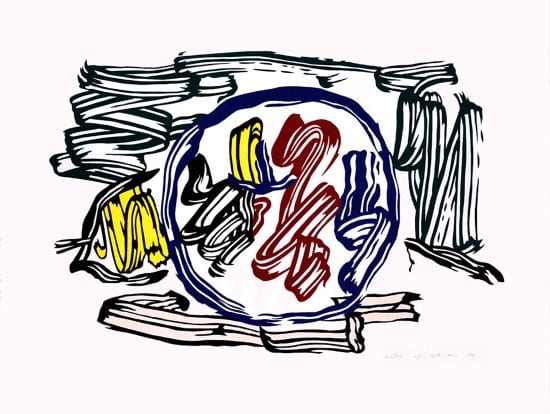
The Brushstroke works are among the most important examples of this shift. Traditionally, a brushstroke was associated with spontaneous artistic expression. Lichtenstein transformed the brushstroke itself into a hard-edged, cartoon-like image, turning the symbol of expressive painting into the subject of a deliberately controlled composition.
His Modern Paintings of the late 1960s similarly transformed decorative motifs associated with Art Deco, Cubism, and modern design into a new Pop vocabulary.
These works demonstrated that Lichtenstein's interest extended beyond popular imagery to the broader systems through which art, design, and visual culture are reproduced and understood.
Entablatures, Mirrors and Later Series
During the 1970s, Lichtenstein continued to expand his range of subjects.
His Mirror works converted reflections and curved surfaces into abstract arrangements of lines and dots. The Entablature series drew on architectural ornament, reducing classical decorative details to strong horizontal bands, geometric forms, and repeating patterns.
Lichtenstein also revisited earlier artists and movements throughout his career. Rather than making straightforward copies, he translated their imagery into his own visual language of outlines, dots, flat color, and mechanical-looking surfaces.
This sustained dialogue with art history became increasingly important in his later work.
Roy Lichtenstein Prints and Printmaking
Printmaking was an important part of Roy Lichtenstein's career from its earliest stages. He began making prints while studying and teaching at Ohio State University in the late 1940s and continued working in print media throughout the rest of his life.
Lichtenstein produced lithographs, screenprints, woodcuts, etchings, relief prints, and works combining several printmaking techniques. His graphic work was not simply a means of reproducing his paintings. Many print projects were conceived as independent series that allowed him to experiment with color, texture, scale, materials, and repeated imagery.
His prints are documented extensively in The Prints of Roy Lichtenstein: A Catalogue Raisonné by Mary Lee Corlett and in the Roy Lichtenstein Catalogue Raisonné, where Corlett and RLCR reference numbers are used to identify individual editions.
Collectors can explore our Roy Lichtenstein prints for signed and numbered works spanning different periods of his printmaking career.
Roy Lichtenstein Lithographs and Screenprints
Lithography played an important role in Lichtenstein's printmaking from the beginning of his career. He created lithographs as early as 1948 and continued using the medium in increasingly complex combinations with screenprinting, relief printing, woodcut, collage, and other processes.
Screenprinting was particularly well suited to Lichtenstein's visual language because it allowed for flat areas of saturated color, crisp outlines, and repeated patterns that echoed commercial printing.
His 1967 portfolio Ten Landscapes combined screenprinting with materials including photography, Mylar, and Rowlux plastic, demonstrating how experimental his printmaking had already become.
In 1969, Lichtenstein began working with Gemini G.E.L. in Los Angeles on the Haystack and Rouen Cathedral series. These prints reinterpreted Claude Monet's serial approach through Lichtenstein's own system of dots, lines, and mechanical color.
Gemini G.E.L., Kenneth Tyler and Serial Printmaking
Lichtenstein's collaboration with Gemini G.E.L. became one of the most important relationships of his printmaking career.
Beginning with the Haystack and Rouen Cathedral prints in 1969, Lichtenstein worked with master printers to explore increasingly sophisticated combinations of lithography, screenprinting, relief, and unconventional materials.
His printmaking developed through major series including Modern Head, Mirror, Bull Profile, Six Still Lifes, Entablatures, Surrealist Series, Expressionist Woodcuts, Imperfect Series, Brushstroke Figures, Reflections, Interiors, Water Lilies, and Nudes.
These projects demonstrate how Lichtenstein used printmaking as a laboratory for ideas that also appeared in his paintings and sculptures. Images often moved between media, but the graphic works were developed specifically around the technical possibilities of printing.
Bull Profile, Reflections, Interiors and Water Lilies
Several of Lichtenstein's print series demonstrate his sustained interest in transformation and reinterpretation.
The Bull Profile series reduced the image of a bull through successive stages of abstraction, playing with the history of modern art and the idea that recognizable forms can gradually become geometric structures.
The Reflections series of 1990 introduced bands and streaks that appear to obscure portions of the underlying image, mimicking the visual interference of reflected light on glass.
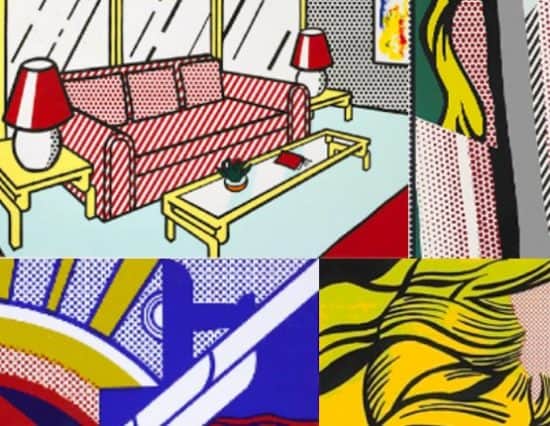
His Interiors transformed idealized domestic spaces into carefully constructed arrangements of furniture, paintings, patterns, and empty architectural surfaces.
In the Water Lilies series of 1992, Lichtenstein revisited the subject associated with Claude Monet using screenprinted enamel on processed stainless steel. The reflective metal surfaces allowed actual light and reflections to become part of the image.
Roy Lichtenstein Nudes
During the 1990s, Lichtenstein created an important group of paintings and prints depicting female nudes.
Rather than drawing these figures from live models, he adapted the visual language of the comic-book women that had appeared throughout his earlier career. By removing clothing while retaining stylized hair, outlines, dots, and facial features, Lichtenstein created images that simultaneously refer to the traditional nude and to the artificial conventions of popular illustration.
The Nudes print series of 1994 became one of the major late graphic projects of his career and remains an important area for collectors of Lichtenstein's prints.
Roy Lichtenstein Sculpture and Public Art
Sculpture became increasingly important in Lichtenstein's work from the 1960s onward.
He translated motifs such as brushstrokes, heads, cups, mirrors, and architectural forms into three-dimensional objects using materials including metal, brass, ceramic, and painted aluminum.
Even when working in three dimensions, Lichtenstein often preserved the appearance of flat graphic imagery. Strong outlines and simplified shapes allowed his sculptures to appear simultaneously volumetric and cartoon-like.
His later career included increasingly ambitious public sculpture and architectural projects. Monumental works such as Brushstrokes in Flight and Barcelona Head extended his familiar vocabulary into large-scale public environments.
Chinese Landscapes and Late Work
In the final years of his career, Lichtenstein continued to reinterpret historical art through the visual language he had developed decades earlier.
His Chinese Landscapes drew inspiration from traditional Chinese landscape painting. Mountains, water, mist, and atmospheric space were recreated through graduated fields of dots rather than traditional brushwork.
The series demonstrates how far Lichtenstein's art had developed beyond the comic-strip imagery with which he was initially identified. By the 1990s, Ben-Day dots and mechanical forms had become tools that he could use to examine nearly any subject, from popular culture to some of the most established traditions in art history.
Roy Lichtenstein's Artistic Style and Legacy
Roy Lichtenstein helped redefine the relationship between fine art and popular visual culture.
His use of comic imagery, Ben-Day dots, black outlines, speech balloons, primary colors, and commercial printing conventions became instantly recognizable, but these devices represented only one part of a much broader career.
Across paintings, prints, sculpture, drawings, and public art, Lichtenstein repeatedly investigated how images are constructed, reproduced, simplified, and interpreted. He transformed subjects ranging from romance comics and advertisements to Monet, Picasso, architectural ornament, brushstrokes, interiors, mirrors, nudes, and Chinese landscapes into a consistent visual language of his own.
Lichtenstein also became one of the most important printmakers associated with American Pop Art. His extensive graphic output included hundreds of editioned works produced over nearly five decades and in collaboration with leading print workshops and publishers.
Roy Lichtenstein died in New York on September 29, 1997, at the age of 73. His work remains central to the history of Pop Art and twentieth-century American art, and his paintings, prints, and sculptures continue to be exhibited and collected worldwide.