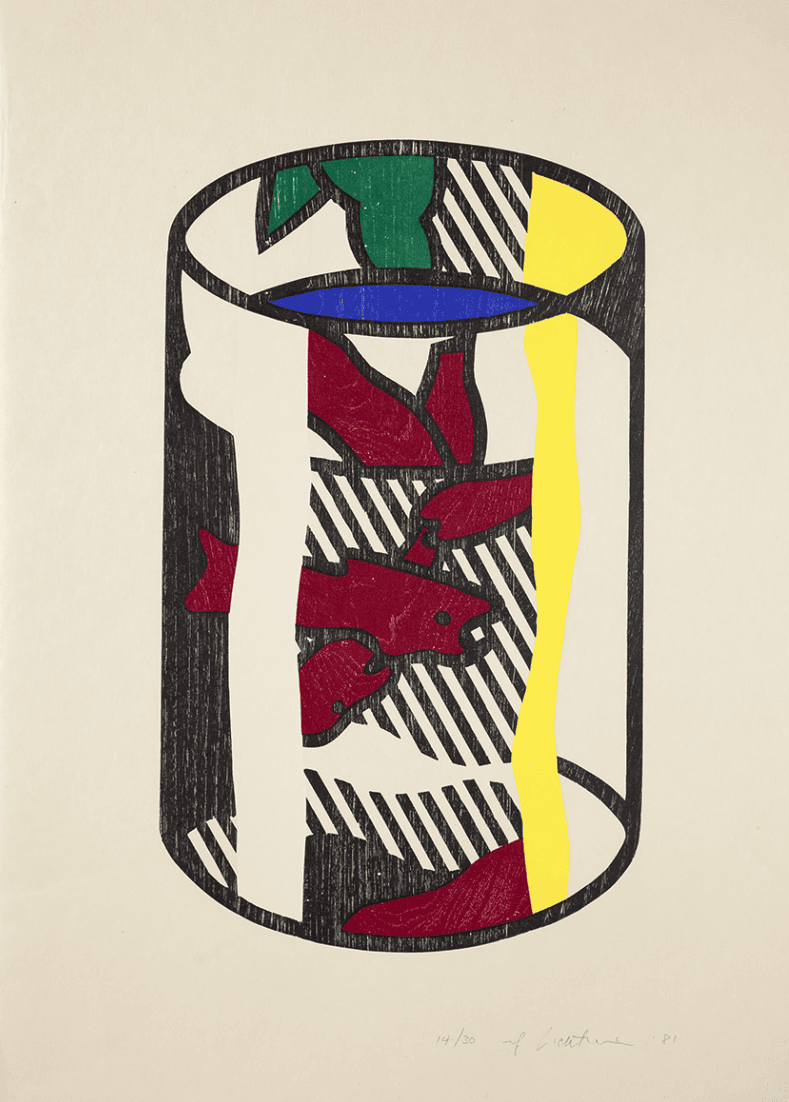
Roy Lichtenstein, Goldfish Bowl, 1981 |
|
| Artist: | Roy Lichtenstein (1923 - 1997) |
|---|---|
| Title: | Goldfish Bowl, 1981 |
| Medium: | Woodcut on natural handmade Okawara paper |
| Image Size: | 18 1/4 x 10 3/4 in. (46.3 x 27.3 cm) |
| Sheet Size: | 25 1/16 x 18 1/4 in. (63.6 x 46.4 cm) |
| Edition: | This work is numbered from the edition of 30; plus 10 AP, 1 RTP, 2 PP, 1 PPI, 1 PPII, 1 A, 1 C, 1 SP and published by Original Editions, New York. |
| Signature: | This work is hand-signed by Roy Lichtenstein (New York, 1923 – New York, 1997) in pencil ‘rf Lichtenstein’. |
| ID # | w-9000-9 |
Roy Lichtenstein’s Goldfish Bowl (1981) is a sublime meditation on the act of seeing — a work in which the ordinary becomes radiant, and the familiar still life dissolves into a crystalline abstraction of perception, color, and line. At once serene and intellectually charged, this late-period composition demonstrates Lichtenstein’s consummate control over the visual language he invented: a language of distilled form, purified rhythm, and conceptual wit.
The scene is deceptively simple — a goldfish bowl resting quietly within the structured geometry of a tabletop — yet it hums with formal complexity. The transparent sphere, rendered through the artist’s disciplined interplay of Ben-Day dots, bold contour, and reflective patterning, seems to vibrate between solidity and illusion. Lichtenstein’s fish, suspended in their stylized aquatic world, appear both tangible and diagrammatic — reduced to perfect shapes of color and light, as though caught in a perpetual shimmer of motion.
The composition is suffused with Lichtenstein’s characteristic tension between surface and depth. Every element — the reflective water, the curved glass, the abstracted environment — is flattened into a precise design, yet collectively they evoke the optical sensations of transparency, distortion, and spatial layering. The viewer’s eye moves rhythmically across the work, tracing the arcs of the bowl and the subtle shifts of pattern that imply refracted light. The scene feels still, yet alive — its calmness masking the restless play of perception beneath.
Color is the emotional key to the composition: a restrained harmony of aquamarine blues, soft grays, and radiant oranges that balance delicacy with clarity. The goldfish, glowing with warmth at the heart of the image, serve as the painting’s lyrical pulse — a quiet burst of life amid the serenity of Lichtenstein’s constructed world.
Beneath its cool elegance lies a poetic inquiry into the nature of representation. The goldfish bowl — a transparent container that distorts what it holds — becomes an exquisite metaphor for painting itself: a surface through which reality is seen, refracted, and reimagined. Just as the fish are visible only through the curved distortion of glass and water, so too is the world filtered through the artist’s graphic discipline and visual intellect.
Goldfish Bowl embodies Lichtenstein’s late mastery — the fusion of intellect and beauty, irony and tenderness. It is both homage and transcendence of the still-life tradition: an image of luminous restraint, where the language of Pop Art attains the quiet dignity of the sublime. In its shimmering equilibrium, the work captures not merely the appearance of a scene, but the pure experience of looking — distilled to its most elegant and essential form.
Created in 1981, this Lichtenstein pop art Woodcut in colors is hand-signed by Roy Lichtenstein (New York, 1923 – New York, 1997) in pencil: ‘rf Lichtenstein’. Numbered from the edition of 30, this work is published by Original Editions, New York.
Catalogue Raisonné & COA:
Roy Lichtenstein, Goldfish Bowl, 1981 is fully documented and referenced in the below catalogue raisonnés and texts (copies will be enclosed as added documentation with the invoices that will accompany the final sale of the work).
About the Framing:
Roy Lichtenstein, Goldfish Bowl, 1981 is framed to museum-grade, conservation standards, presented in a complementary moulding and finished with silk-wrapped mats and optical grade Plexiglas.
Subject Matter: $51-75k Contemporary Abstract
