Jewish artist, Yaacov Agam offers us a unique and highly dynamic vision on optical and geometric art. He is a master of light and color, transforming any medium into that of his choosing. From Spinning Polymorphs to Levels Menorah, Agam has been able to transcend his contemporaries and shine in a genre of his own. Masterworks is proud to hold a distinct collection of his three-dimensional works and, more notably, his celebrated Agamographs. [Read biography »]
Light and color are transformed in Agam prints. This Israeli artist explored geometry and mastered Op Art in his lithographs, serigraphs and Agamographs.
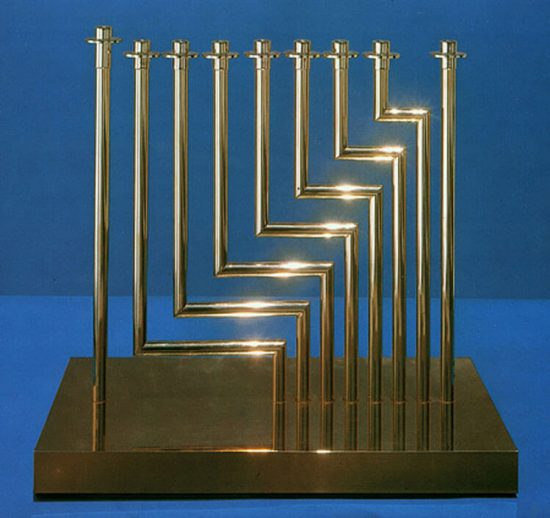
Layered 24 K gold over bronze sculpture with detachable candle holders
Image Size:
13 in L x 7 in W x 11 3/4 in H (33 cm x 17.8 cm x 29.9 cm) with a 1 1/2 in (3.8 cm) base
Signed:
This work has a guaranteed authentic signature by Yaacov Agam (Rishon LeZion, 1928-) incised twice in the base of the work with the dedication 'To Joyces et Bernard Sternthoe'.
Edition:
Numbered 57 from the edition of 90.
Condition:
This work is in excellent condition, with minor scratches in the base that do not detract from the piece! (comes with original fitted case)
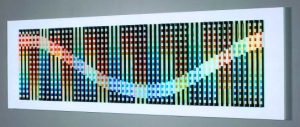
This brightly colored agamograph is a fascinating and colorful addition to any collection of contemporary art. Agam requires his viewers to move to experience his art, incorporating time and space into this work.
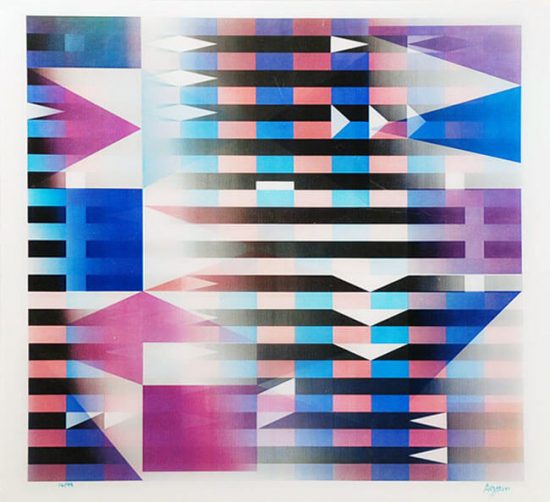
Placing cool blue hues arranged in abstract shapes against horizontal black parallels, Agam creates an Agamograph that relays a sense of peace and calm. This intriguing piece beautifully displays Yaacov Agam's unique perception of art and his revolutionary style, which relied upon the utilization of movement and the fourth dimension in order to gain a complete understanding of his compositions.
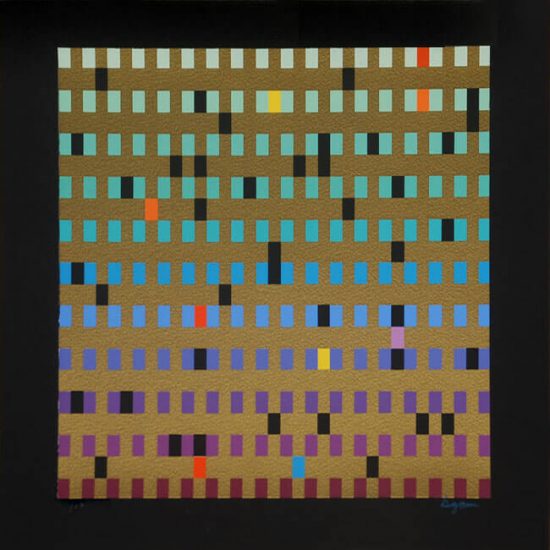
A myriad of colors undergo a gradual metamorphosis against a shimmering gold background in this striking work. Agam exemplifies his mastery of the color spectrum and elements of luminescence in this astounding piece.
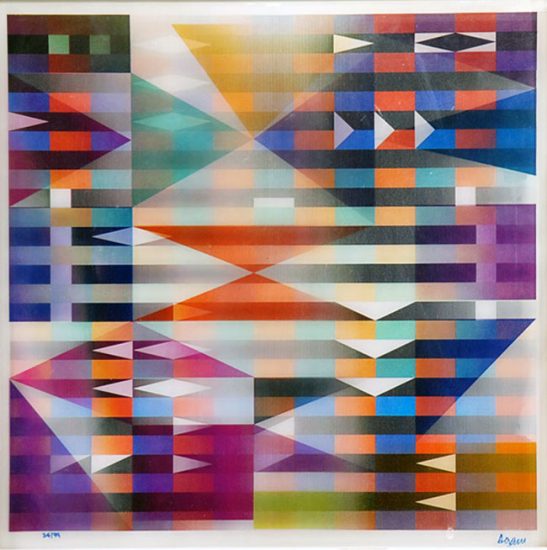
Creating a sense of the brilliancy of light and color, this work is designed with a layering of images giving the effect of colors bouncing off each other. Brightly colored abstract shapes are connected with vertical and horizontal black lines, unifying the separate elements into one composition.
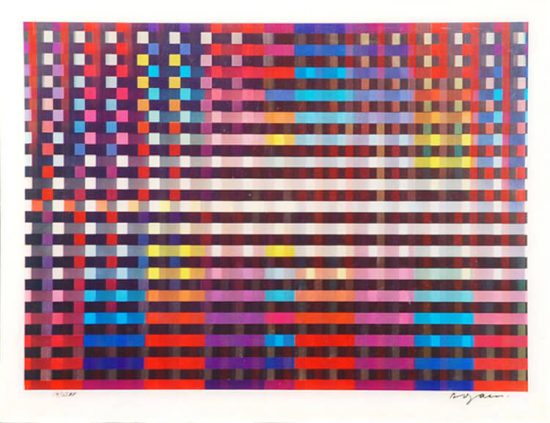
This colorful work brings to mind the pixilated, self-portraits of Chuck Close or a television set consumed with static. Agam's serigraph engages the viewer through its visual rhythms.
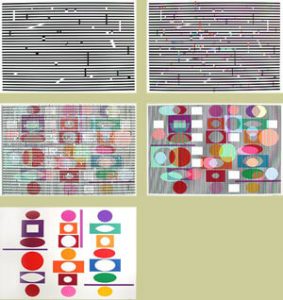
Addressing the concept of movement within time and space, this intriguing suite displays a gradual evolution from the absence of color to the predomination of color. We witness a sense of motion and progression in this striking series that engages us and keeps us guessing.
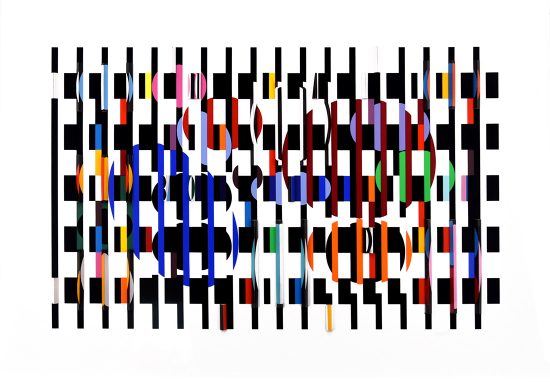
One of Agam's most spectacular Agamographs, this piece is notable for its striking color contrasts. Agam's use of black and white alongside bright pinks, yellows, and blues instantly captures our eye. This intriguing piece beautifully displays Yaacov Agam's unique perception of art and his revolutionary style, which relied upon the utilization of movement and the fourth dimension in order to gain a complete understanding of his compositions.
Placing cool blue hues arranged in abstract shapes against horizontal black parallels, Agam creates an Agamograph that relays a sense of peace and calm. This intriguing piece beautifully displays Yaacov Agam's unique perception of art and his revolutionary style, which relied upon the utilization of movement and the fourth dimension in order to gain a complete understanding of his compositions.
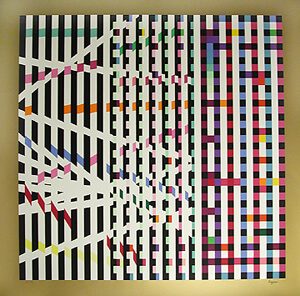
Remarkable for its strong linear design, this piece exemplifies Agam's mastery of color and form, as criss-crossing verticals, horizontals, and diagonals with bursts of color create a maze-like pattern within a geometric order.
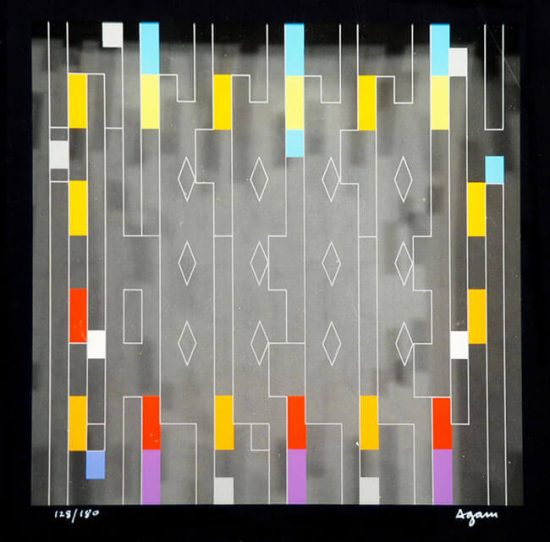
This work is hand signed by Yaacov Agam (Rishon LeZion, 1928 - ) in silver marker in the lower right margin on black mat that is incorporated into the work.
Edition:
Numbered 128/180 in silver marker in the lower left margin on black mat that is incorporated into the work.
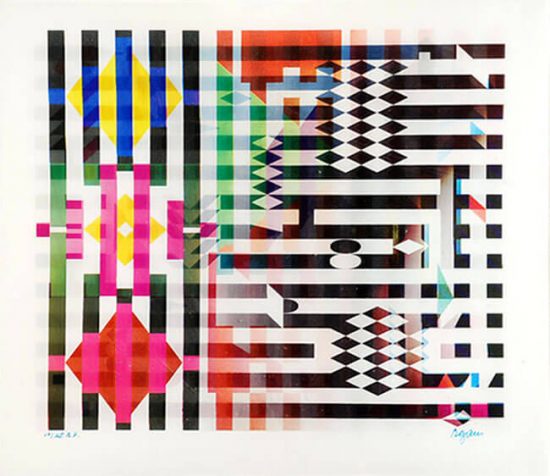
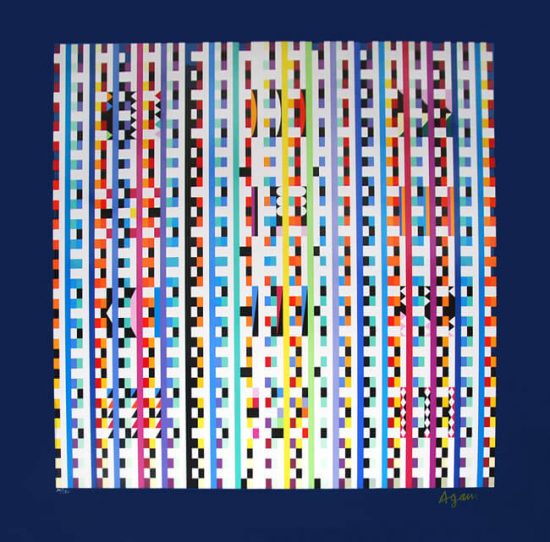
Working with concepts of light and transparency, Agam creates a striking work with a sense of rhythm and illumination. Utilizing a strong vertical pattern of rectangles and diamonds, this piece is both aesthetically pleasing and geometrically precise.
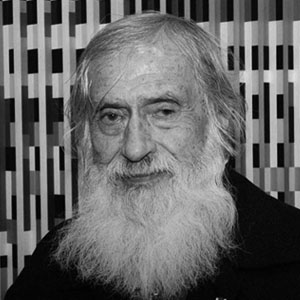
Yaacov Agam is a truly unique, creative force in the world of art. His works transcend traditional artistic boundaries, propelling him into the forefront of a new art aesthetic. Art critics and art historians in museums and institutions throughout the world have acclaimed him for his inventive, talented genius, bestowing upon him numerous awards and honors. Agam is certainly among the world's foremost artists, and he is already recognized as influential and important in the history of art. The son of an Orthodox Rabbi, scholar and writer, Agam was born on May 11, 1928 in Rishon Letzion, Israel. As a child, he began to draw, despite religious proscription against visual expression. Agam's family recognized his artistic ability and, in 1946, he entered the Bezalel Academy of Arts and Design in Jerusalem. Studying with Mordecai Ardon, a former student at the Weimar Bauhaus, he discovered the differences between other cultures which stress the afterlife and the Hebrew culture which emphasizes the present. Because Judaism believes life is dynamic and ever-changing, Agam determined that static paintings were inadequate to express the constantly occurring changes which surround us. In 1950, upon Ardores recommendation, Agam went to Zurich to study with Johannes Itten at the Kunstgewerbeschule. There, he met Frank Lloyd Wright and Siegfried Giedion, whose ideas on the element of time in art and architecture impressed him. In 1951, Agam moved to Paris. A number of the world-famous Surrealist artists living in France were the first to discover and encourage him. His first one-man exhibition held at Galerie Craven, Paris in 1953, featured kinetic and transformable paintings which invited spectator participation. The show was a critical success and attracted considerable attention in art circles. Max Ernst was the first person to acquire a work by Agam.
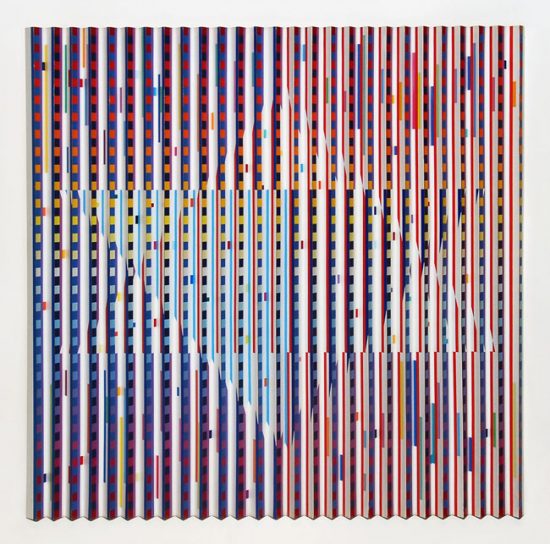
AGAMOGRAPH: An Agamograph is a serigraphed image of slivers of a number of images placed side by side. Once the image is created, there is a corrugated lenticular optical lens fused on top of the printed image. As the viewer moves back and forth in front of the image the image is in constant change as the viewer moves. A common misspelling is 'Agamagraph'.