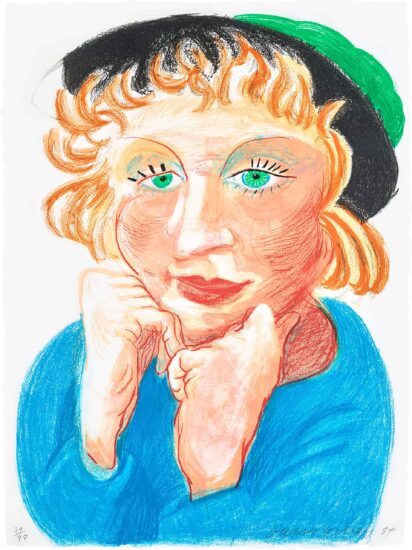
David Hockney Music
Original David Hockney fine art of flute, guitar, violin, singer, Beethoven, Bach, musical instruments.
Original David Hockney fine art of flute, guitar, violin, singer, Beethoven, Bach, musical instruments.


David Hockney (British, 1937–2026) was one of the most influential and recognizable artists of the twentieth and twenty-first centuries. Over a career spanning more than six decades, he worked across painting, drawing, printmaking, photography, stage design, and digital media while continually reconsidering how artists represent space, time, and the act of seeing.
Known for his brilliant use of color, exceptional draftsmanship, portraits, California swimming pools, landscapes, and innovative approaches to perspective, Hockney developed a visual language that remained distinctly his own even as his work changed dramatically throughout his life.
Although his early career was associated with British Pop Art, Hockney resisted being defined by a single movement, medium, or subject. From his early years in Bradford and London to Los Angeles, Yorkshire, and Normandy, his work reflected an enduring curiosity about people, places, technology, and perception.
Explore David Hockney Art and Original Prints
David Hockney was born on July 9, 1937, in Bradford, Yorkshire, England.
He developed an interest in drawing and art at an early age and studied at the Bradford School of Art from 1953 to 1957. His training emphasized drawing from life, portraiture, observation, and traditional artistic skills that would remain important throughout his career.
After completing two years of national service as a hospital orderly, Hockney entered the Royal College of Art in London in 1959.
At the Royal College of Art, Hockney studied alongside artists including R.B. Kitaj, Allen Jones, and Derek Boshier. He quickly distinguished himself through the individuality of his work and graduated in 1962 with the Royal College of Art’s prestigious gold medal.
Hockney entered the Royal College of Art during a period of major change in British art.
A younger generation of artists was moving away from the conventions that had dominated postwar British painting and looking toward popular culture, advertising, contemporary life, American art, and personal experience.
Hockney’s early work became associated with British Pop Art, although even at this stage he was developing a highly personal approach.
He began exhibiting and selling work while still a young artist, and by the early 1960s his paintings and prints were attracting critical attention. His first solo exhibition was held at the Kasmin Gallery in London in 1963.
Rather than remaining within the visual vocabulary of Pop Art, Hockney gradually expanded his interests toward portraiture, landscape, perspective, photography, and printmaking.
Hockney is frequently described as an important figure in British Pop Art.
That association is useful for understanding the historical moment in which his career began, but it does not fully describe the artist he became.
His work drew from an unusually broad range of sources, including Pablo Picasso, Henri Matisse, Renaissance painting, Cubism, photography, and traditional Chinese landscape painting.
Hockney combined these influences with strong observational drawing and an increasingly distinctive use of color.
Throughout his career, he moved comfortably between realism, abstraction, photography, printmaking, and digital technology without abandoning his fundamental interest in how people experience the visual world.
A transformative period in Hockney’s life began when he traveled to California.
Los Angeles offered a visual environment very different from postwar England. Hockney became fascinated by the city’s intense sunlight, modern architecture, open spaces, swimming pools, and distinctive lifestyle.
California soon became one of the defining subjects of his career.
The bright light and architectural geometry of Los Angeles encouraged Hockney to develop flatter areas of color, clean lines, and carefully constructed compositions.
Swimming pools were particularly compelling. Water presented an unusual artistic problem: it is transparent, reflective, constantly moving, and difficult to represent on a flat surface.
Hockney repeatedly returned to this challenge.
Hockney’s California swimming-pool paintings became some of the most famous works of his career.
Images such as A Bigger Splash and Portrait of an Artist (Pool with Two Figures) helped establish the visual language for which he became internationally recognized: brilliant color, modern architecture, controlled compositions, and close attention to light and space.
Yet the swimming pools were never simply decorative subjects.
For Hockney, they provided a way to explore transparency, movement, reflections, surface, and the relationship between natural and constructed space.
The subject also became deeply connected with his experience of Southern California.
Portraiture was another central element of Hockney’s art.
Throughout his career, he repeatedly depicted friends, family members, fellow artists, collectors, and people from his personal life.
Hockney was an exceptional draftsman, and his portraits often convey character with relatively economical means.
His drawings demonstrate his ability to observe posture, expression, gesture, and physical presence without excessive detail.
In his paintings and double portraits, sitters often appear within carefully constructed interiors. Furniture, architecture, windows, objects, and the distance between people can become as psychologically important as facial expression.
Portraiture therefore allowed Hockney to explore both individual identity and human relationships. His large double portraits of the late 1960s and 1970s became some of his most important paintings, combining psychological observation with carefully structured interiors and relationships between sitters.
Drawing formed the foundation of Hockney’s artistic practice from his early education in Bradford through the final decades of his career.
He was particularly admired for his ability to capture a sitter with a confident and economical line.
His drawings range from pencil and ink studies to colored works and later digital drawings created using new technology.
Despite changes in medium, sustained observation remained central.
For Hockney, drawing was not merely preparatory. It was a means of investigating how things appear and how the artist experiences them.
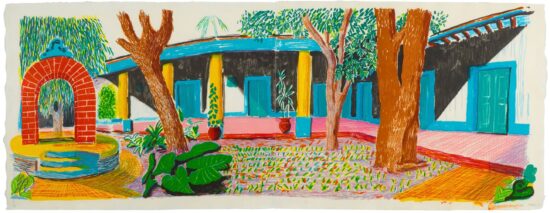
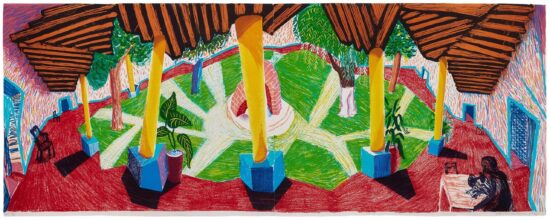
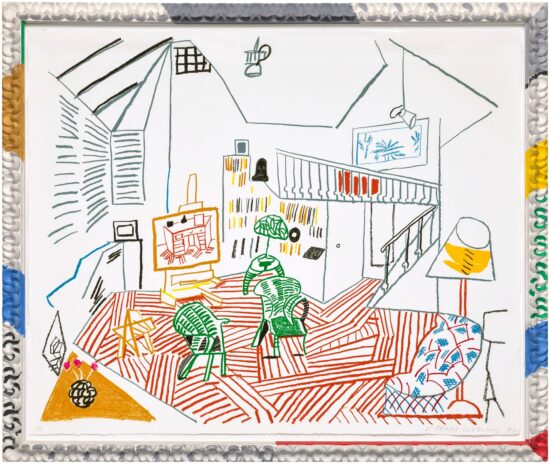
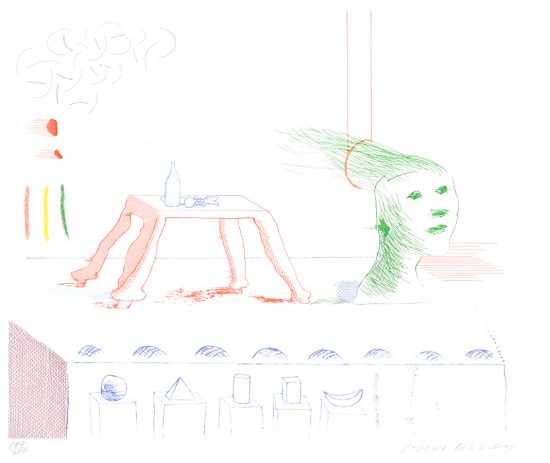
Printmaking was a major and sustained part of David Hockney’s artistic career, encompassing etchings, lithographs, screenprints, portfolios, and experimental print projects.
He began experimenting with printmaking as a young artist and developed into an accomplished creator of etchings, lithographs, screenprints, and other original prints.
Hockney worked with important printers and workshops, including Gemini G.E.L. in Los Angeles.
These collaborations enabled him to experiment with color, scale, layered imagery, paper, and different printing techniques.
Among his major print projects are:
Among these projects, The Blue Guitar became one of Hockney’s best-known print series. Created during the 1970s, it reflects his fascination with Picasso, Cubism, fragmented forms, shifting viewpoints and the relationship between artistic influence and invention. Rather than simply illustrating a narrative, Hockney used the series to explore how images are made, transformed and interpreted.
Hockney’s original prints remain an important area of his market, with individual works distinguished by medium, edition size, printer, publisher, signature, condition and catalogue raisonné documentation.
Explore David Hockney Original Prints
Explore David Hockney Lithographs
Explore David Hockney Etchings
Photography became increasingly important to Hockney as he investigated the limitations of conventional perspective.
He questioned whether a single photograph could adequately represent human vision.
A camera records one viewpoint at one moment. Human vision, by contrast, involves movement, memory, changing focus, and the experience of looking over time.
Hockney began creating photographic collages that assembled multiple images into a larger composition.
These works allowed different viewpoints and moments to coexist within a single image.
This experimentation became part of Hockney’s broader critique of traditional one-point perspective.
Perspective was one of the defining intellectual concerns of Hockney’s career.
He questioned whether Renaissance one-point perspective accurately represented how people actually experience the world.
Instead of presenting a scene from a single fixed viewpoint, Hockney increasingly experimented with multiple perspectives.
He wanted viewers to experience an image rather than simply look through it as though through a window.
This concern appears throughout his paintings, photographs, drawings, and prints.
Hockney’s interest in Cubism, Chinese landscape painting, and photography all contributed to this investigation.
Hockney’s Moving Focus series became one of his most important practical explorations of these ideas. By combining multiple viewpoints within a single composition, the works challenge conventional spatial construction and suggest the experience of moving through space rather than observing it from one fixed position.
Explore David Hockney Moving Focus →
Although California remained important, Hockney increasingly turned toward landscape.
California, Yorkshire, and later Normandy all became settings through which he explored space, roads, trees, fields, changing seasons, and light.
His landscapes frequently use vivid color and unconventional perspective to transform familiar environments.
Hockney was interested not only in what a landscape looked like but also in what it felt like to move through it.
Roads, curves, trees, horizons, and changing viewpoints allowed him to suggest the physical experience of traveling through space.
Hockney later returned repeatedly to the landscape of Yorkshire.
The countryside offered a dramatic contrast to Southern California.
Rather than swimming pools and modern architecture, Hockney focused on roads, fields, trees, seasonal changes, and the structure of the English landscape.
The changing seasons became especially important.
Hockney observed the same places repeatedly, allowing him to investigate how light, color, foliage, and atmosphere transform a landscape over time.
Hockney consistently embraced new technologies throughout his career, experimenting with Polaroid photography, photocopiers, fax machines, computers, video, iPhones and iPads.
Rather than treating digital technology as separate from traditional art, he used new tools to investigate many of the same questions that had occupied him for decades: how artists record observation, how color changes across different media, how quickly an image can be made and how technology changes the way images are created and shared.
The iPhone and iPad became particularly important tools for drawing, allowing Hockney to work quickly while retaining the immediacy of direct observation.
Normandy became another important landscape subject during Hockney’s later career.
The changing seasons, trees, flowers, weather, and countryside allowed him to continue exploring the relationship between observation, time, and nature.
By this stage, his practice brought together decades of experience in drawing, painting, photography, printmaking, and digital media.
His later work demonstrates that experimentation remained central to his practice even after more than six decades as an artist.
Hockney represented himself repeatedly throughout his career.
He produced self-portraits using drawing, painting, printmaking, photography, and digital media.
His distinctive glasses, changing hair, aging face, and direct gaze became recurring features.
These images document his physical appearance over time, but they also demonstrate his continued investigation of observation and artistic technique.
Self-portraiture gave Hockney an immediately available subject through which to experiment.
David Hockney’s artistic style changed considerably throughout his career, but several characteristics remained consistent.
These include:
Although Hockney is frequently associated with Pop Art, his work also reflects influences from Picasso, Matisse, Cubism, Renaissance art, photography, and traditional Chinese landscape painting.
His style is therefore better understood as continually evolving rather than belonging permanently to one artistic movement.
Hockney’s work entered major museum collections internationally.
Institutions holding his paintings, drawings, photographs, and prints include:
The National Gallery of Art alone holds more than 150 works associated with Hockney, including prints, self-portraits, and works created in collaboration with Gemini G.E.L.
Hockney received extensive institutional recognition throughout his career.
His first retrospective was organized by the Whitechapel Gallery in London in 1970.
Later major exhibitions included David Hockney Portraits at the National Portrait Gallery in London and David Hockney: A Bigger Exhibition at the de Young Museum in San Francisco.
In 2017, a major retrospective traveled from Tate Britain to the Centre Pompidou in Paris and The Metropolitan Museum of Art in New York.
In 2025, Fondation Louis Vuitton in Paris presented another major survey of Hockney’s career, bringing together more than 400 works.
David Hockney died peacefully at his home in London on June 11, 2026, at the age of 88, approximately one month before what would have been his 89th birthday.
His death marked the end of one of the longest and most influential careers in contemporary British art.
From his early training in Bradford through his California swimming pools, portraits, landscapes, printmaking, photography, and digital drawings, Hockney continually expanded his methods of image-making.
David Hockney’s legacy extends far beyond any single painting, subject or medium.
His California swimming pools became icons of twentieth-century art, but his portraits, landscapes, drawings, original prints, photographs and digital works reveal an artist whose defining characteristic was a persistent curiosity about how people see the world.
Throughout his career, Hockney investigated fundamental questions about visual representation: how perspective works, how an artist can represent time and movement, and how a two-dimensional image can recreate the experience of looking at a three-dimensional world.
He moved between painting and lithography, drawing and photography, and pencil and iPad while continuing to investigate these same ideas.
Hockney remained deeply committed to observation and drawing while repeatedly challenging conventional ideas about perspective, space and image-making. His willingness to embrace new technologies without abandoning traditional artistic skills made him unusually adaptable across more than six decades.
His combination of recognizable imagery, extraordinary draftsmanship, brilliant color and continual experimentation established David Hockney as one of the defining artists of his generation.
Hockney produced an extensive body of original prints throughout his career, including lithographs, etchings, screenprints, portfolios, proofs, and works from important series.
Collectors researching an original David Hockney print should consider the specific edition, signature, paper, dimensions, printer, publisher, provenance, condition, and relevant catalogue raisonné documentation.
Masterworks Fine Art specializes in authentic David Hockney original prints and works on paper, including signed lithographs, etchings, screenprints and works from major series.
Explore David Hockney Art for Sale
Explore David Hockney Lithographs
Explore David Hockney Etchings
David Hockney Catalogue Raisonné Guide
How to Authenticate a David Hockney Print
David Hockney was born July 9, 1937, in Bradford, Yorkshire, England.
Hockney studied at the Bradford School of Art before attending the Royal College of Art in London, where he graduated with the gold medal in 1962.
Hockney became fascinated by Los Angeles and its sunlight, swimming pools, modern architecture, and open landscape. California subsequently became one of the defining visual environments of his career.
Hockney was especially known for his California swimming-pool paintings, portraits, landscapes, brilliant color, printmaking, photography, and experimentation with perspective.
Hockney’s early work was associated with British Pop Art, but his career developed far beyond that movement and incorporated influences ranging from Picasso and Matisse to photography, Renaissance painting, and traditional Chinese landscape art.
Yes. Printmaking was an important part of Hockney’s career. He created etchings, lithographs, screenprints, and other original prints and worked with major workshops including Gemini G.E.L.
Yes. Hockney embraced computers, iPhones, iPads, video, and other technologies as part of his continuing investigation of drawing and visual perception.
David Hockney died on June 11, 2026, at his home in London.
Hockney was important for his combination of exceptional draftsmanship, vivid color, experimentation with perspective, engagement with photography and technology, and ability to continually reinvent his practice across more than six decades.