Alex Katz (American, b. 1927) is celebrated for his distinctive portraits, flowers and landscapes defined by flat planes of color, cropped compositions and a refined, instantly recognizable style. A major figure in postwar American art, Katz developed an influential body of paintings, silkscreens, woodcuts, lithographs, etchings, archival pigment prints and sculpture that helped shape the visual language of contemporary figurative art. Explore original Alex Katz artwork for sale, including signed and numbered prints, paintings, woodcuts, silkscreens and other works featuring many of the artist’s most iconic subjects.
Buy Original Alex Katz Signed and Edition Numbered Artwork For Sale
Shop hand-signed original Alex Katz paintings and prints featuring flowers, portraits, and landscapes.
Alex Katz (American, b. 1927) is celebrated for his distinctive portraits, flowers and landscapes defined by flat planes of color, cropped compositions and a refined, instantly recognizable style. A major figure in postwar American art, Katz developed an influential body of paintings, silkscreens, woodcuts, lithographs, etchings, archival pigment prints and sculpture that helped shape the visual language of contemporary figurative art. Explore original Alex Katz artwork for sale, including signed and numbered prints, paintings, woodcuts, silkscreens and other works featuring many of the artist’s most iconic subjects.
Sell Alex Katz artwork with us. We specialize in buying and selling original hand-signed numbered edition prints. We will research its value and popularity for you.
Alex Katz (American, b. 1927) is one of the most recognizable American artists of the postwar and contemporary eras. Known for his large-scale portraits, flattened areas of color, precise cropping and refined compositions, Katz developed a distinctive form of figurative painting that remained independent of both Abstract Expressionism and traditional realism.
Over a career spanning more than seven decades, Katz has worked across painting, drawing, printmaking, sculpture, cutouts and public art. His recurring subjects include portraits, his wife and longtime muse Ada Katz, flowers, landscapes, dancers and scenes of modern life.
Alex Katz’s Early Life and Artistic Training
Alex Katz was born on July 24, 1927, in Brooklyn, New York, and moved with his family to St. Albans, Queens, the following year. He studied at The Cooper Union in New York from 1946 to 1949, where he was trained in modern art theories and techniques.
After graduating, Katz received a scholarship to attend the Skowhegan School of Painting and Sculpture in Maine in 1949 and returned the following summer. At Cooper Union, he had largely been taught to work from drawings; at Skowhegan, he was encouraged to paint directly from life and outdoors. Katz later described this shift toward plein-air painting as pivotal to his development.
The experience helped establish the direct, observational approach that would remain central to his work.
Developing the Alex Katz Style
During the 1950s, Katz worked to develop a visual language that could remain figurative while still feeling contemporary.
He painted landscapes, still lifes, figures and scenes from New York and Maine while gradually simplifying his compositions. Katz became increasingly interested in flat areas of color, sharply defined forms and images that could be understood almost instantly.
His first one-person exhibition was held at the Roko Gallery in New York in 1954. During the second half of the decade, he also produced small collages using hand-colored paper, often depicting figures in landscapes.
By the late 1950s, portraiture had become increasingly important, and Katz began using the monochrome backgrounds that would become one of the defining characteristics of his mature style.
Alex Katz and Ada
Ada Katz became one of the most important subjects in Alex Katz’s career.
Katz began portraying Ada in the late 1950s and has returned to her image repeatedly across paintings, drawings, prints and sculptural cutouts. Her profile, dark hair, direct gaze and carefully composed poses became closely associated with his work.
Rather than treating portraiture as conventional biography, Katz often simplified his sitters into bold visual statements. Ada appears as both an individual and an enduring visual motif within his broader investigation of style, presence and modern life.
In the early 1960s, Katz began increasing the scale of his paintings.
Influenced in part by film, television and billboard advertising, he developed large compositions with dramatically cropped faces and figures. These works gave his paintings an immediate visual impact while retaining the flat surfaces and controlled compositions that distinguished his style.
Katz frequently portrayed friends, artists, poets, critics and members of his social circle. His group paintings from the 1960s and 1970s became distinctive records of the cultural world around him.
Alex Katz Paintings
Painting has remained central to Katz’s practice throughout his career.
His paintings include portraits, group scenes, flowers, landscapes and close-up studies of individual faces. Despite changes in scale and subject, his work consistently emphasizes color, light, surface and economy of form.
Katz’s portraits are often built from broad areas of color and simplified features, while his landscapes and flowers transform familiar natural subjects into highly controlled compositions.
Printmaking became an important part of Katz’s career beginning in the 1960s.
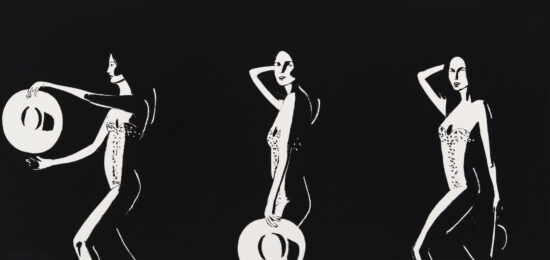
He has created editions in screenprint, lithography, etching, aquatint, woodcut, linocut and later archival pigment printing. His prints frequently revisit the same subjects found in his paintings, including Ada, portraits, flowers, dancers and landscapes.
Rather than simply reproducing paintings, Katz used printmaking as an independent medium, adapting his imagery to the specific qualities of each process.
Screenprinting became especially well suited to Katz’s mature visual language.
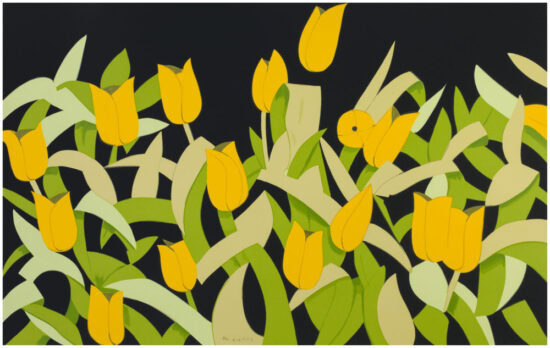
Its flat, saturated areas of color and sharply defined edges complemented his portraits, flowers and large-scale compositions. Many of Katz’s best-known editions use screenprinting to translate the clarity and immediacy of his paintings into graphic form.
Woodcut allowed Katz to work with simplified forms, strong contours and broad areas of color.
His woodcuts often depict portraits, landscapes and flowers, combining the physical qualities of the medium with the economy of line that characterizes his work.
Katz began producing cutout figures in the late 1950s.
His earliest cutouts were made from canvas mounted on shaped wood. He later began painting directly on shaped supports and, by the 1960s, worked with painted aluminum sheets to create freestanding and wall-mounted figures.
These works occupy a space between painting and sculpture. By removing the conventional rectangular canvas, Katz transformed the painted figure into an object existing directly within the viewer’s physical space.
Alex Katz Flowers and Landscapes
Flowers and landscapes have remained major subjects throughout Katz’s career.
Maine, where Katz has spent summers since the 1950s, became particularly important to his landscape practice. His paintings of trees, fields, water and changing light often reduce natural forms to broad areas of color and carefully organized space.
Flowers similarly became a recurring subject, allowing Katz to explore scale, repetition, color and simplified organic forms.
Maine played a central role in Katz’s artistic development.
After first attending Skowhegan in 1949, Katz continued returning to Maine and became a longtime summer resident of Lincolnville beginning in the 1950s. The region’s landscape, changing light and natural environment became recurring subjects in his paintings and prints.
The contrast between New York and Maine helped define two recurring aspects of his work: the social world of modern urban portraiture and the direct observation of landscape.
Alex Katz and Dance
Katz also developed an important relationship with dance and performance.
Beginning in the 1960s, he designed sets and costumes for choreographer Paul Taylor and continued collaborating with dance throughout his career. Dancers also became recurring subjects in his paintings and prints.
These collaborations extended Katz’s interest in movement, gesture, cropping and the relationship between the figure and surrounding space.
Alex Katz Exhibitions and Museum Recognition
Katz’s work has been exhibited extensively in the United States and internationally.
His first one-person show was held in 1954. Major later exhibitions included a retrospective at the Whitney Museum of American Art in 1986, a print retrospective at the Brooklyn Museum in 1988, and Alex Katz: Gathering, a major career survey presented by the Solomon R. Guggenheim Museum in New York in 2022–23.
His work has since appeared in hundreds of solo and group exhibitions and is represented in major public collections including The Museum of Modern Art, The Metropolitan Museum of Art, the Whitney Museum of American Art, the National Gallery of Art, Tate and numerous other institutions.
Alex Katz’s Late Career
Katz has continued refining his approach to portraiture and landscape into the twenty-first century.
Beginning around 2010, he increasingly used extreme cropping and repeated views of the same sitter within a single composition. In later years, he also incorporated photography and digital tools into his preparatory process while continuing to paint large-scale oils and create prints.
Flowers, portraits and landscapes have remained central subjects, demonstrating the consistency of his visual concerns across changing techniques and formats.
Alex Katz’s Artistic Style
Alex Katz’s style is defined by clarity, flatness, economy and immediacy.
His figures and landscapes are often reduced to essential shapes, large areas of color and carefully controlled contours. His work reflects influences from modern painting, cinema, advertising, Japanese prints and contemporary visual culture, yet remains distinctively his own.
Although Katz is often discussed in relation to Pop Art, his mature figurative style developed before Pop became established as a movement. His emphasis on flat color, cropped imagery and modern visual culture anticipated aspects of Pop while remaining rooted in direct observation and painting from life.
Alex Katz’s Legacy
Alex Katz occupies a distinctive position in postwar American art.
At a time when abstraction dominated much of the New York art world, Katz remained committed to figurative painting while developing a contemporary visual language based on immediacy, scale and reduction.
His influence can be seen in later generations of painters who embraced figuration, flatness, cropping and images drawn from contemporary life.
Across painting, printmaking, sculpture and public art, Katz has maintained a remarkably consistent exploration of how much information an image needs in order to feel immediate, recognizable and alive.
Explore Alex Katz by Medium
Continue your research through our Alex Katz collections and guides: