
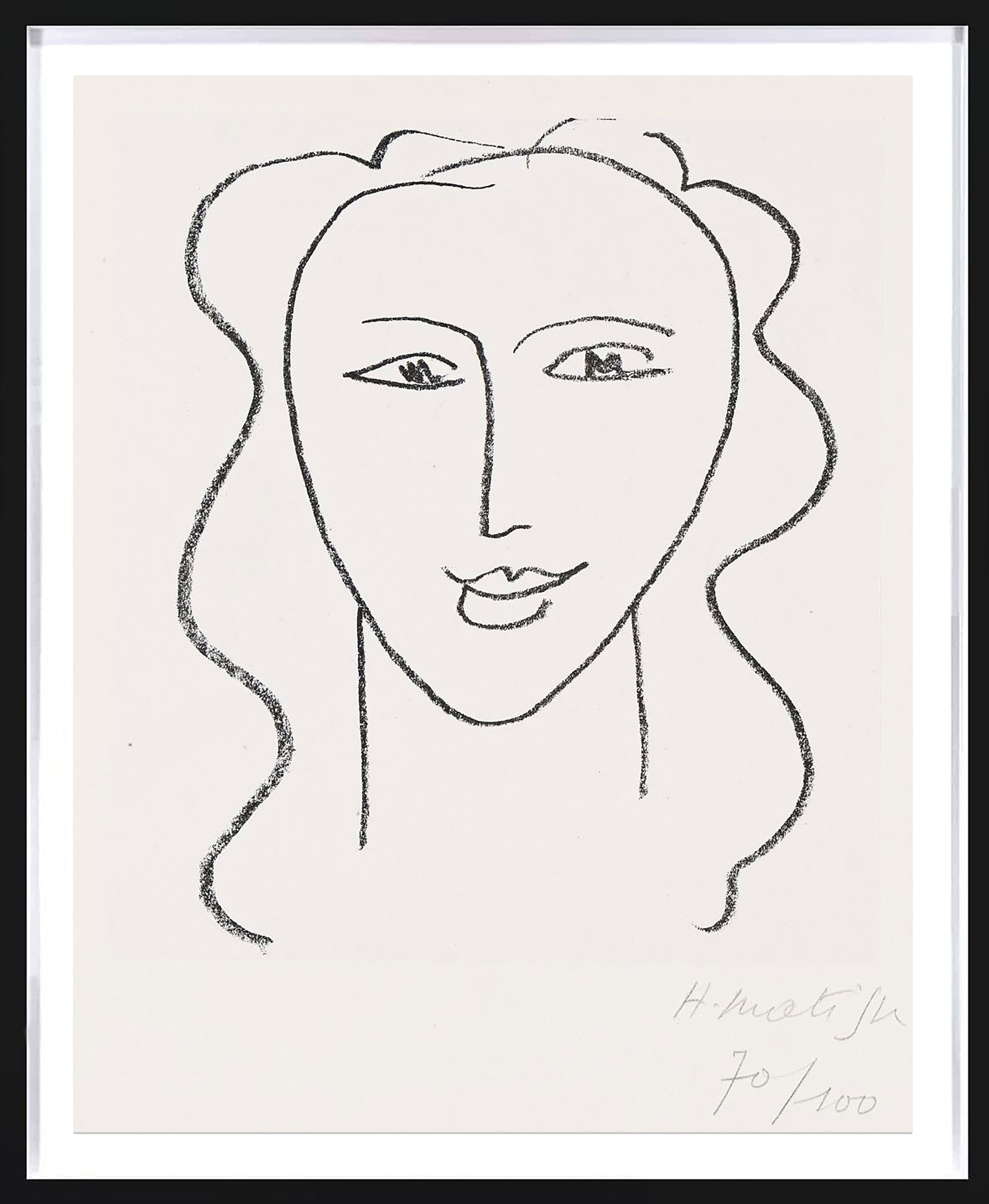
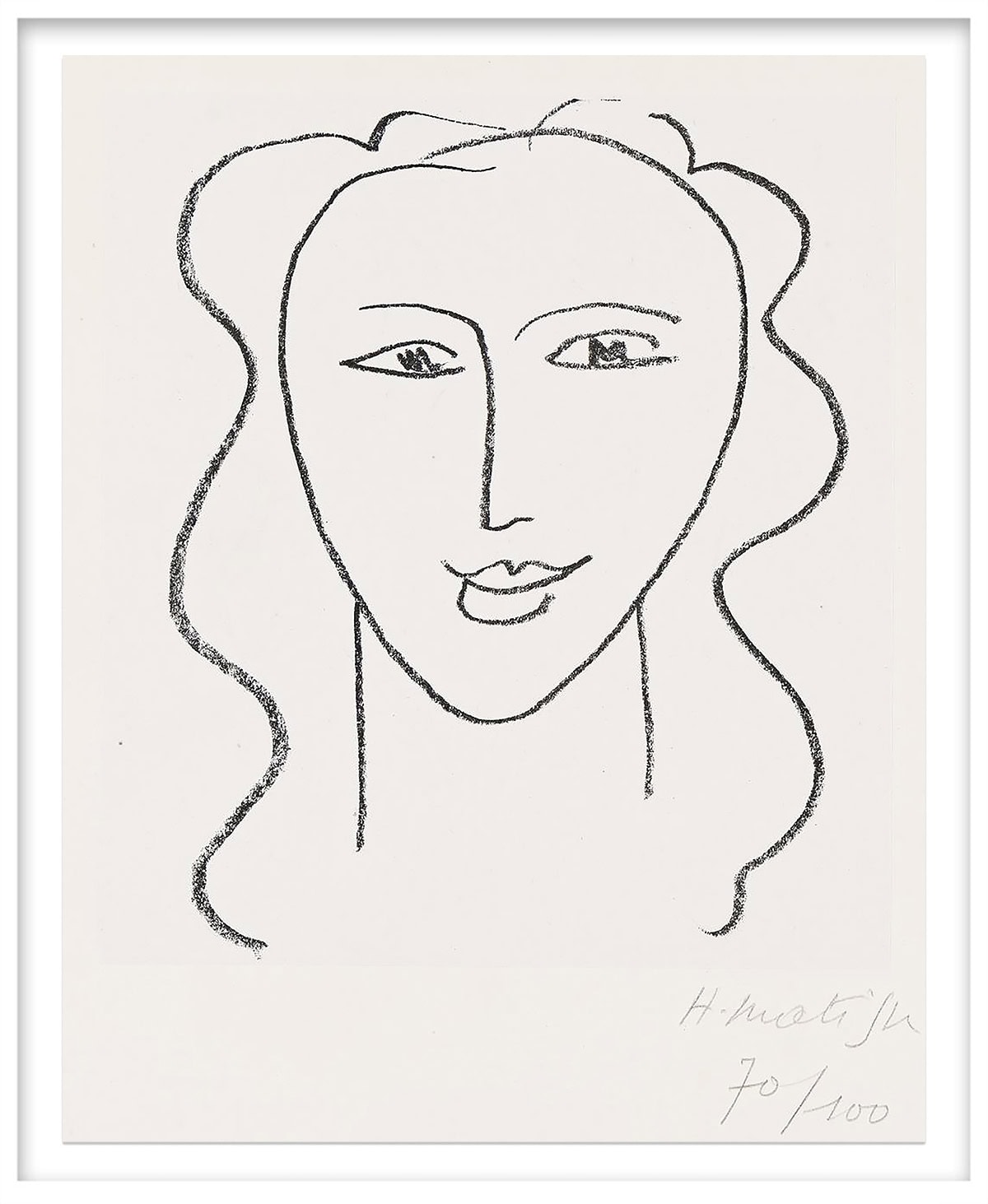
Henri Matisse, Études pour la Vierge, Visage. 1950-51 |
|
| Artist: | Henri Matisse (1869 - 1954) |
|---|---|
| Title: | Lithograph on Chine appliqué, 1950-51. |
| Reference: | Duthuit 638 |
| Series: | Ulysses, 1935 |
| Medium: | Lithograph on Chine appliqué. |
| Image Size: | 8 5/8 in x 6 5/8 in. (21.5 cm x 16.9 cm) |
| Edition: | Numbered from the edition of 100 in pencil in the lower right. |
| Signature: | This work is hand-signed by Henri Matisse (Le Cateau-Cambrésis, 1869 - Nice, 1954) in pencil in the lower right |
| ID # | W-10028 |
|
Price on Request
Questions? |
|
Henri Matisse Études pour la Vierge, Visage. 1950-51, was created during the twilight of Henri Matisse’s life, Études pour la Vierge, Visage stands as a sublime testament to the artist’s enduring pursuit of purity, grace, and spiritual harmony. Executed between 1950 and 1951, this drawing belongs to the profound series of studies Matisse conceived for the Chapelle du Rosaire de Vence, a project that would come to define his late years both artistically and spiritually. Stripped of all excess, the work reveals the artist’s mastery of the essential — a single, fluid line that encapsulates the serenity, compassion, and timeless beauty of the Virgin’s face.
In these late drawings, Matisse abandoned the decorative exuberance of his Fauvist years in favor of an art of reduction — an art that aspires to the universal. Here, the Virgin is rendered not as an icon of opulence, but as an embodiment of inner radiance. Her visage, outlined with confident, unbroken strokes, radiates quietude and spiritual repose. The simplicity of the contour belies its sophistication; each curve, each delicate turn of the brush, is imbued with a lifetime of observation, discipline, and faith in the expressive power of line.
The Études pour la Vierge drawings are inseparable from the luminous vision of the Vence Chapel, often referred to as “Matisse’s masterpiece.” Confined to his bed and weakened by illness, Matisse nonetheless orchestrated every aspect of the chapel — from the stained-glass windows and murals to the vestments and liturgical objects. These preparatory studies were not mere technical exercises but meditations — visual prayers through which the artist sought transcendence. The Visage of the Virgin, in particular, reflects Matisse’s belief that spiritual truth could be reached through the clarity of form and the lightness of touch.
Radiating both tenderness and monumental calm, Études pour la Vierge, Visage captures the essence of Matisse’s final creative period — an art freed from material constraint, reduced to the purest synthesis of line and feeling. It is a work of profound stillness and luminous faith, embodying the artist’s final revelation: that beauty, distilled to its most essential form, becomes an act of devotion.
Catalogue Raisonné & COA:
Henri Matisse Études pour la Vierge, Visage. 1950-51 is fully documented and referenced in the below catalogue raisonnés and texts (copies will be enclosed as added documentation with the invoices accompanying the final sale of the work).
1. Duthuit-Matisse, Marguerite, Henri Matisse: Catalogue raisonné de lœuvre grave Tome II. Paris: Claude Duthuit, 1983. Listed and illustrated as catalogue raisonné no. 638.
2. A Certificate of Authenticity will accompany this work.
About the Framing:
Framed to museum-grade, conservation standards, Henri Matisse Études pour la Vierge, Visage. 1950-51 is presented in a complementary moulding and optical-grade Plexiglas.
Subject Matter: Femme
