Details
| Artist: | Frank Stella (1936 - 2024) |
|---|---|
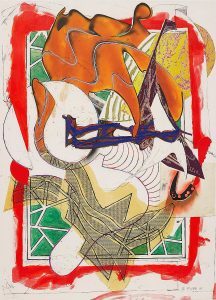
| Title: | Lunna Wola (V), from Paper Reliefs, 1975 |
| Reference: | Axsom 106.5 |
| Series: | Paper Reliefs Series, 1975 |
| Medium: | Unique cast paper relief with collage and hand-coloring in acrylic, casein, watercolor and metallic paints, on HMP papers. |
| Image Size: | 24 in x 20 in x 1 in (60.96 cm x 50.8 cm x 2.54 cm) |
| Sheet Size: | 24 in x 20 in x 1 in (60.96 cm x 50.8 cm x 2.54 cm) |
| Framed Size: | 31 in x 28 in x 4 in (78.74 cm x 71.12 cm x 10.16 cm) |
| Edition: | This work is one of fourteen Trial Proofs, aside from the regular numbered edition of 26. |
| Signature: | This work is hand-signed by Frank Stella (1936 - 2024) in pencil in the lower right. |
| Price: | $38,000 |
| Availability | This Frank Stella Relief is for sale |
| Item # | w-12628 |
Historical Description
Frank Stella’s Lunna Wola (V), from Paper Reliefs, 1975, is an extraordinary and visually sophisticated example of the artist’s groundbreaking exploration of abstraction, dimensionality, and the physical possibilities of paper. Created during a pivotal period in Stella’s artistic development, this remarkable composition transforms the traditionally flat surface of a print into a sculptural arrangement of raised forms, overlapping elements, and carefully organized geometric relationships. Rather than treating paper as a passive support for an image, Stella makes the material itself an essential component of the artwork, challenging the conventional boundaries between painting, printmaking, collage, and sculpture. The composition belongs to his celebrated Paper Reliefs series, in which the artist explored the interaction between geometric structure and physical depth with extraordinary inventiveness. Particularly compelling is the way the relief elements establish a sense of movement and spatial complexity, allowing the composition to extend beyond the familiar limitations of a two-dimensional image. The interplay between its constructed surfaces and carefully considered arrangement of forms creates an experience that changes as light moves across the work, emphasizing the subtle variations of depth, texture, and shadow. What initially appears to be an exercise in geometric abstraction gradually reveals a remarkably sophisticated investigation of material, structure, and artistic expression. The result is unmistakably Frank Stella: intellectually ambitious, technically innovative, visually commanding, and filled with the inventive spirit that transformed the course of postwar American art.
The combination of cast paper relief, collage, and hand-coloring is particularly important to Lunna Wola (V). Executed with acrylic, casein, watercolor, and metallic paints on HMP papers, the work demonstrates Stella’s remarkable ability to push the possibilities of original printmaking beyond conventional methods of applying ink to a flat surface. By manipulating paper pulp into raised and sculptural forms, Stella transforms the paper itself into an active artistic medium, creating a composition in which physical structure and visual design become inseparable. The addition of collage introduces another dimension of complexity, allowing distinct elements to interact within a carefully orchestrated arrangement, while the hand-coloring brings an individual expressive quality to the finished impression. These techniques establish a fascinating relationship between the precision of Stella’s geometric vocabulary and the inherent irregularities of handmade materials. The physical relief creates subtle variations of light and shadow, lending the work a sculptural presence that cannot be fully appreciated through photographic reproduction alone. Produced through the innovative papermaking and printmaking techniques associated with the Paper Reliefs series, the work reflects the extraordinary technical experimentation that characterized Stella’s artistic practice during the 1970s. Rather than simply reproducing a composition, the process becomes fundamental to the artistic conception itself. The result is a work of exceptional material sophistication, combining the discipline of geometric abstraction with the tactile richness and individuality of cast paper, collage, and hand-applied color.
Imagine living with Frank Stella’s Lunna Wola (V) every day. This is not simply an artwork to be admired on a wall, but a remarkable sculptural presence capable of introducing an extraordinary sense of refinement, architectural interest, and artistic sophistication into a beautifully considered interior. Displayed in an elegant living room, contemporary study, sophisticated library, or distinguished private gallery, the work would establish a compelling dialogue between its carefully organized geometric forms and the surrounding architecture. Unlike a conventional print, the dimensional qualities of Lunna Wola (V) allow the composition to interact with natural and artificial light, creating subtle changes in shadow, texture, and visual emphasis throughout the day. From across the room, its structured composition communicates the confidence and authority of Stella’s artistic vision; as one approaches, the tactile character of the handmade paper, the raised relief elements, and the intricacies of the collage become increasingly apparent. There is something particularly rewarding about living with an artwork that reveals its sophistication gradually, inviting closer examination without sacrificing its immediate visual presence. In a contemporary interior, Lunna Wola (V) would beautifully complement clean architectural lines, sculptural furnishings, natural materials, and carefully selected design objects, introducing an exceptional balance of intellectual rigor and understated elegance. In a more traditional environment, its modern geometric language could establish an unexpected yet sophisticated contrast with classical furniture, rich textures, and timeless decorative elements. Whether displayed as a defining focal point or incorporated into an important collection of postwar American art, this original Stella relief would bring a lasting sense of artistic distinction to its surroundings. More than a decorative statement, Lunna Wola (V) offers the rare pleasure of living with a work that occupies the fascinating territory between painting, printmaking, and sculpture—an enduring expression of Stella’s imagination, technical innovation, and extraordinary contribution to modern art.
Frank Stella (American, 1936–2024) was one of the most influential and innovative artists of the postwar period, continually redefining the possibilities of abstraction through painting, printmaking, sculpture, and architectural form. Born in Malden, Massachusetts, Stella studied at Phillips Academy in Andover before attending Princeton University, where he developed an increasingly sophisticated interest in the history and structure of painting. Emerging in New York during the late 1950s, he became internationally recognized for his revolutionary Black Paintings, whose disciplined geometric compositions challenged the expressive gestures and emotional intensity associated with Abstract Expressionism. His famous assertion, “What you see is what you see,” reflected an artistic philosophy that emphasized the physical and structural qualities of an artwork rather than its symbolic or narrative content. During the 1960s, Stella expanded his investigations through shaped canvases, increasingly complex geometric configurations, and brilliant color, helping to establish him as a defining figure in the development of Minimalism and post-painterly abstraction. By the 1970s, however, his work had undergone a remarkable transformation. The restrained surfaces and rigorous geometry of his earlier paintings evolved into increasingly dimensional compositions incorporating relief, collage, unconventional materials, and more elaborate spatial relationships. Printmaking became an essential part of this artistic evolution, providing Stella with opportunities to collaborate with master printers and experiment with techniques that challenged the distinction between original prints and unique works of art. His Paper Reliefs series of 1975 represents a particularly important stage in this development, demonstrating his determination to transform the physical structure of paper into an active component of artistic expression. These investigations anticipated the increasingly elaborate relief paintings, sculptural constructions, and exuberant compositions that would define his mature career. Stella's achievements were recognized through major retrospectives at the Museum of Modern Art in New York, including his landmark 1970 exhibition, and at the Whitney Museum of American Art in 2015–2016. His work is represented in the collections of the Museum of Modern Art, the Metropolitan Museum of Art, the Whitney Museum of American Art, the Solomon R. Guggenheim Museum, and numerous other prestigious institutions internationally. Throughout a career spanning more than six decades, Stella remained committed to challenging established artistic conventions and expanding the possibilities of abstract form. Lunna Wola (V), 1975, reflects this extraordinary spirit of experimentation, offering a compelling example of the material inventiveness, structural intelligence, and artistic ambition that established Frank Stella as one of the most important American artists of his generation.
Frank Stella’s Lunna Wola (V), from Paper Reliefs, 1975, is a cast paper relief with collage and hand-coloring in acrylic, casein, watercolor, and metallic paints on HMP papers. This work is one of only fourteen Trial Proofs, aside from the regular numbered edition of 26, and is hand-signed by Frank Stella (Malden, 1936–New York, 2024) in pencil in the lower right. The unusual trial-proof designation and individually worked surface distinguish this impression within Stella’s ambitious Paper Reliefs series.
Catalogue Raisonné & COA:
Frank Stella, Lunna Wola (V), from Paper Reliefs, 1975, is fully documented and referenced in the below catalogue raisonnés and texts (copies will be enclosed as added documentation with the invoices that will accompany the sale of the work (when available)).
1. Axsom, Richard H. The Prints of Frank Stella: A Catalogue Raisonné. New York: Jordan Schnitzer Family Foundation, 2016. Listed and illustrated as catalogue raisonné no. 106.5.
2. A Certificate of Authenticity will accompany Frank Stella, Lunna Wola (V), from Paper Reliefs, 1975.
About the Framing:
Frank Stella’s Lunna Wola (V), from Paper Reliefs, 1975, is presented in museum-grade conservation framing with complementary molding and optical-grade Plexiglas. The carefully considered presentation is particularly important for a work of this unusual material character, allowing the sculptural qualities of the cast paper relief and collage to remain central to the viewing experience. Unlike a conventional flat print, the raised elements of the composition create subtle variations in depth, texture, and shadow that contribute significantly to its artistic identity. The restrained framing provides an elegant architectural boundary around the artwork without competing with the sophistication of Stella’s geometric language or the tactile richness of the handmade paper. The conservation presentation respects the delicate qualities of the relief, allowing the individual elements to be appreciated as part of a unified and remarkably inventive composition. The complementary molding creates a refined transition between the artwork and its surrounding environment, while the optical-grade Plexiglas provides a polished and sophisticated finished appearance. Whether displayed in a contemporary residence, an elegant traditional interior, or a distinguished private collection, the framing enhances the work’s sculptural presence and emphasizes its importance as an exceptional example of Stella’s experimental printmaking. The finished presentation gives Lunna Wola (V) the distinguished character appropriate for an original work by one of the most influential American artists of the twentieth century.
Some of Frank’s most prestigious museum exhibitions worldwide, reflect his significant impact on contemporary art. Here are some notable exhibitions:
1. Museum of Modern Art (MoMA), New York: MoMA has hosted several exhibitions featuring Stella's work, including his major retrospective in 1970, which showcased his early explorations in Minimalism and Abstract Expressionism.
2. Whitney Museum of American Art, New York: In 2015-2016, the Whitney Museum organized a comprehensive retrospective titled 'Frank Stella: A Retrospective," highlighting his prolific career from the late 1950s to the present. This exhibition underscored Stella's versatility and innovation across different media.
3. Solomon R. Guggenheim Museum, New York: Stella's work has been prominently displayed at the Guggenheim, including in the 1995 exhibition "Frank Stella: A Retrospective," which provided an extensive overview of his career, from his early paintings to his more recent three-dimensional works.
4. San Francisco Museum of Modern Art (SFMOMA): In 2002, SFMOMA hosted "Frank Stella: Painting into Architecture," which examined Stella's transition from two-dimensional paintings to three-dimensional architectural forms.
5. Centre Pompidou, Paris: In 1988, the Centre Pompidou presented a major exhibition of Stella's work, emphasizing his influence on both American and European art scenes.
6. Hirshhorn Museum and Sculpture Garden, Washington, D.C.: Stella's work has been featured in multiple exhibitions at the Hirschhorn, including a 1976 retrospective that showcased his evolving style and technique.
These exhibitions have cemented Frank Stella's reputation as a pioneering artist who continues to influence contemporary art with his innovative approach and creative vision.
About the Series: Paper Reliefs Series, 1975
Frank Stella's Paper Reliefs, 1975 is a series of six cotton-pulp reliefs, each of which are from editions of varying sizes. Each of the works are reconfigurations of Stella's painting series, the Polish Village series of 1971-73. The respective titles of each work are derived from the names of cities, settlements, districts, or shtetls in Poland and the Soviet Union. Browse Frank Stella, Paper Reliefs Series, 1975.
Frank Stella (1936 - 2024)
Explore original Frank Stella prints and artwork for sale, including signed and editioned screenprints, lithographs, etchings, woodcuts, reliefs and mixed-media works. Masterworks Fine Art specializes in important Frank Stella series such as Imaginary Places, Circuits, The Waves, Moby Dick, Italian Folktales and Had Gadya, with detailed edition information, provenance and catalogue raisonné references provided for collectors.
Availability
This Frank Stella Relief is for sale. Collectors can buy this work immediately. Upon purchase, we ship as soon as overnight or your preferred shipping method. Learn more about shipping.
Selling
If you are looking for where to sell Frank Stella Paper Reliefs Series, 1975 original works, we are interested in buying from collections of private sellers. As seasoned fine art dealers of 30+ years, we will research the current value and guide you in our simple online selling process.
-
Step 1:
Send Photos -
Step 2:
Receive Offer -
Step 3:
Get Paid
Artwork Subject Matter
Frank StellaLunna Wola (V), from Paper Reliefs, 1975 Unique cast paper relief with collage and hand-coloring in acrylic, casein, watercolor and metallic paints, on HMP papers. |
|
| Unique cast paper relief with collage and hand-coloring in acrylic, casein, watercolor and metallic paints, on HMP papers. | |
| This work is one of fourteen Trial Proofs, aside from the regular numbered edition of 26. | |
| hand-signed by Frank Stella (1936 - 2024) in pencil in the lower right. | |
|
$38,000
|
|
|
|
|