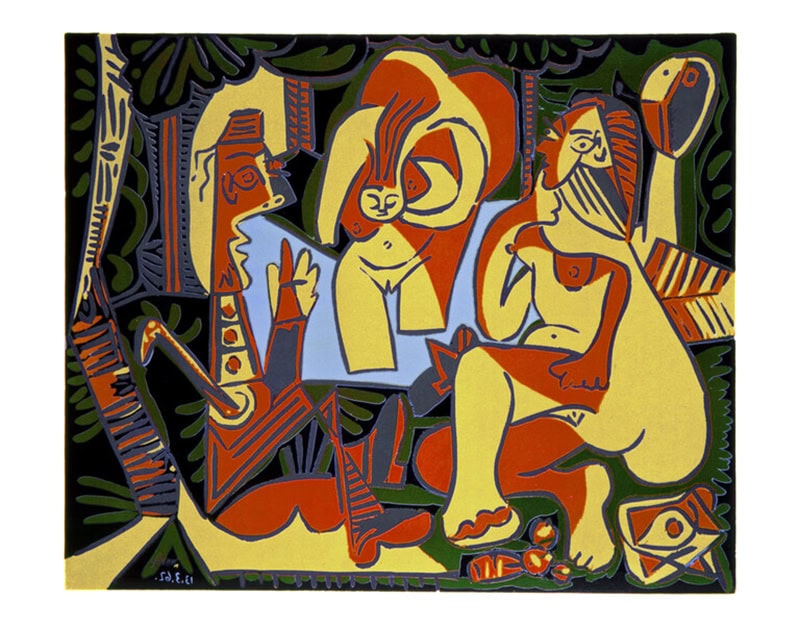
Pablo Picasso, Luncheon on the Grass, after Edouard Manet, 1962 |
|
| Artist: | Pablo Picasso (1881 - 1973) |
|---|---|
| Title: | Luncheon on the Grass, after Edouard Manet, 1962 |
| Reference: | Bloch 1027 |
| Medium: | Color Linocut on Arches Paper |
| Image Size: | 25 1/4 in x 20 7/8 in (64.1 cm x 53 cm) |
| Sheet Size: | 29 5/8 in x 24 3/8 in (75.2 cm x 61.9 cm) |
| Edition: | Numbered from the edition of 50 in pencil in the lower left margin; published by Galerie Louise Leiris, Paris. |
| Signature: | This work is hand-signed by Pablo Picasso (Malaga, 1881- Mougins, 1973) in pencil in the lower right margin. |
| ID # | W-8493 |
|
|
|
Pablo Picasso’s Luncheon on the Grass, after Edouard Manet, 1962, is a bold reinvention of one of the most provocative masterpieces of 19th-century art. In this linocut, created in 1962, Picasso pays homage to Manet’s radical Le Déjeuner sur l’herbe (1863), while simultaneously transforming it through his own modernist lens. The composition—two clothed men seated beside a nude woman in a pastoral setting—remains instantly recognizable, yet Picasso reimagines it with the graphic intensity of linocut, stripping the scene to its essential forms and rhythms.
The bold, carved lines and stark contrasts of black and white replace Manet’s lush brushwork, shifting the focus from painterly sensuality to structural clarity. Figures emerge with sculptural weight, their forms interlocked in a dialogue of light and shadow that conveys both intimacy and tension. Picasso’s interpretation heightens the scene’s sense of theatricality, making the viewer acutely aware of the charged interplay between gazes, gestures, and bodies. The landscape, simplified into rhythmic planes, becomes less a backdrop than a stage for human presence and desire.
By reworking Manet’s daring composition nearly a century later, Picasso situates himself in direct conversation with modern art’s lineage. The linocut embodies both homage and challenge: an acknowledgment of Manet’s audacity and a demonstration of Picasso’s own power to dismantle, reconstruct, and immortalize a canonical image in a wholly new medium.
With Luncheon on the Grass, after Édouard Manet, Picasso not only revives one of art history’s most controversial and celebrated scenes, but also asserts the enduring vitality of reinvention. It is at once a tribute, a transformation, and a statement of Picasso’s lifelong commitment to pushing tradition into the modern age.
Created in 1962, Pablo Picasso Luncheon on the Grass, after Edouard Manet is a linocut on Arches paper hand-signed by Pablo Picasso (Malaga, 1881 - Mougins, 1973) in pencil in the lower right margin. Numbered from the edition of 50 in pencil in the lower left margin, this work was published by Galerie Louise Leiris, Paris.
Catalogue Raisonné & COA:
Pablo Picasso Luncheon on the Grass, after Edouard Manet, 1962 is fully documented and referenced in the below catalogue raisonnés and texts (copies will be enclosed as added documentation with the invoices that will accompany the final sale of the work):
1. Bloch, Georges. Picasso Catalogue de l'ouvre gravé et lithographié, Volume I. Kornfeld et Cie: Switzerland, 1968. Listed and illustrated as catalogue raisonné no. 1027.
2. McVinney, L. Donald, et al Picasso Linoleum Cuts: The Mr. and Mrs. Charles Kramer Collection in the Metropolitan Museum of Art, New York: Random House, 1985. Listed and illustrated as catalogue raisonné no. 87.
3. A Certificate of Authenticity will accompany our Pablo Picasso’s Luncheon on the Grass, after Edouard Manet, 1962,
About the Framing:
Framed to museum-grade, conservation standards, Pablo Picasso Luncheon on the Grass, after Edouard Manet, 1962 is presented in a complementary moulding and finished with silk-wrapped mats and optical grade Plexiglas.