Details
| Artist: | Pablo Picasso (1881 - 1973) |
|---|---|
| Title: | Jacqueline Au Chapeau Noir (Jacqueline Au Chapeau Noir), 1962 |
| Reference: | Bloch 1028; Baer 1311 |
| Series: | Jacqueline |
| Medium: | Linocut (Linoleum Cut) on Arches Wove Paper |
| Image Size: | 25 1/8 in x 20 5/8 in (63.9 cm x 52.4 cm) |
| Sheet Size: | 29 1/2 in x 24 1/2 in (75.1 cm x 62.1 cm) |
| Framed Size: | 40 1/2 in x 35 3/4 in (102.9 cm x 90.8 cm) |
| Edition: | Numbered from the edition of 50 in pencil in the lower left margin. Printed by Arnéra, Vallauris and published by Gallery Louise Leiris, Paris in 1963. |
| Signature: | This work is hand-signed by Pablo Picasso (Malaga, 1881 - Mougins, 1973) in pencil in the lower right margin. |
| Price: | $148,000 |
| Availability | This Pablo Picasso Linocut is for sale |
| Item # | w-8419 |
Historical Description
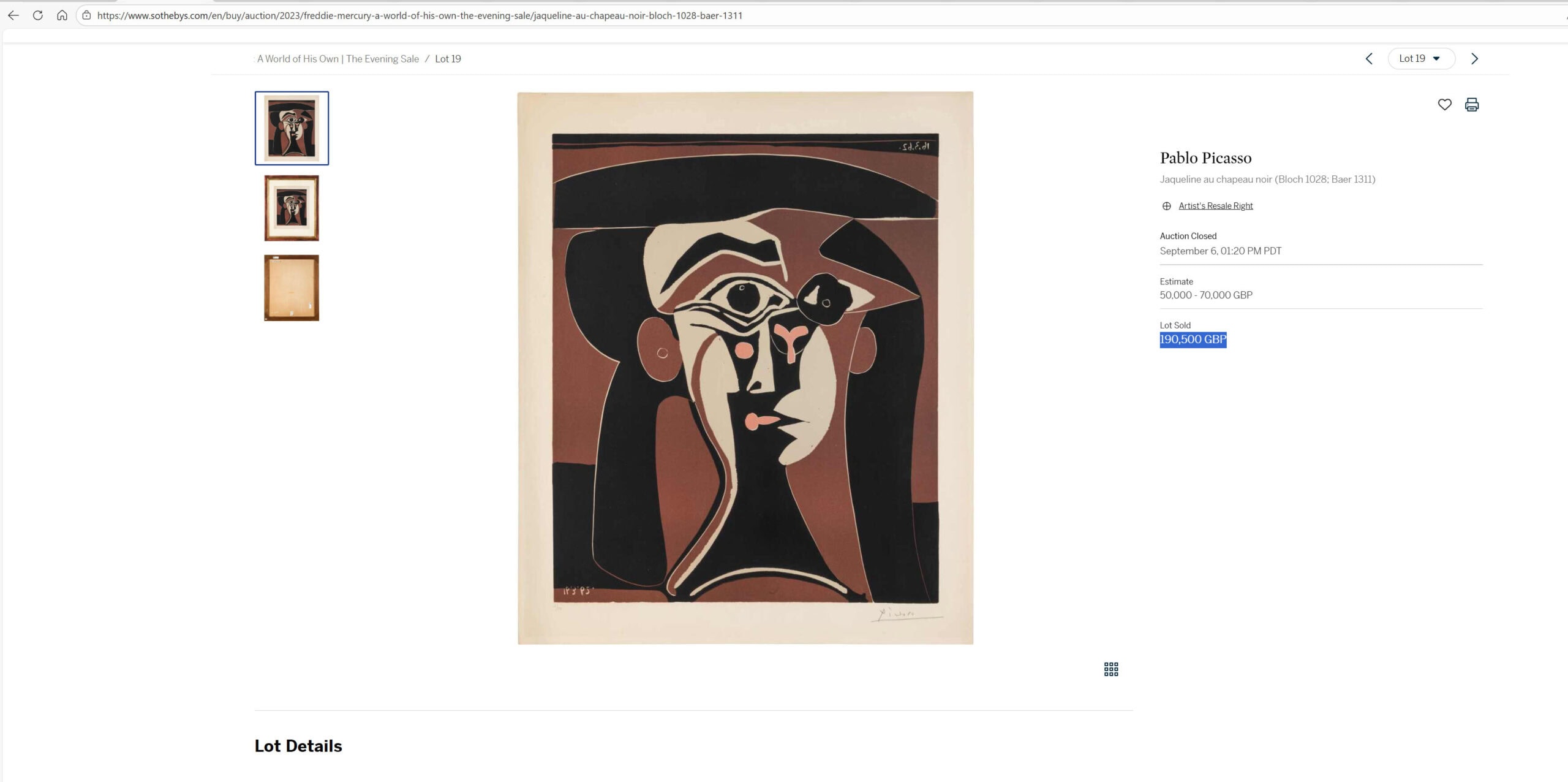
Pablo Picasso’s Jacqueline au chapeau noir (Jacqueline in Black Hat) is a commanding and deeply personal portrait of Jacqueline, Picasso’s wife and the defining muse of his late career.
The composition transforms Jacqueline’s face into an extraordinary arrangement of black, deep burgundy, warm cream, and brilliant accents of red. The woman's enormous black hat sweeps dramatically across the upper portion of the image, while the dark masses of her hair descend along either side of her face, creating an almost architectural framework around the portrait. Within this structure, Picasso fractures and reconstructs Jacqueline’s features with remarkable confidence. One eye expands dramatically across the center of the face while the other is compressed within a competing profile; brows, noses, lips, and contours overlap so that Jacqueline appears to be viewed simultaneously from several perspectives. Particularly compelling are the small flashes of vivid red across her cheek, lips, and the flower-like form near her eye, which animate the otherwise restrained palette and continually draw the viewer back toward her gaze. There is something almost mask-like about the image, yet it never loses its sense of an individual sitter. Picasso knew Jacqueline intimately, and rather than pursuing a conventional likeness, he transforms the familiarity of her face into something psychological, mysterious, and intensely present. The result is unmistakably Picasso—radical in its construction, extraordinarily assured in its use of color and form, and deeply connected to the woman who occupied such an important place in the final decades of his life.
The importance of Jacqueline au chapeau noir (Jacqueline in Black Hat) within Picasso’s graphic work is reflected by its presence in major museum collections internationally. Impressions of this celebrated 1962 linocut are represented in the collections of The Museum of Modern Art (MoMA), New York; The Metropolitan Museum of Art, New York; Museu Picasso, Barcelona; the High Museum of Art, Atlanta; the Städel Museum, Frankfurt; and Museum Boijmans Van Beuningen, Rotterdam. The presence of this image in such distinguished institutional collections provides an important museum context for Jacqueline au chapeau noir and its place within Picasso’s extraordinary body of late graphic work.
Picasso’s Jacqueline au chapeau noir (Jacqueline in Black Hat) is represented in the collections of several important international museums, underscoring the significance of this image within Picasso’s celebrated body of linocuts. Examples are held by The Museum of Modern Art (MoMA), New York; The Metropolitan Museum of Art, New York; Museu Picasso, Barcelona; the High Museum of Art, Atlanta; the Städel Museum, Frankfurt; and Museum Boijmans Van Beuningen, Rotterdam.
There is also a significant public auction precedent for this specific image. Another signed and numbered impression of Jacqueline au chapeau noir, from the same edition of 50, sold at Sotheby’s London on September 6, 2023 for £190,500 (approximately $254,804), Lot 19. The result provides an important public auction reference for another example of this celebrated Picasso linocut.
Imagine living with Picasso’s Jacqueline au chapeau noir every day. This is a work with tremendous presence. From across a room, the enormous black hat, deep burgundy ground, and broad passages of black give the portrait an almost monumental quality, despite the more intimate scale of a work on paper. Jacqueline’s face emerges immediately from the darkness, while the few brilliant touches of red seem almost illuminated against the surrounding earth tones. As you move closer, however, the portrait becomes increasingly complex. What initially appears to be a single face begins to separate into overlapping profiles, competing viewpoints, eyes, contours, and unexpected shapes. You can follow one profile and then suddenly discover another, making Jacqueline appear to shift before you as you look at her. That quality would make the work particularly rewarding to live with because the image never completely resolves itself. In a contemporary interior, its strong geometry and sophisticated palette could become the visual anchor of an entire room; in a more traditional setting, the richness of the burgundy, cream, red, and black could feel unexpectedly elegant. There is also an intimacy to living with a portrait Picasso made of Jacqueline: behind all of the formal experimentation is the repeated act of an artist looking at someone he knew extraordinarily well. It is bold enough to command a room, sophisticated enough to coexist with almost any interior, and visually complex enough to continue revealing itself over years of looking.
Pablo Picasso (Spanish, 1881–1973) was one of the most transformative artists of the twentieth century, continually reinventing the possibilities of painting, drawing, sculpture, ceramics, and printmaking throughout a career spanning more than seven decades. From his Blue and Rose periods through Cubism and the extraordinary freedom of his later work, Picasso repeatedly challenged conventional ideas of how the world and the human figure could be represented. Portraiture remained central to that experimentation, and the women closest to him frequently became subjects through whom he developed and tested new visual languages. Jacqueline Roque entered Picasso’s life in the 1950s and married him in 1961. She became the dominant female subject of his final decades, appearing repeatedly in paintings, drawings, ceramics, and prints. By the early 1960s, Picasso was working with remarkable freedom, combining multiple viewpoints, abbreviated forms, dramatic color, and references to earlier artistic traditions while still preserving something recognizable about his sitter. Jacqueline au chapeau noir belongs directly to this important late period, when Jacqueline’s distinctive features became the foundation for some of Picasso’s most inventive explorations of portraiture.
The linocut medium was particularly important to Picasso during these years, and Jacqueline au chapeau noir demonstrates the extraordinary sophistication he achieved with the technique. Rather than treating printmaking simply as a means of reproducing an existing image, Picasso approached the linoleum block as an independent artistic medium. Broad areas of color could be cut into bold, simplified shapes, while narrow lines and unprinted passages created surprisingly delicate details. Here, large expanses of black and burgundy give the portrait its extraordinary weight, while thin cream-colored contours carve Jacqueline’s eyes, nose, mouth, and profiles from the surrounding forms. The apparent simplicity of the finished image conceals a highly controlled process in which color, positive and negative space, and the carved surface of the block had to work together with exceptional precision. The Museum of Modern Art identifies the work as a 1962 linoleum cut from an edition of 50, printed by Arnéra in Vallauris and published by Galerie Louise Leiris in Paris. The Museum of Modern Art
Created in 1962, Jacqueline au chapeau noir (Jacqueline in Black Hat) is a color linocut on Arches wove paper. ) This impression is numbered from the edition of 50 in pencil in the lower left margin and is hand-signed by Pablo Picasso in pencil in the lower right margin. In addition to the numbered edition of 50.. The work was printed by Hidalgo Arnéra, Vallauris, and published by Galerie Louise Leiris, Paris, in 1963.
Catalogue Raisonné & COA:
Pablo Picasso Jacqueline Au Chapeau Noir (Jacqueline in Black Hat), 1962 is fully documented and referenced in the below catalogue raisonné and texts (copies will be enclosed as added documentation with the invoices that will accompany the final sale of the work):
1. Baer, Brigitte. Picasso Peintre-Graveur, Tome V. Galerie Kornfeld: Switzerland, 1989. Listed and illustrated as catalogue raisonné no. 1311.|
2. Bloch, Georges. Picasso Catalogue de l'ouvre gravé et lithographié, Volume I. Kornfeld et Cie: Switzerland, 1968. This work is listed and illustrated as catalogue raisonné no. 1028.
3. A Certificate of Authenticity will accompany this work.
About the Framing:
Pablo Picasso Jacqueline au chapeau noir (Jacqueline in Black Hat) is presented in an exceptional handmade, closed-corner frame finished in 24-karat gold leaf, with elegant silk mats and Tru Vu Optium Museum Acrylic. The frame has been carefully selected to complement the richness of Picasso’s deep burgundy, black, cream, and red palette, while the warmth of the hand-applied gold leaf provides a sophisticated counterpoint to the bold modernism of the image. The silk mats create a refined transition between the artwork and the frame, giving the composition space to breathe while emphasizing the generous proportions of the Arches sheet. The work has been framed to museum conservation standards, using archival materials and Optium Museum Acrylic to provide exceptional clarity and protection while minimizing distracting reflections. The result is a presentation of remarkable quality—combining traditional craftsmanship and conservation-conscious materials with a level of finish appropriate for an important signed and numbered Picasso linocut.
About the Series: Jacqueline
Portraits and artworks of Pablo Picasso's wife and muse, Jacqueline Roque. Browse Pablo Picasso, Jacqueline.
Pablo Picasso (1881 - 1973)
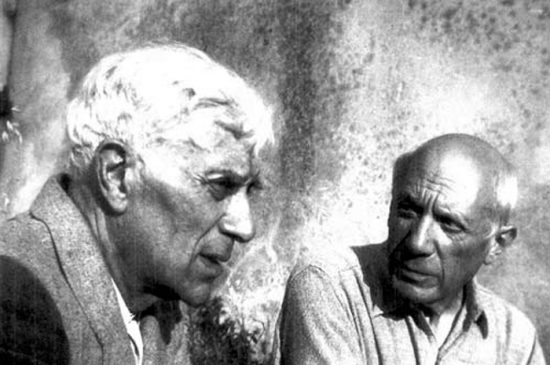
Pablo Picasso revolutionized the art world and to many is THE artist of the 20th century. He is famous for pioneering Cubism with Georges Braque and for his melancholy Blue Period pieces. Original hand-signed Picasso lithographs and prints are a sure investment while Picasso ceramics continue to rise in value in the art market.
Whether you are looking to buy an original Pablo Picasso artwork for sale or to sell a Picasso from your collection, we provide expert guidance based on authenticity research, catalogue raisonné references, edition details, condition, provenance and current art market activity.
Availability
This Pablo Picasso Linocut is for sale. Collectors can buy this work immediately. Upon purchase, we ship as soon as overnight or your preferred shipping method. Learn more about shipping.
Selling
If you are looking for where to sell Pablo Picasso Jacqueline original works, we are interested in buying from collections of private sellers. As seasoned fine art dealers of 30+ years, we will research the current value and guide you in our simple online selling process.
-
Step 1:
Send Photos -
Step 2:
Receive Offer -
Step 3:
Get Paid
Pablo PicassoJacqueline in Black Hat (Jacqueline Au Chapeau Noir) |
|
| Linocut (Linoleum Cut) on Arches Wove Paper | |
| from the edition of 50 in pencil in the lower left margin. Printed by Arnéra, Vallauris and published by Gallery Louise Leiris, Paris in 1963. | |
| hand-signed by Pablo Picasso (Malaga, 1881 - Mougins, 1973) in pencil in the lower right margin. | |
|
$148,000
Follow this work for updates
|
|
|
|
|