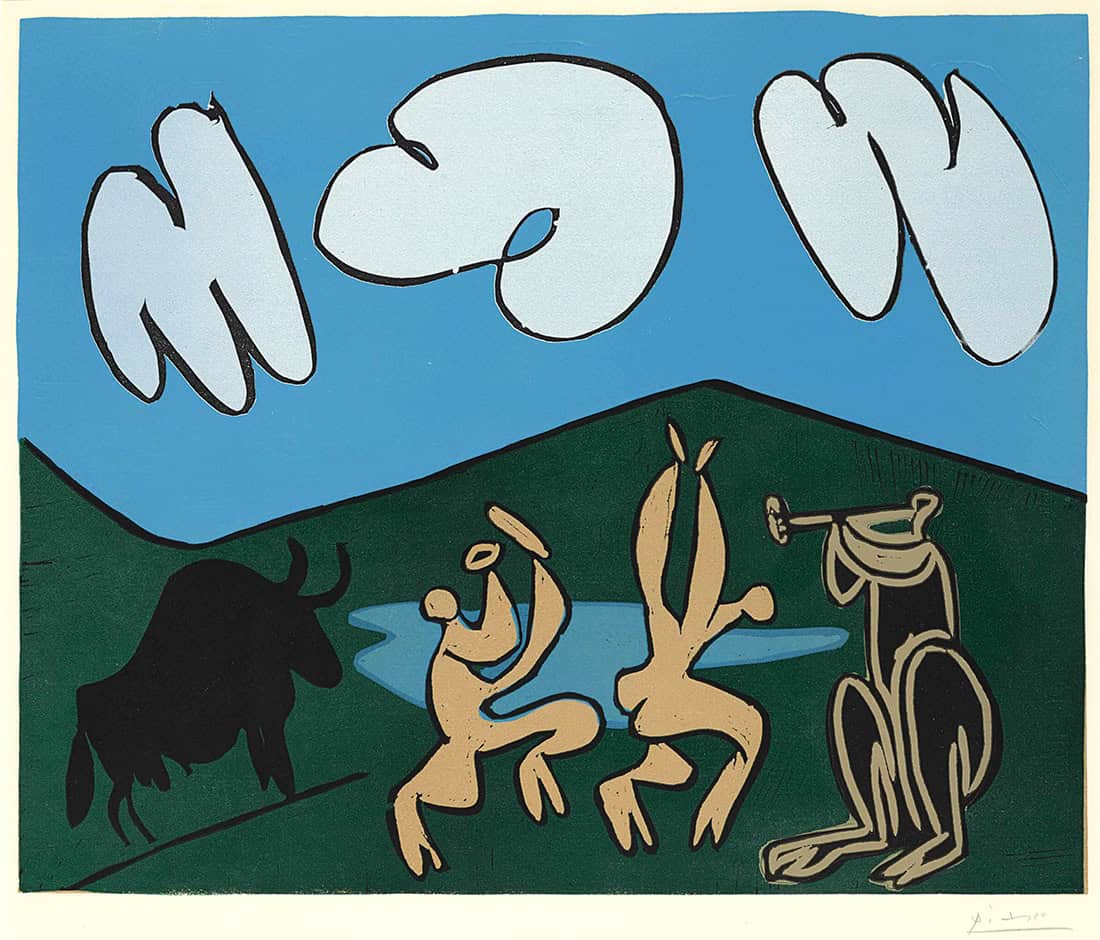
Pablo Picasso, Bacchanale au taureau noir (Bacchanalia with a Black Bull), 1959 |
|
| Artist: | Pablo Picasso (1881 - 1973) |
|---|---|
| Title: | Bacchanale au taureau noir (Bacchanalia with a Black Bull), 1959 |
| Reference: | Bloch 935 |
| Medium: | Color Linocut on Arches Paper |
| Image Size: | 25 1/4 in x 20 3/4 in (64.1 cm x 52.7 cm) |
| Sheet Size: | 29 1/2 in x 24 1/2 in (74.9 cm x 62.2 cm) |
| Edition: | Numbered from the edition of 50 in pencil in the lower left margin; published by Galerie Louise Leiris, Paris. |
| Signature: | This work is hand-signed by Pablo Picasso (Malaga, 1881- Mougins, 1973) in pencil in the lower right margin. |
| ID # | w-8388 |
|
|
|
Pablo Picasso’s Bacchanale au taureau noir (Bacchanalia with a Black Bull), 1959, is a powerful linocut that unites myth, ritual, and primal energy in a single, dynamic vision. In this work, Picasso revisits the theme of the Bacchanalia—ancient festivals devoted to Dionysus, filled with music, dance, and ecstatic revelry—and sets it against the commanding presence of the black bull, a creature that had become one of his most enduring symbols. The composition surges with vitality: human figures and mythological beings intertwine in a whirlwind of movement, while the dark, monumental bull dominates the scene as both participant and symbol, embodying strength, fertility, and mortality.
Executed with the graphic force of bold carving and high-contrast printing, the linocut dramatizes the tension between order and abandon, civilization and instinct. The swirling rhythms of the dancers and musicians evoke the sensual freedom of the Bacchic ritual, while the bull, rendered in stark black, anchors the composition with immovable gravity. Light and shadow, positive and negative space, play across the surface with a vitality that recalls both ancient friezes and Picasso’s distinctly modern abstraction.
Bacchanale au taureau noir exemplifies Picasso’s genius for merging the mythological with the contemporary. It is a work at once archaic and avant-garde, an image where the exuberant joy of revelers collides with the looming presence of the bull—a timeless symbol of both creation and destruction. In this linocut, Picasso transforms a scene of festivity into a meditation on life’s eternal dualities: ecstasy and struggle, vitality and mortality, the human and the divine.
Created in 1959, Pablo Picasso Bacchanale au taureau noir (Bacchanalia with a Black Bull), 1959is a color linocut on Arches paper hand-signed by Pablo Picasso (Malaga, 1881 - Mougins, 1973) in pencil in the lower right margin. Numbered from the edition of 50 in pencil in the lower left margin, this work was published by Galerie Louise Leiris, Paris.
Catalogue Raisonné & COA:
Pablo Picasso Bacchanale au taureau noir (Bacchanalia with a Black Bull), 1959 is fully documented and referenced in the below catalogue raisonnés and texts (copies will be enclosed as added documentation with the invoices that will accompany the final sale of the work):
1. Baer, Bridgette. Picasso Peintre-Graveur, Tome V – Catalogue Raisonné de l’œuvre grave et des monotypes, Berne: Editions Kornfeld, 1989. Listed and illustrated as catalogue raisonné no. 1253.
2. Bloch, Georges. Picasso Catalogue de l'ouvre gravé et lithographié, Volume I. Kornfeld et Cie: Switzerland, 1968. Listed and illustrated as catalogue raisonné no. 935.
3. McVinney, L. Donald, et al Picasso Linoleum Cuts: The Mr. and Mrs. Charles Kramer Collection in the Metropolitan Museum of Art, New York: Random House, 1985. Listed and illustrated as catalogue raisonné no. 40.
4. A Certificate of Authenticity will accompany our Pablo Picasso’s Bacchanale au taureau noir (Bacchanalia with a Black Bull), 1959.
About the Framing:
Framed to museum-grade, conservation standards, Pablo Picasso Bacchanale au taureau noir (Bacchanalia with a Black Bull), 1959 is presented in a complementary moulding and finished with silk-wrapped mats and optical grade Plexiglas.