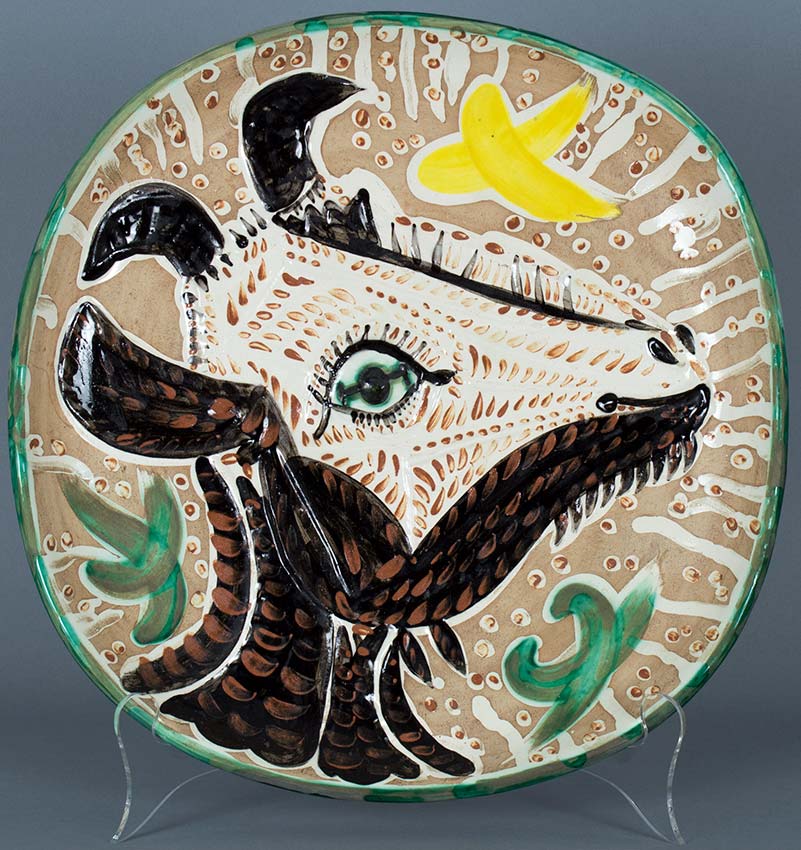
Pablo Picasso, Tête de chèvre de profil (Goat's Head in Profile), 1952 A.R. 153 |
|
| Artist: | Pablo Picasso (1881 - 1973) |
|---|---|
| Title: | Tete de chevre de profil (Goat's Head in Profile), 1952 |
| Reference: | A.R. 153 |
| Medium: | Madoura white earthenware clay round/square dish with decoration in engobes (black, green, yellow, russet, beige patina) under partial brushed glaze |
| Image Size: | DIAMETER: 16 in (41 cm) |
| Edition: | Numbered from the edition of 100. |
| Signature: | This work is stamped with the 'MADOURA PLEIN FEU' and 'EMPREINTE ORIGINALE DE PICASSO' stamps on the reverse. |
| ID # | w-5921 |
Pablo Picasso Tête de chèvre de profil (Goat's Head in Profile), 1952 A.R. 153
Pablo Picasso Tête de chèvre de profil (Goat's Head in Profile), 1952 A.R. 153; Against a dotted white and beige background, the elegant profile of a curious goat emerges. The raised surface of this large-scale dish delineates the outline of the goat's face, yet the painterly applications of color are what truly define the goat's profile. Delicate, short strokes convey the impression of the goat's hair while relief details add a sense of texture and dimension to this impressive piece. Picasso's skill at capturing the expression of his subject shines through, even in his animal subjects, as we sense a mischievous twinkle in this goat's eye.
Created in 1952, Pablo Picasso Tête de chèvre de profil (Goat's Head in Profile), 1952 A.R. 153 is a Madoura white earthenware clay round/square dish with decoration in engobes (black, green, yellow, russet, beige patina) under partial brushed glaze. From the edition of 100, this work is stamped with the 'MADOURA PLEIN FEU' and 'EMPREINTE ORIGINALE DE PICASSO' stamps on the reverse.
Catalogue Raisonné & COA:
Pablo Picasso Tête de chèvre de profil (Goat's Head in Profile), 1952 A.R. 153 is fully documented and referenced in the below catalogue raisonnés and texts (copies will be enclosed as added documentation with the invoices accompanying the final sale of the work):
1. Ramié, Alain. Picasso Catalogue of the edited ceramic works 1947-1971. Madoura: Galerie Madoura, 1988. Listed and illustrated as catalogue raisonné no. 153 on pg. 85.
2. A Certificate of Authenticity will accompany this work.
Subject Matter: Goat
