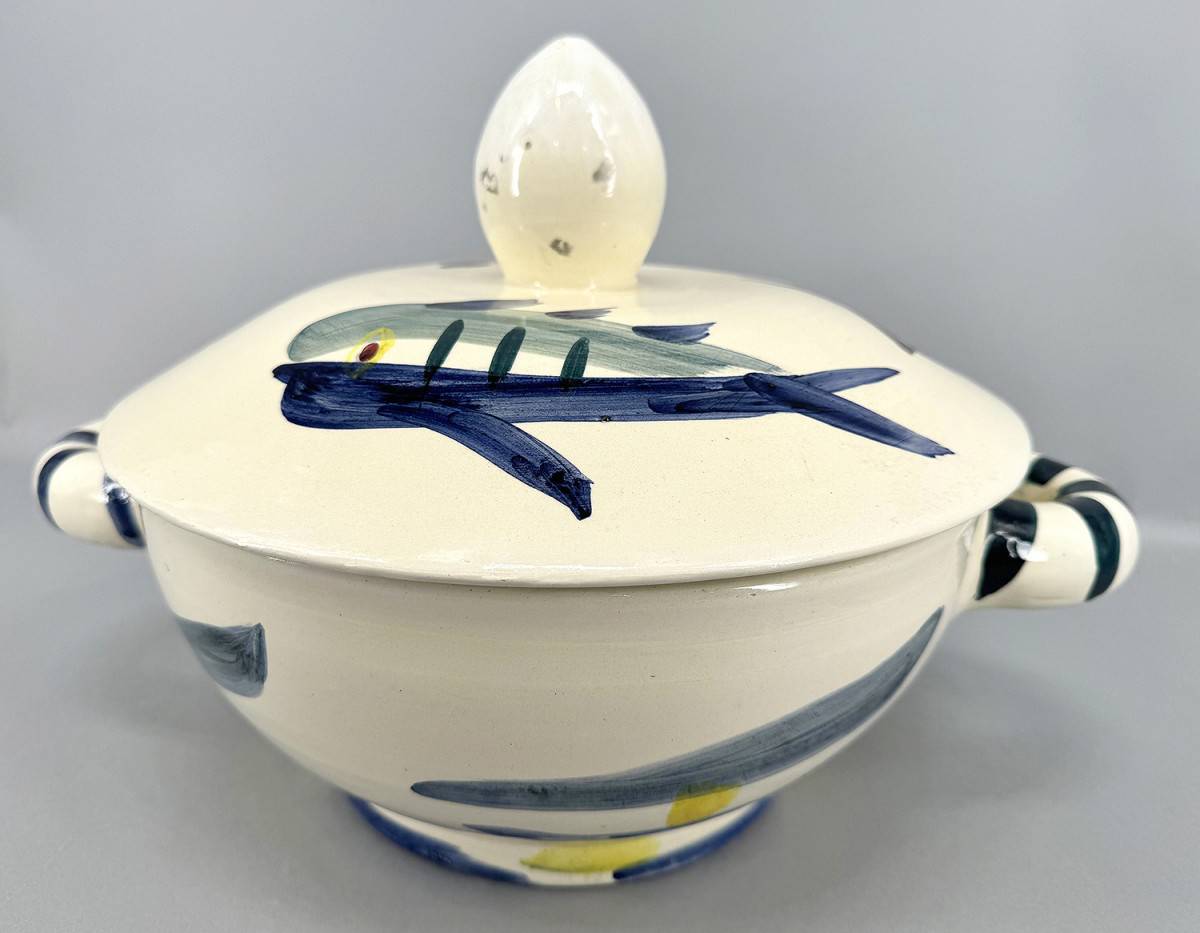
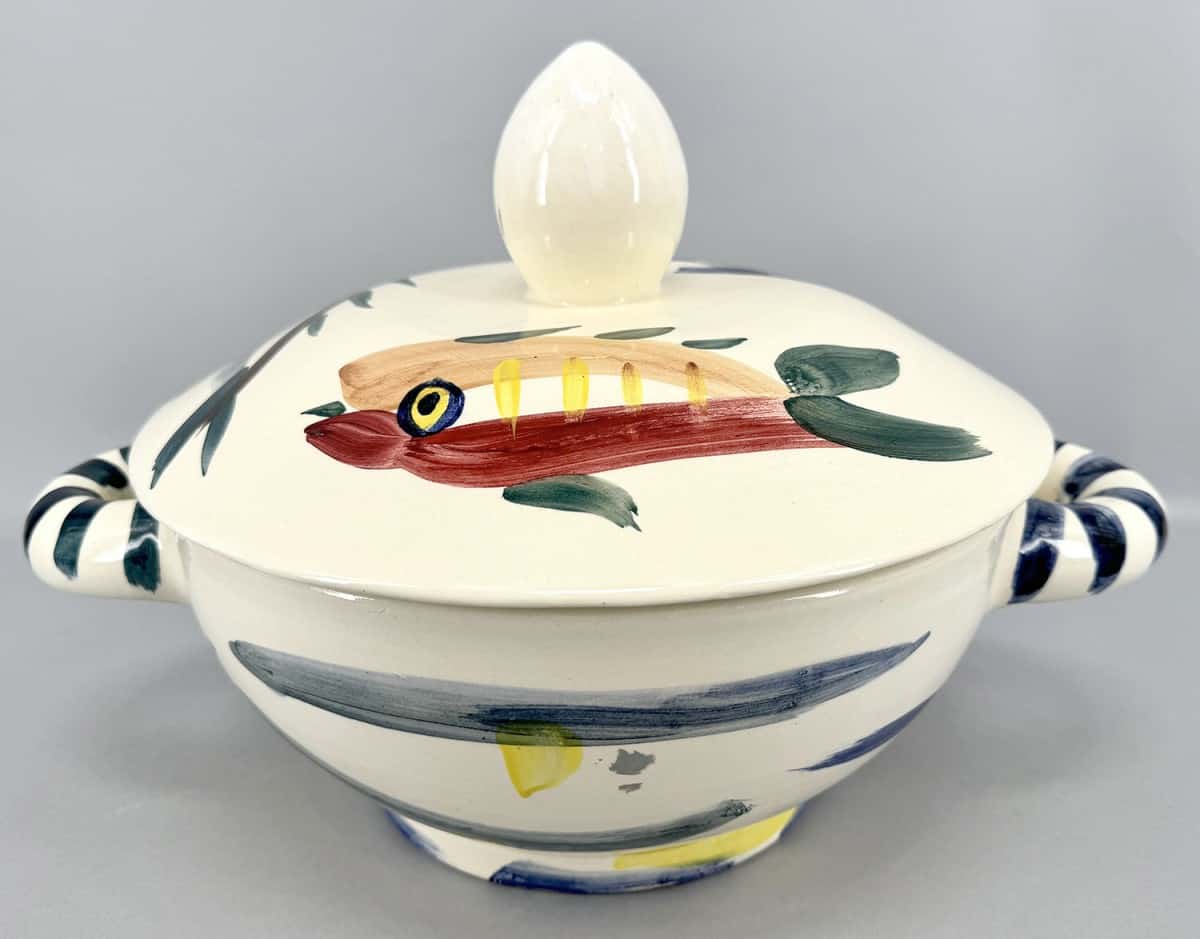
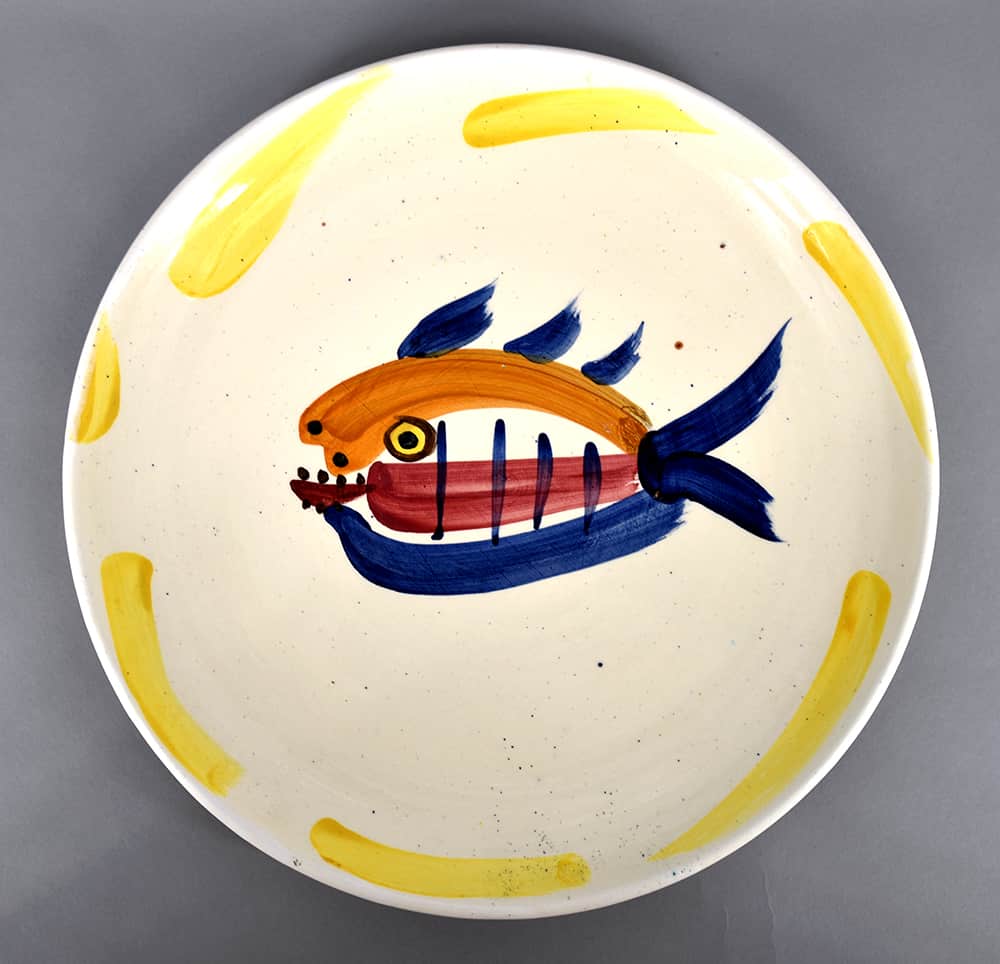
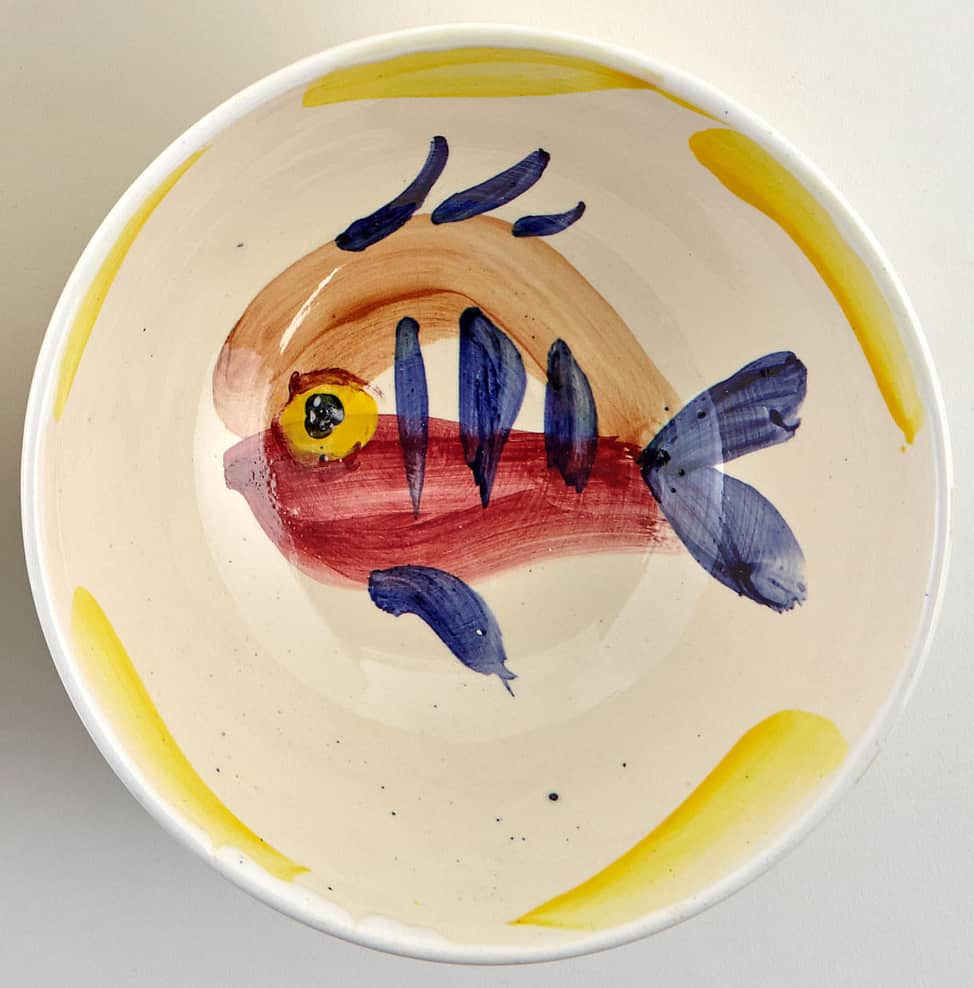
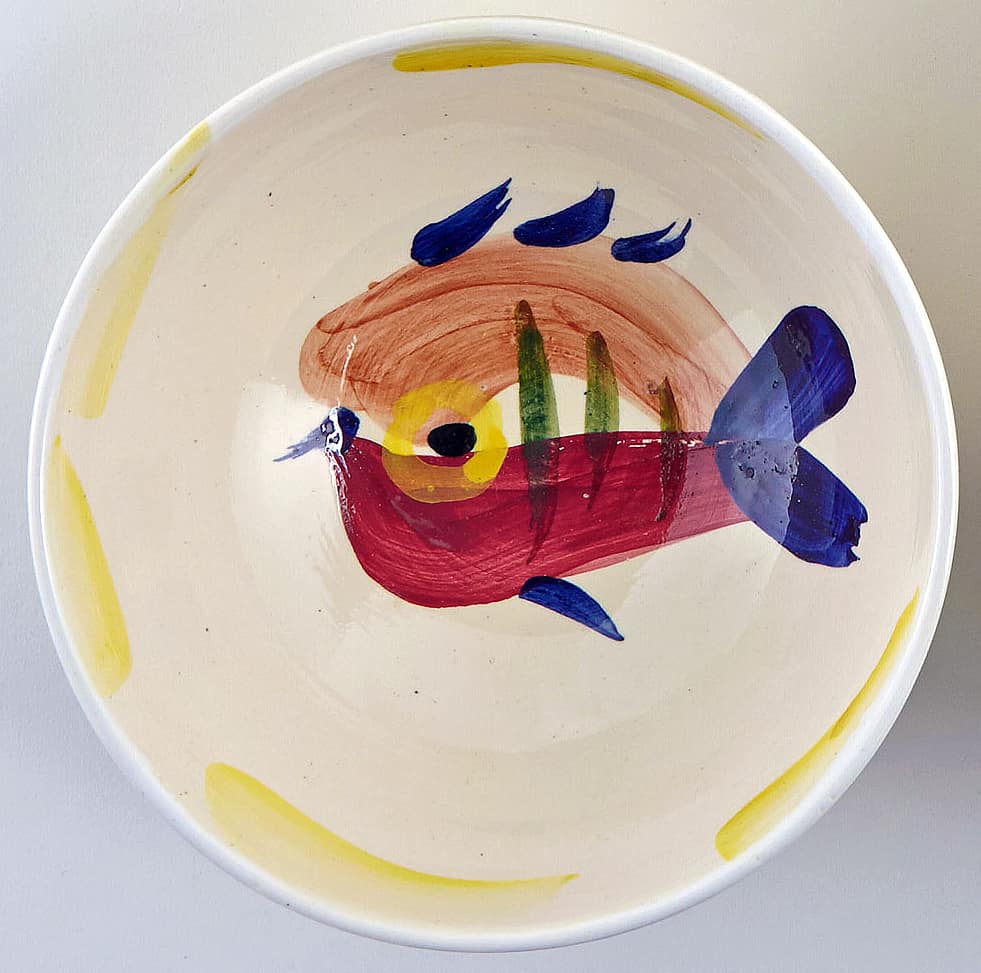
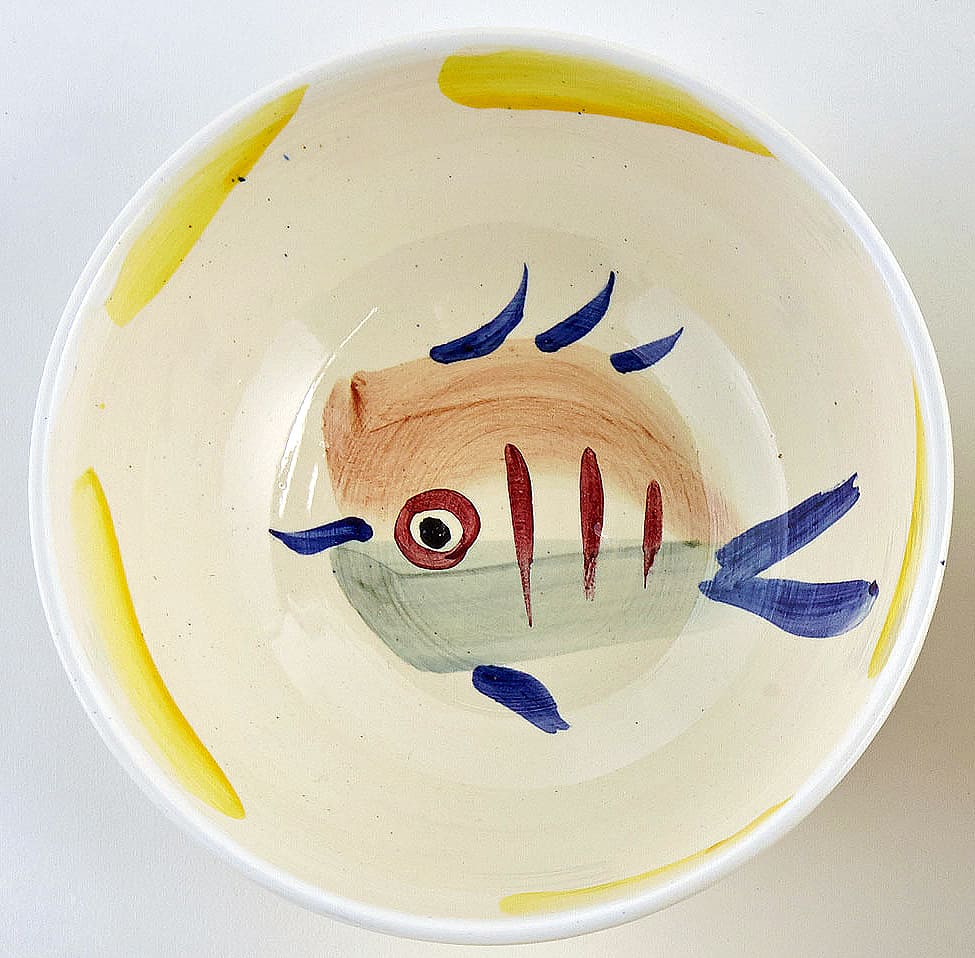
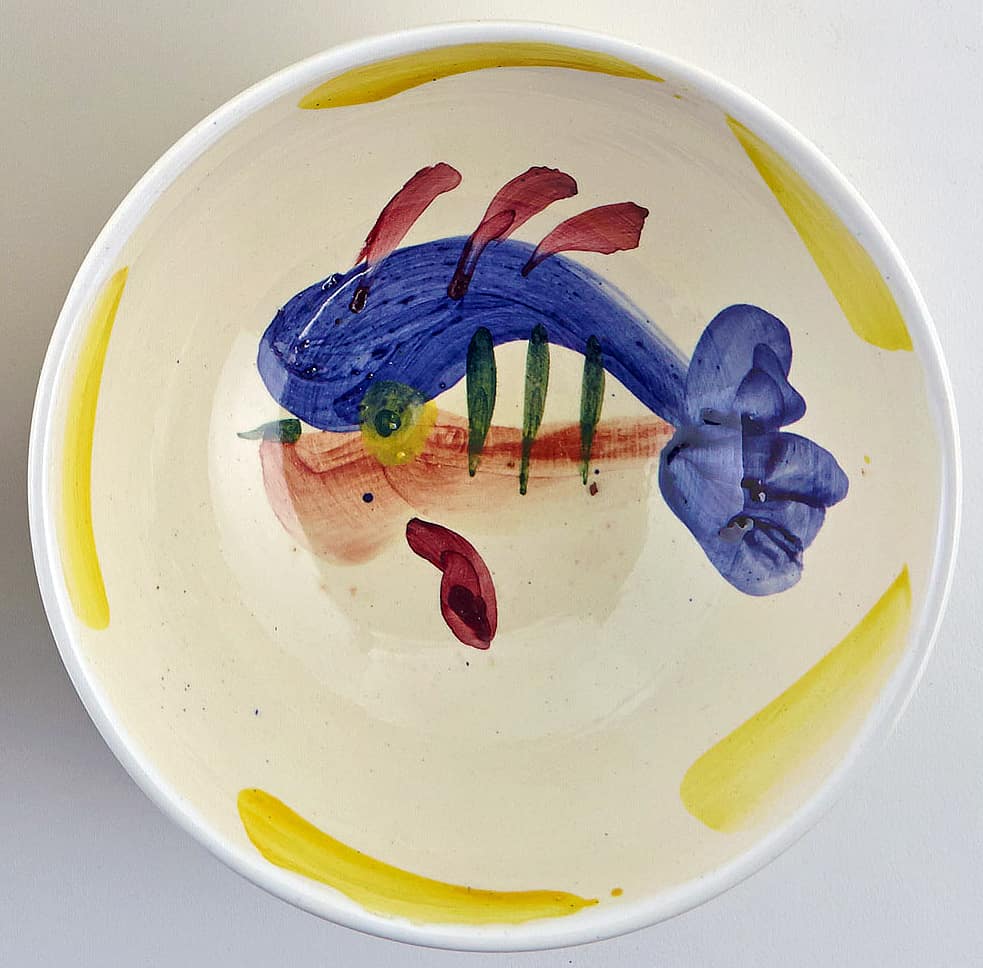
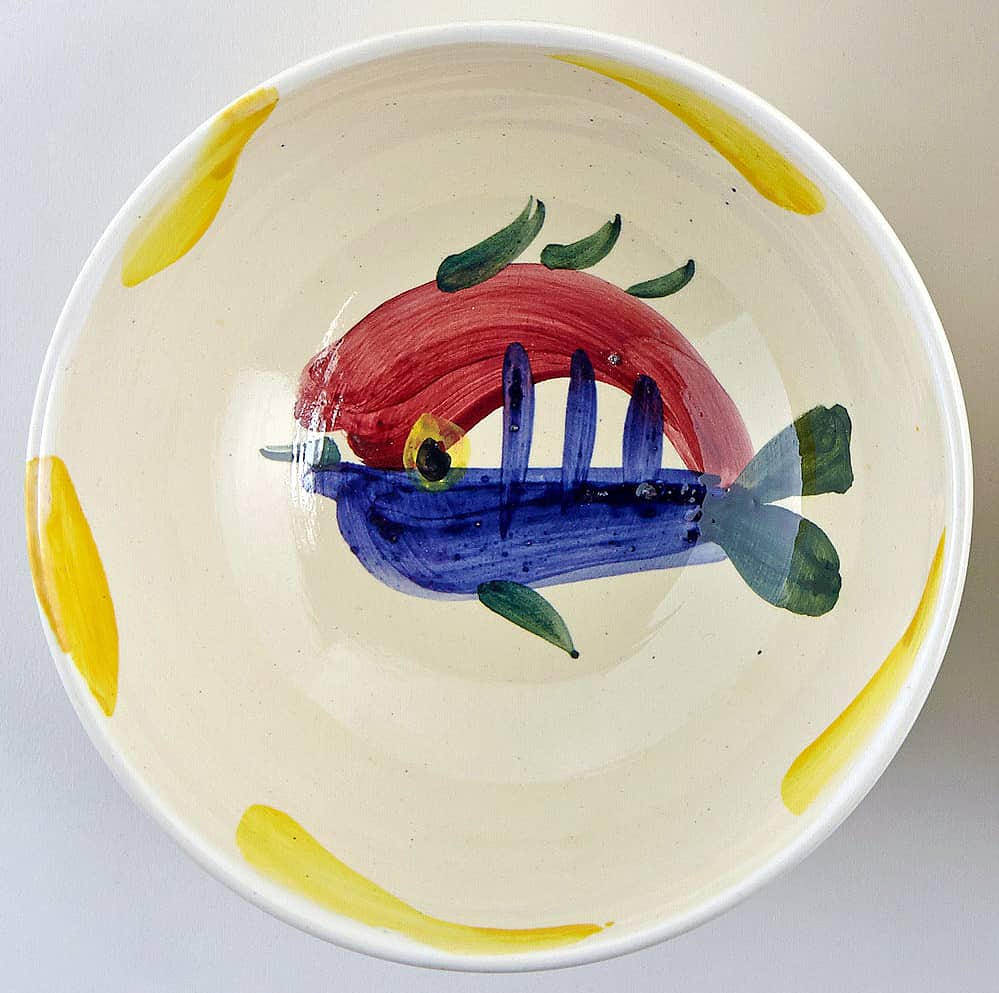
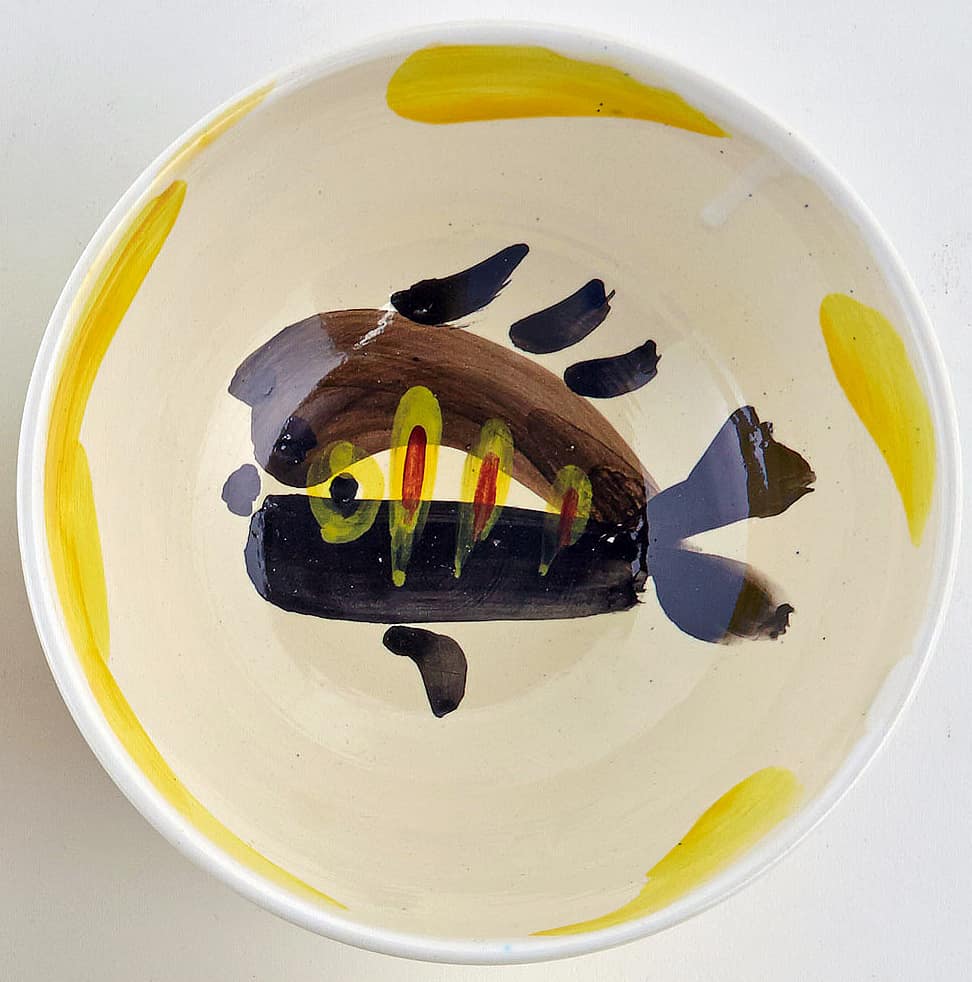
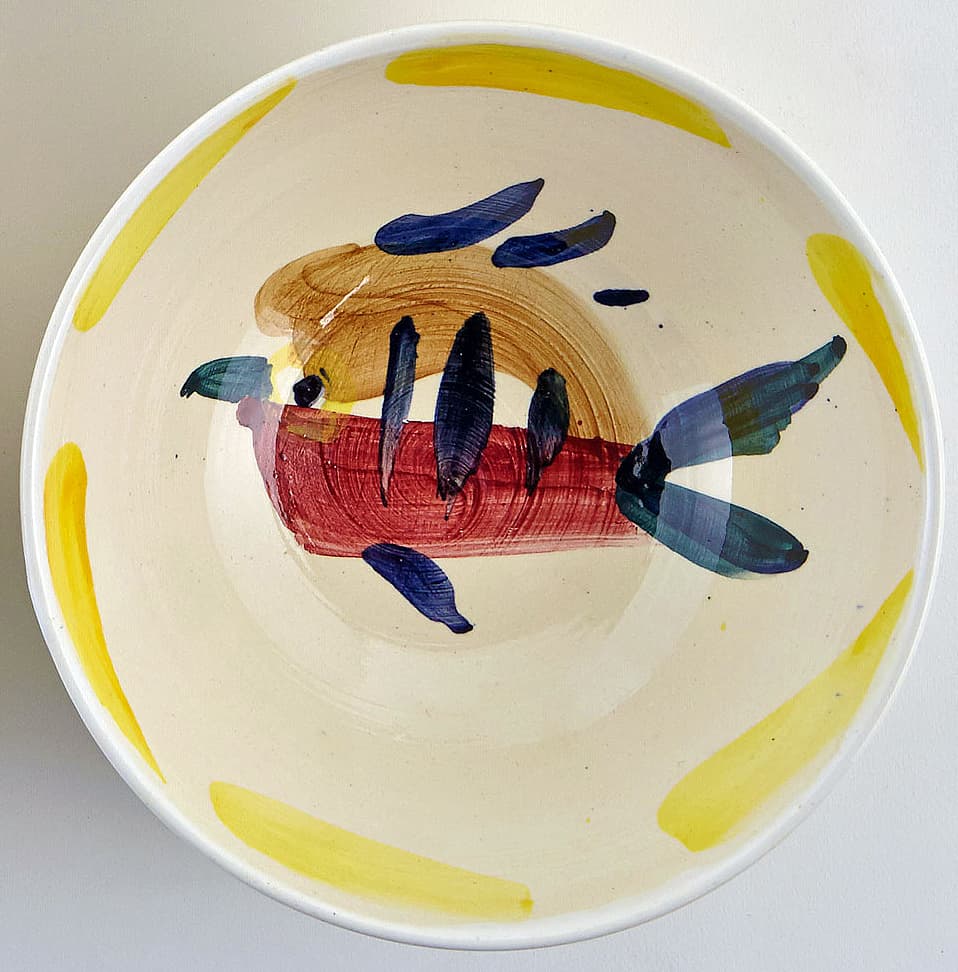
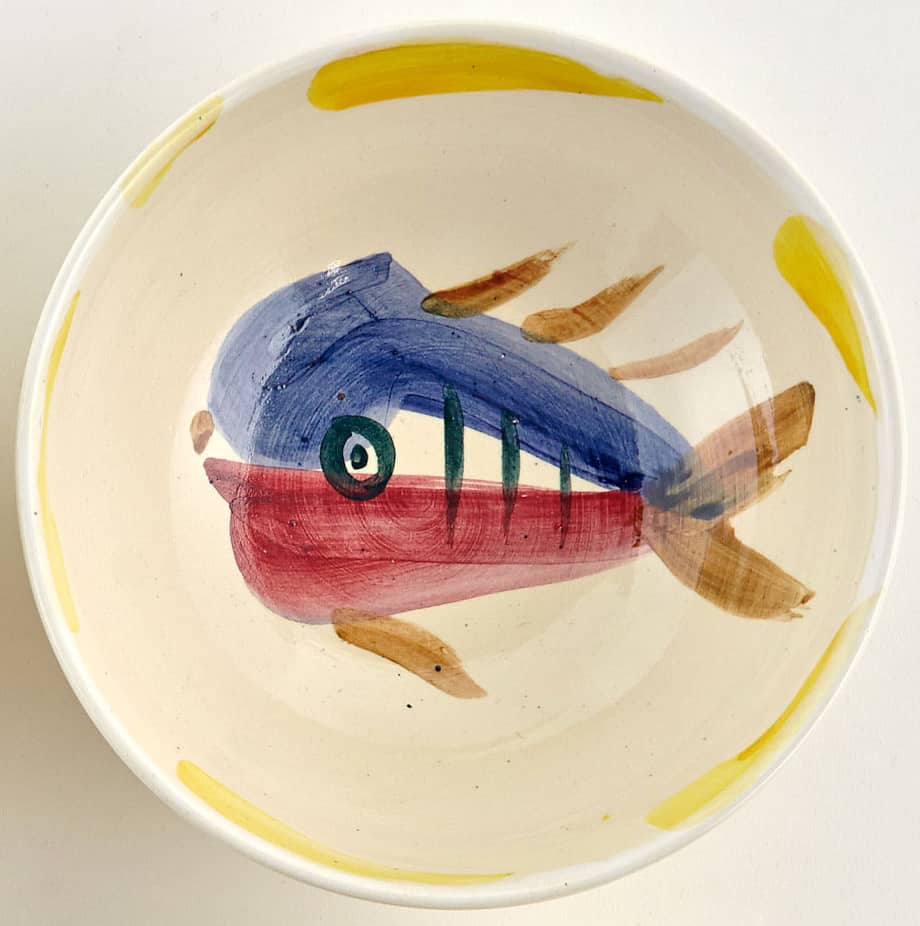
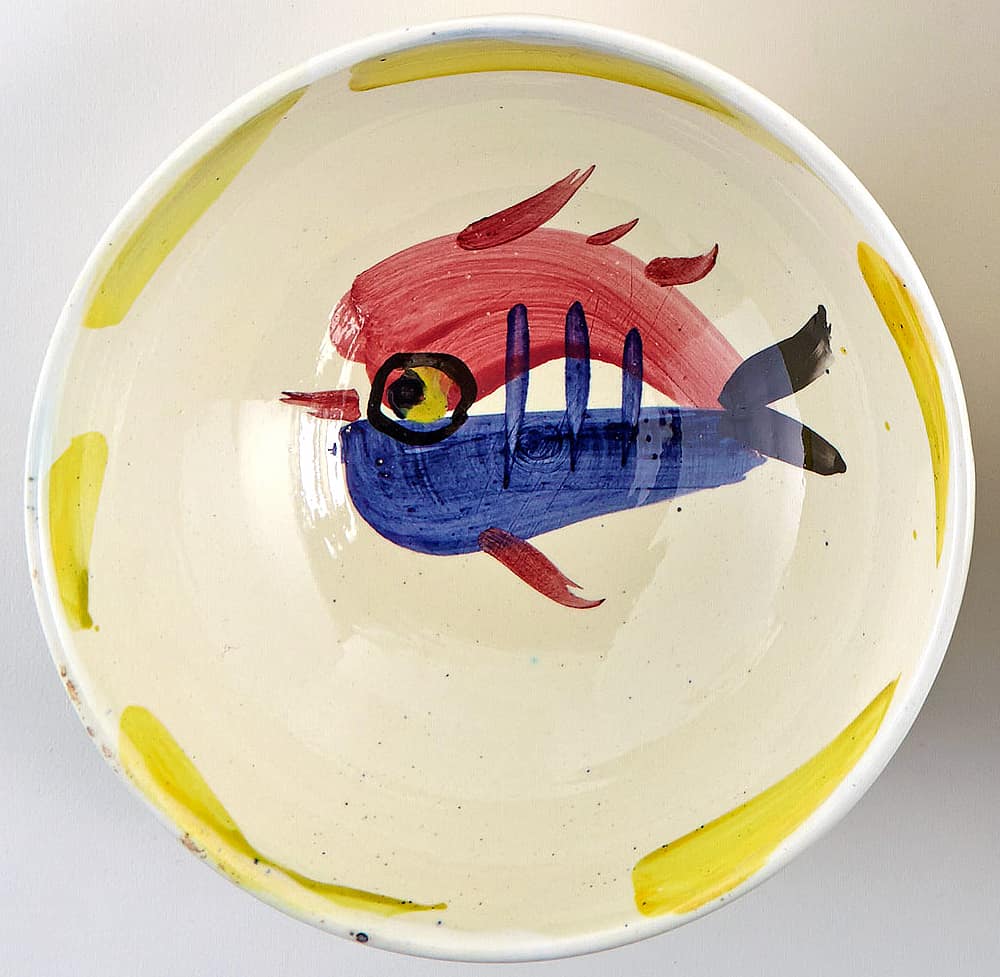
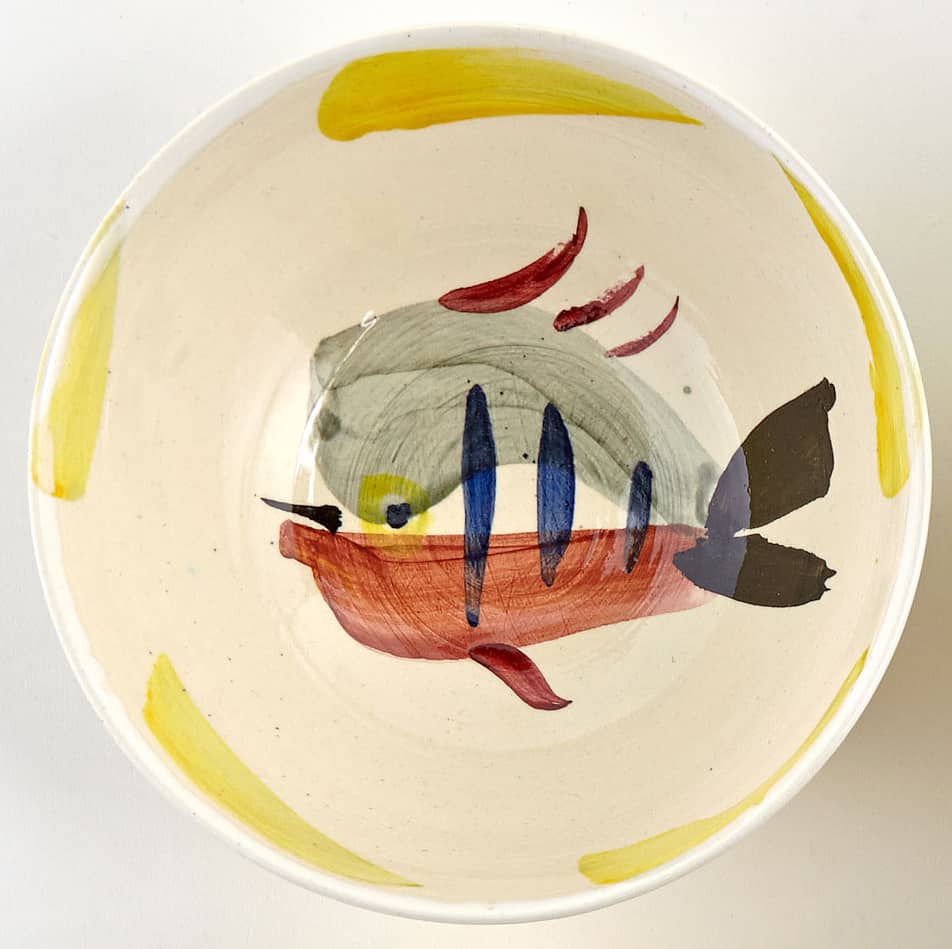
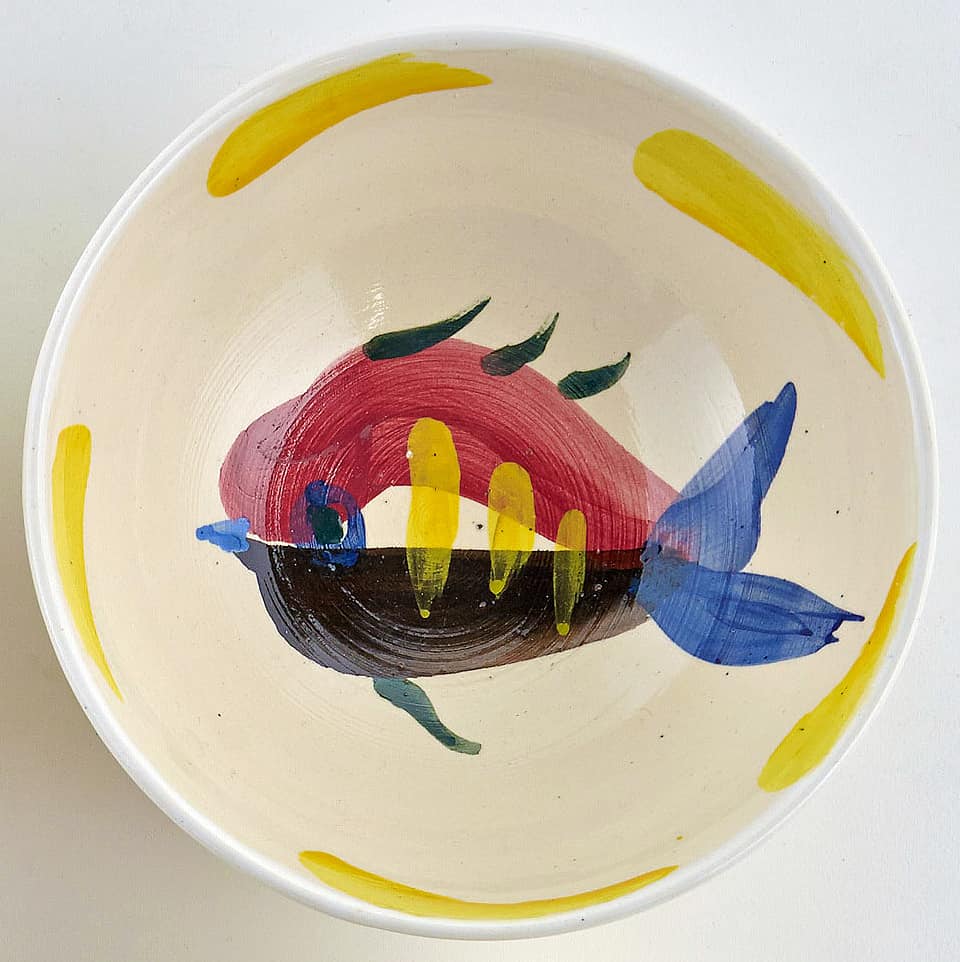
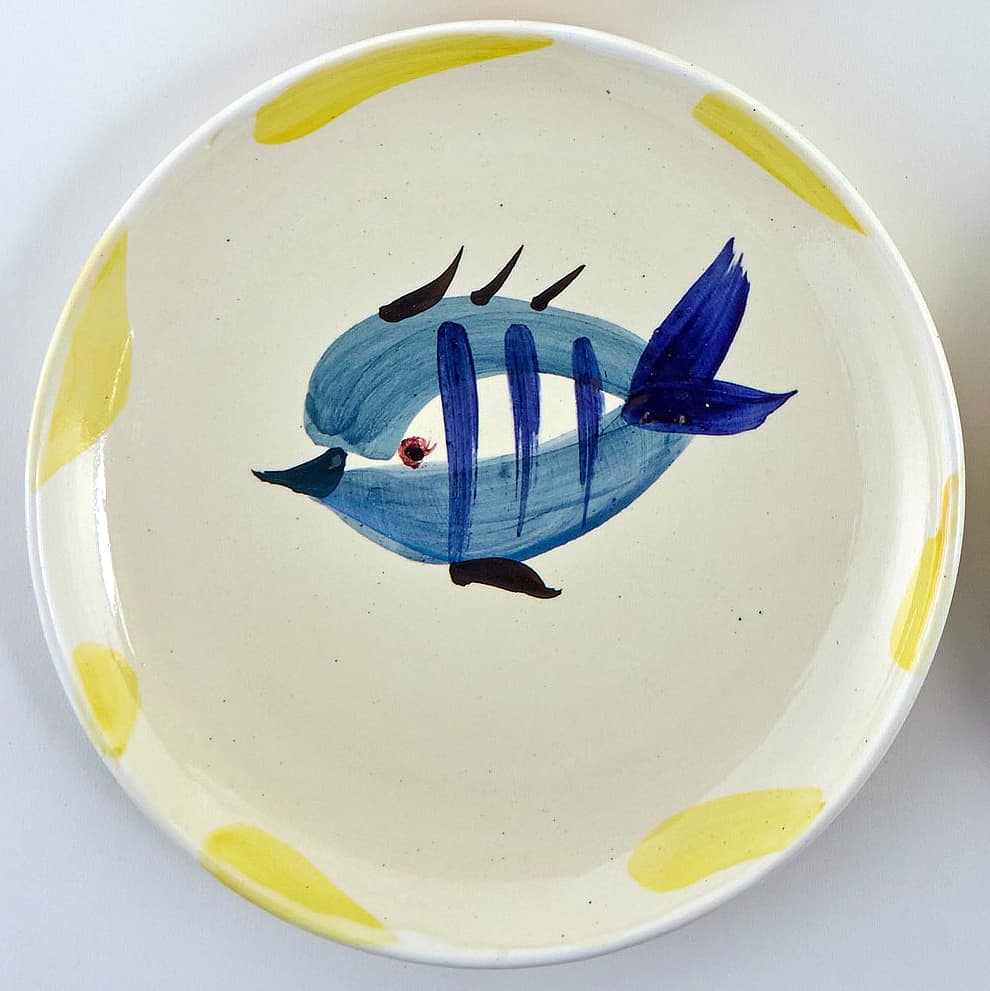
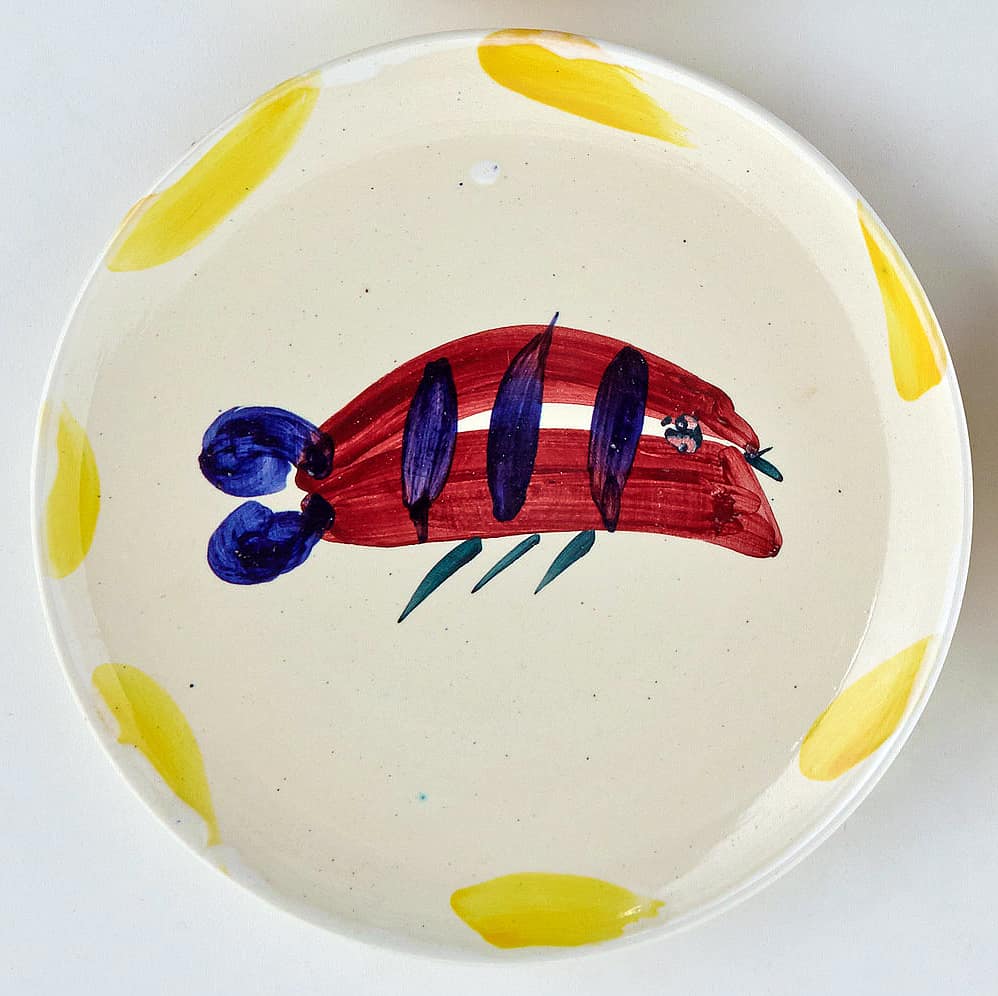
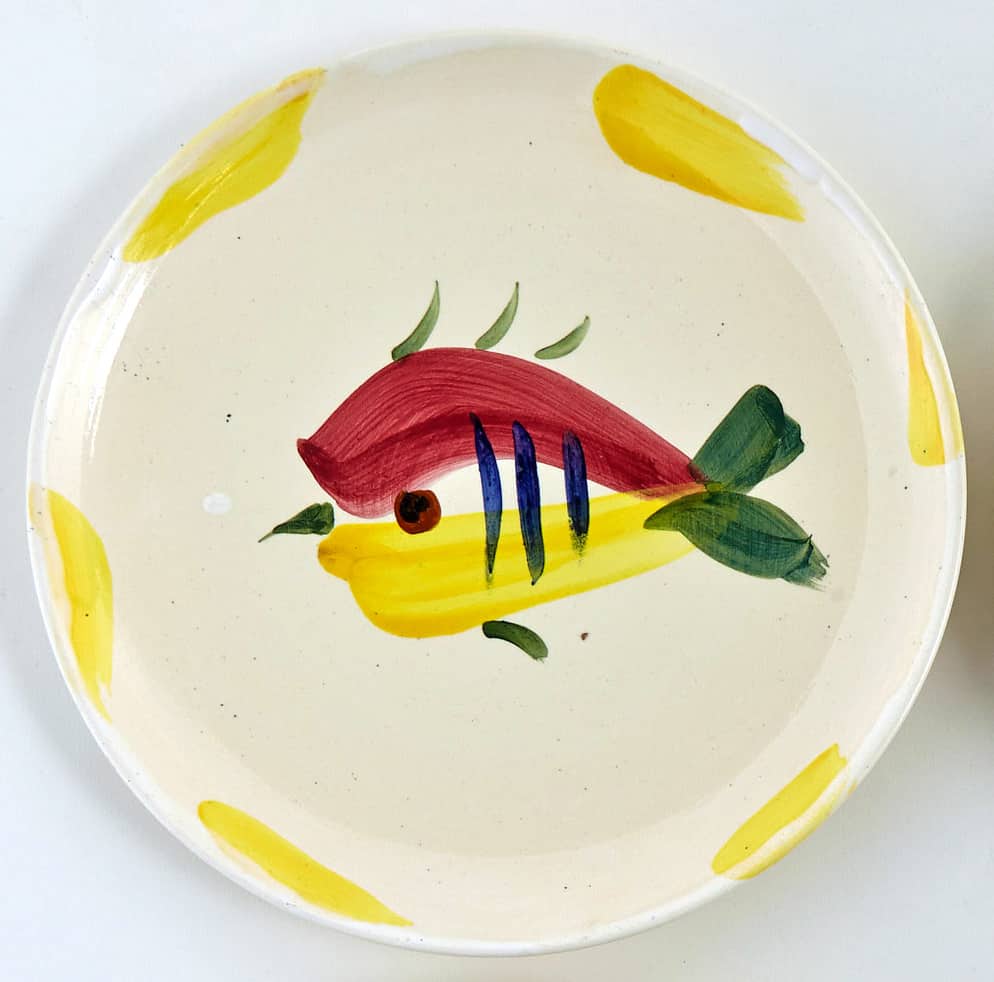
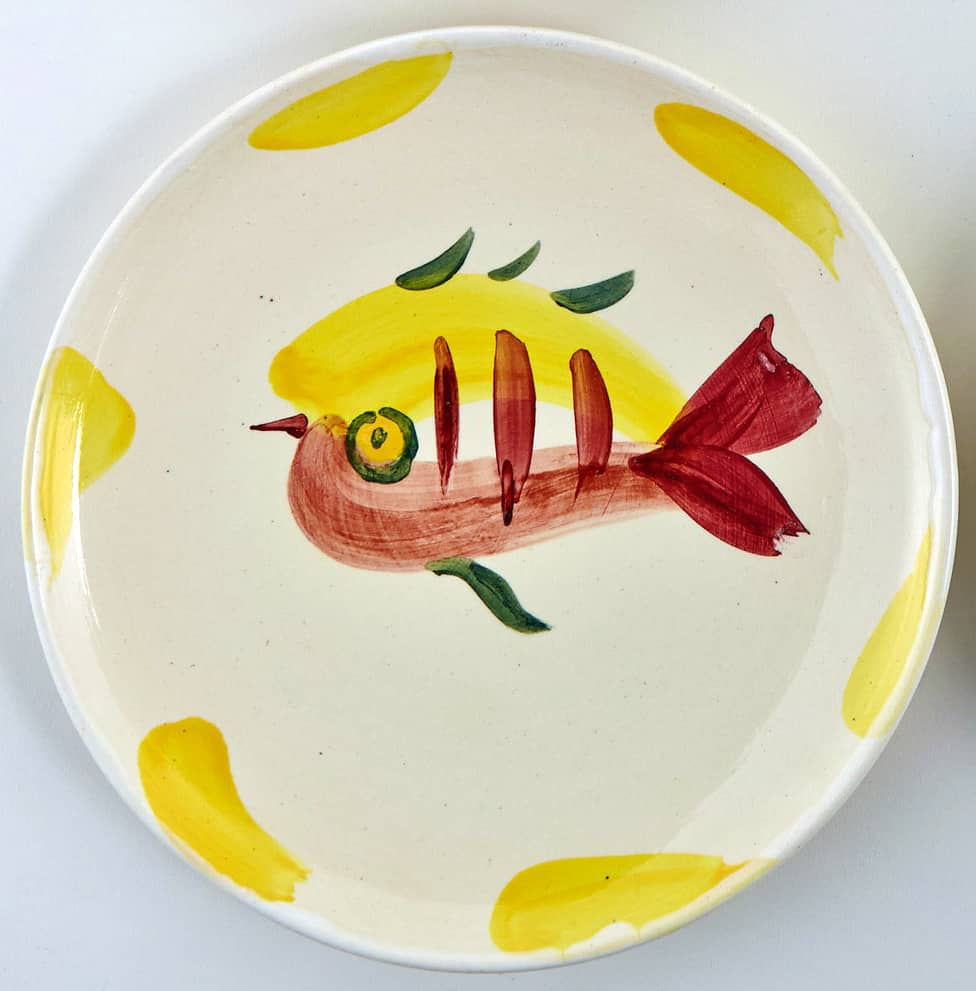
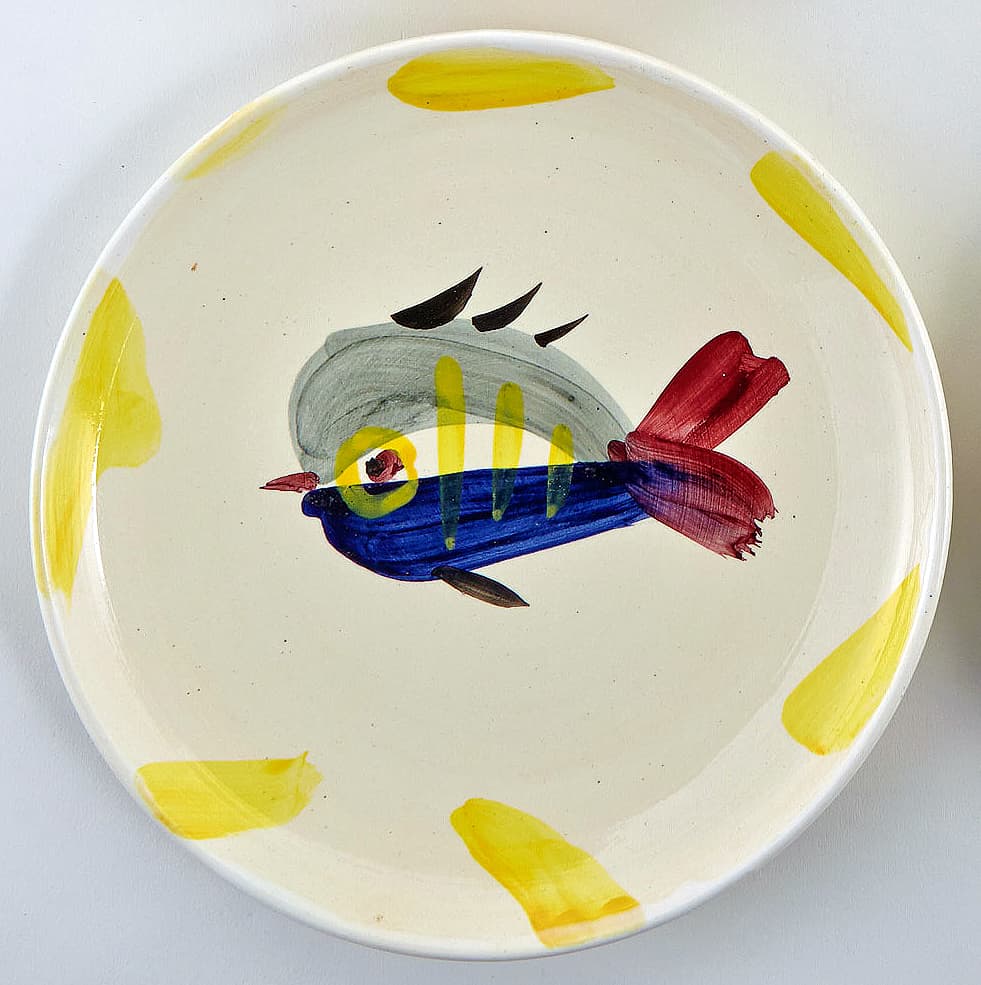
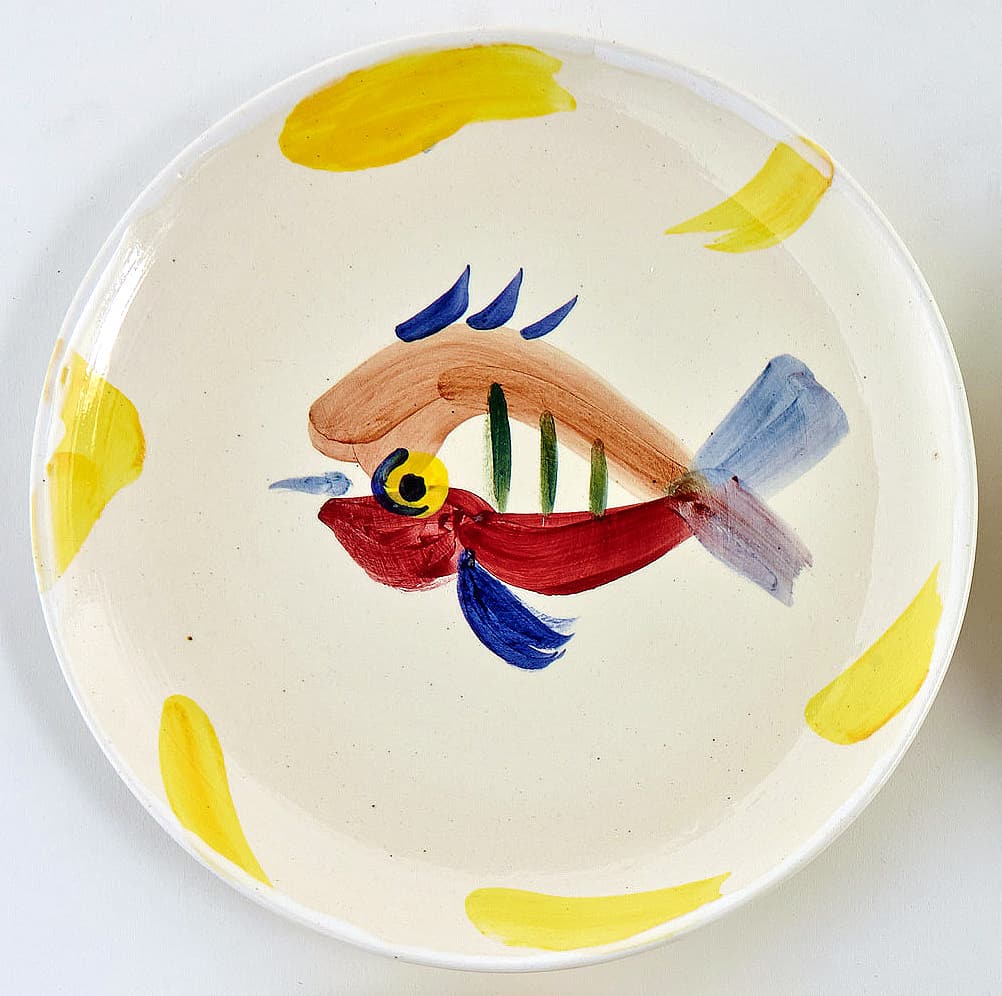
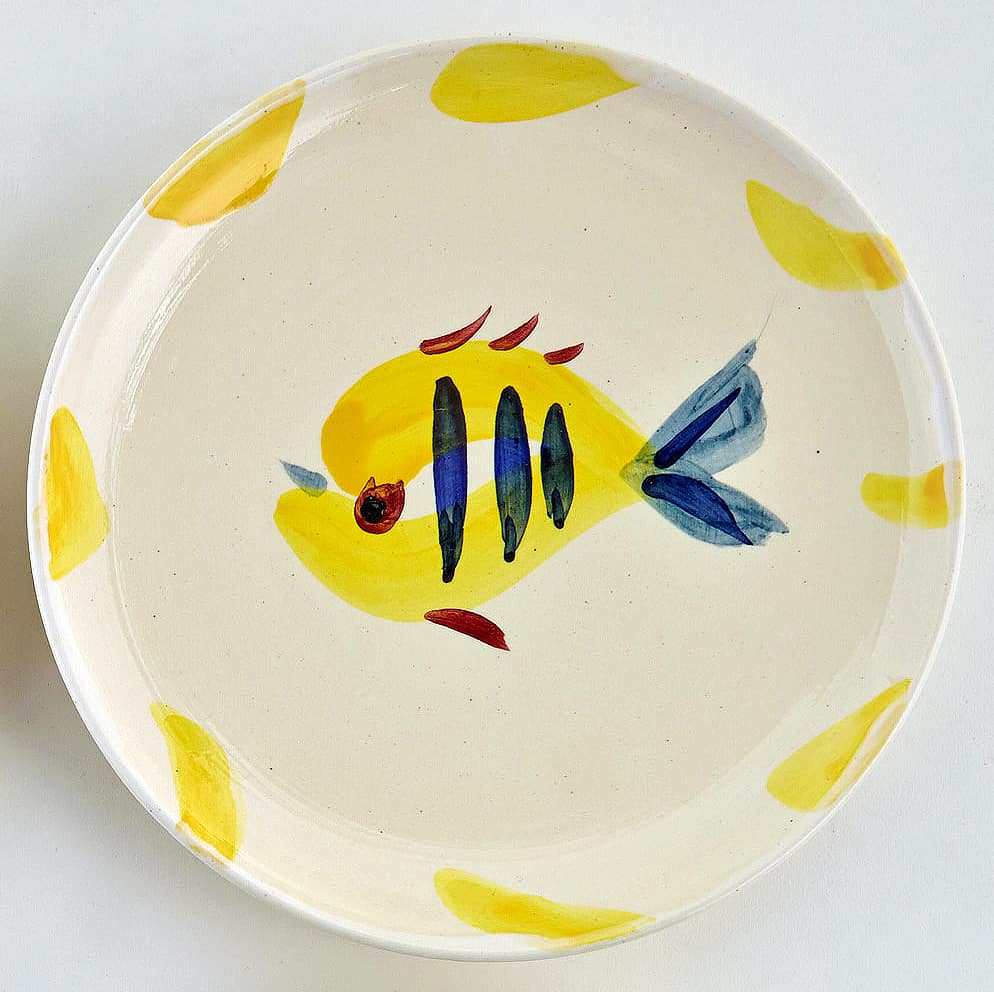
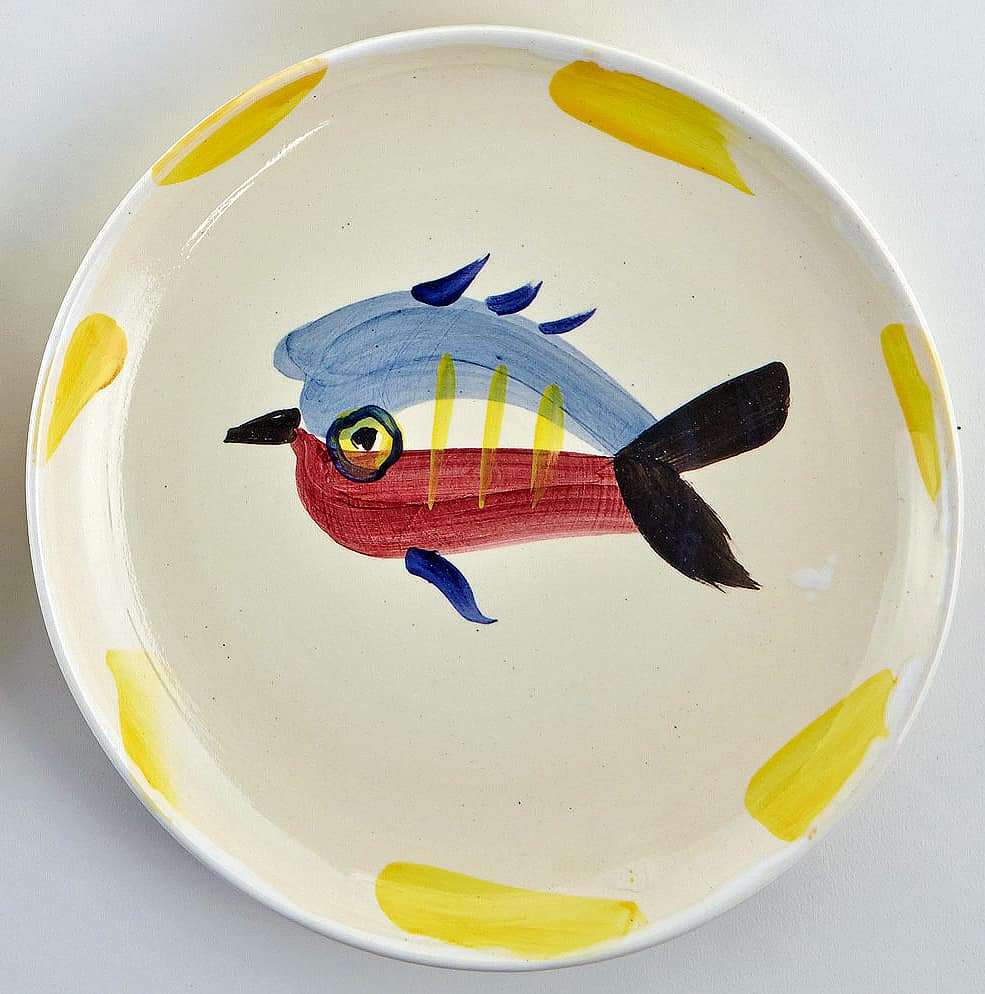
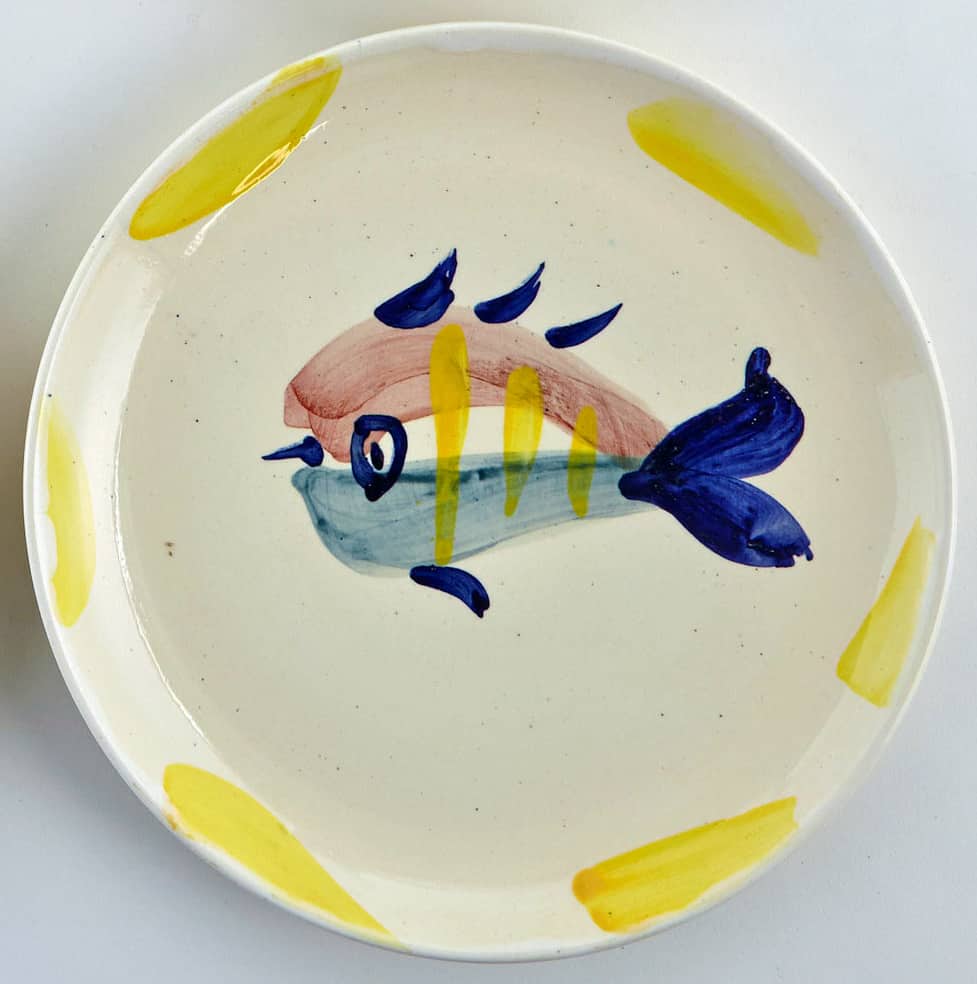
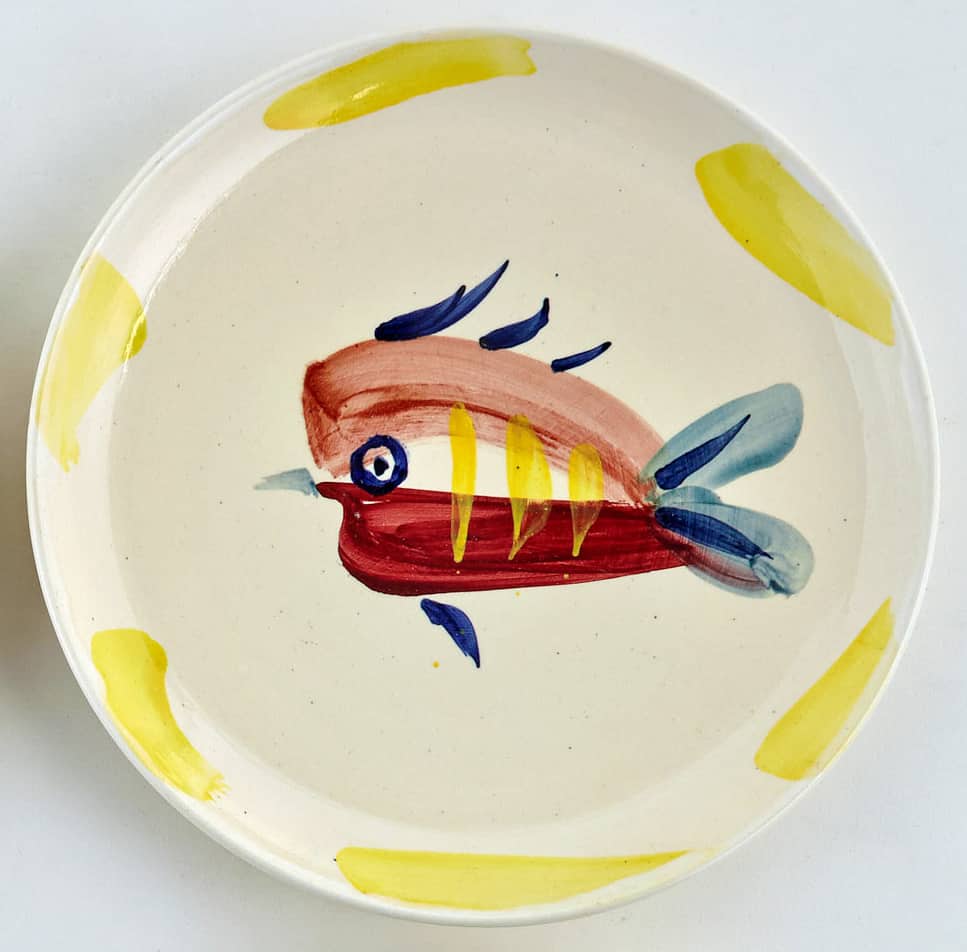
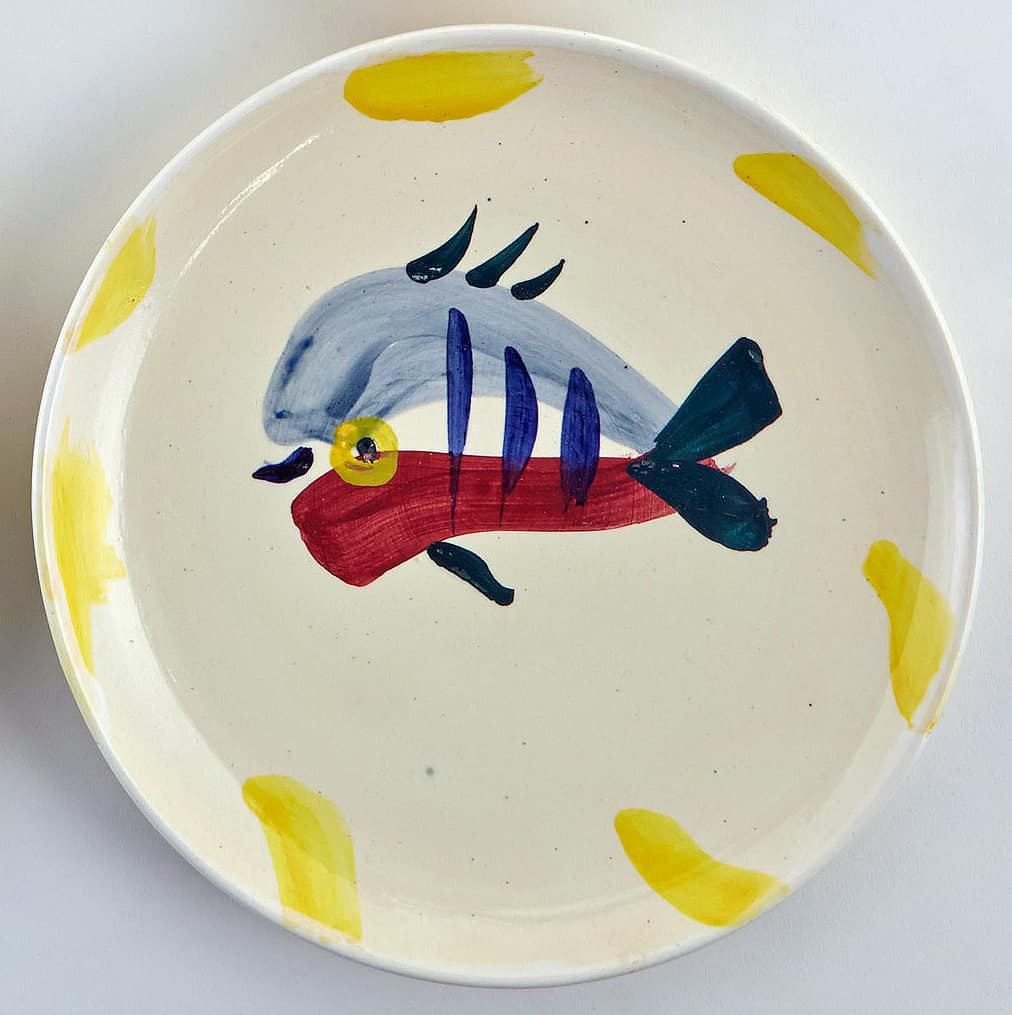
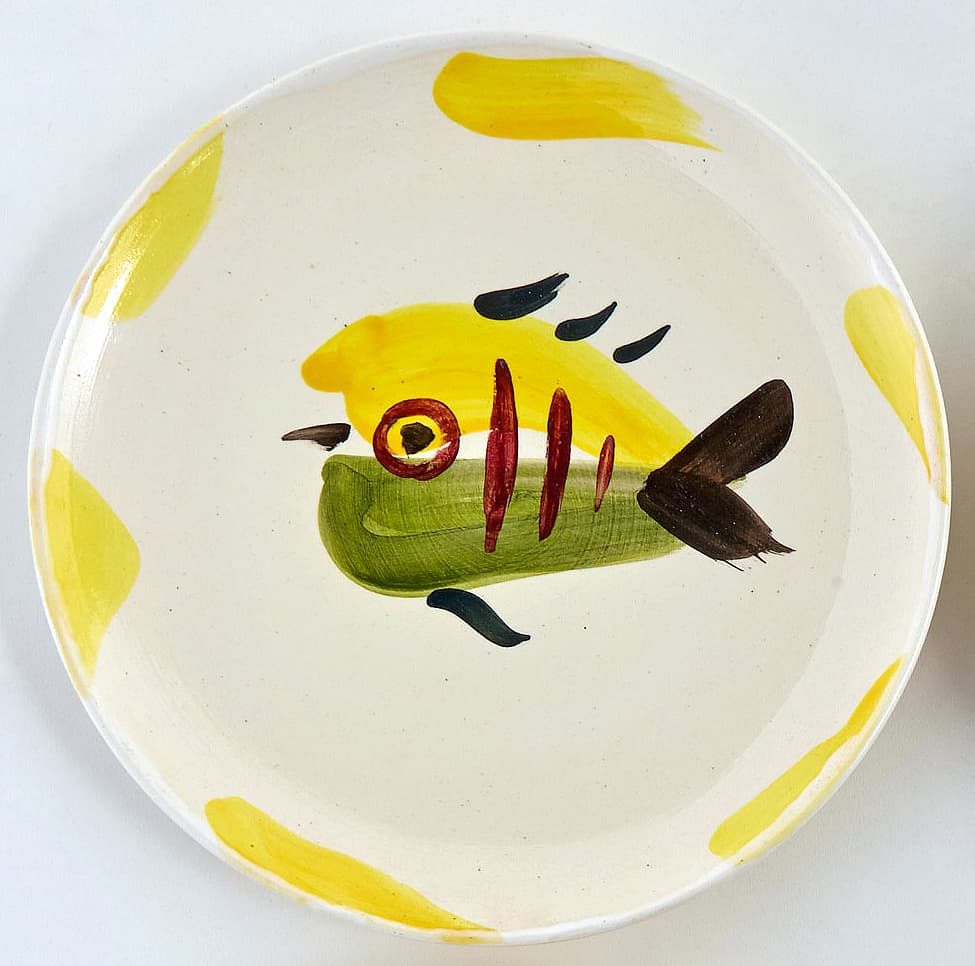
Pablo Picasso, Service poisson (“Fish” Service) Set of 26 ceramics, 1947 |
|
| Artist: | Pablo Picasso (1881 - 1973) |
|---|---|
| Title: | Service poisson (“Fish” Service) Set of 26 ceramics, 1947 |
| Reference: | A.R. 3-28 |
| Series: | Service Poisson |
| Medium: | Full set of 26 madoura tureen of white earthenware clay with decoration in engobes and oxides (yellow, red, blue, green, black) under glaze. |
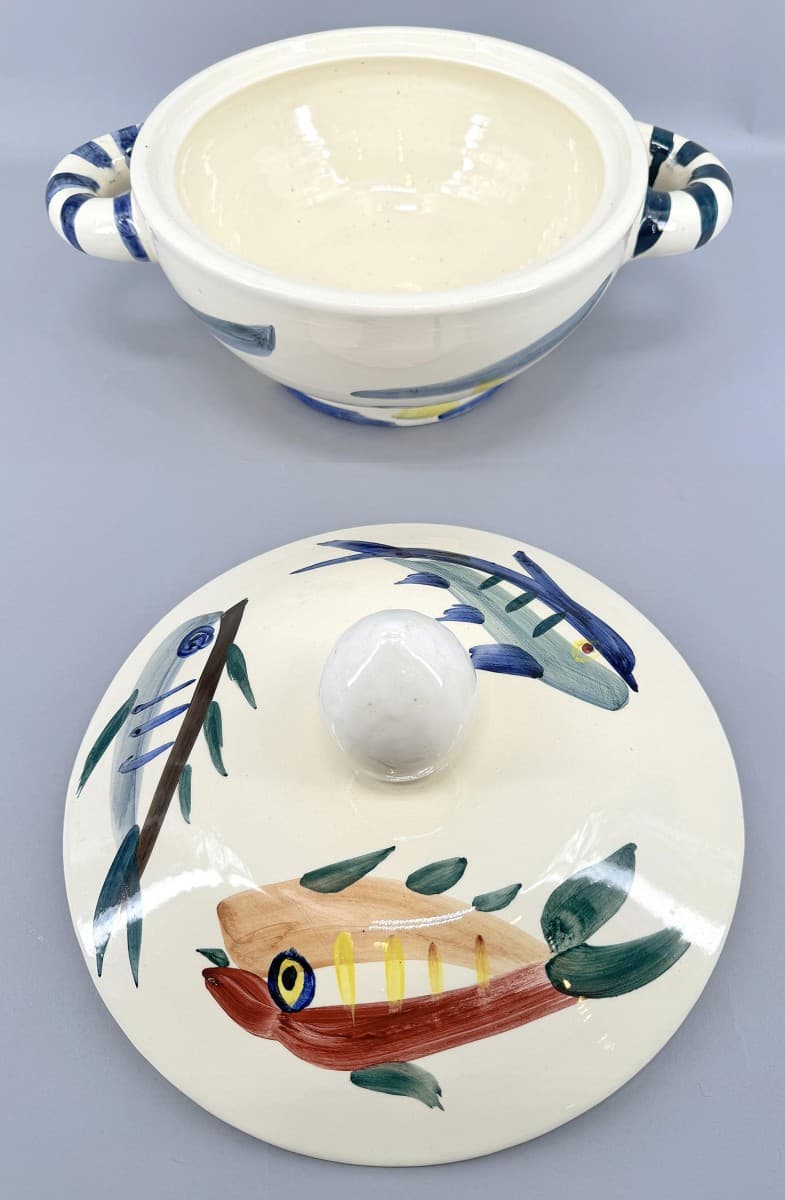
| Image Size: | TUREEN DIMENSIONS: 10 in x 16 in x 11 1/4 in (25.4 cm x 40.6 cm x 28.5 cm) |
| Sheet Size: | PLATE DIAMETER: 9 in (22.9 cm) |
| Framed Size: | BOWL DIAMETER: 7 7/16 in (19 cm) |
| Edition: | This work is from the edition of 300. |
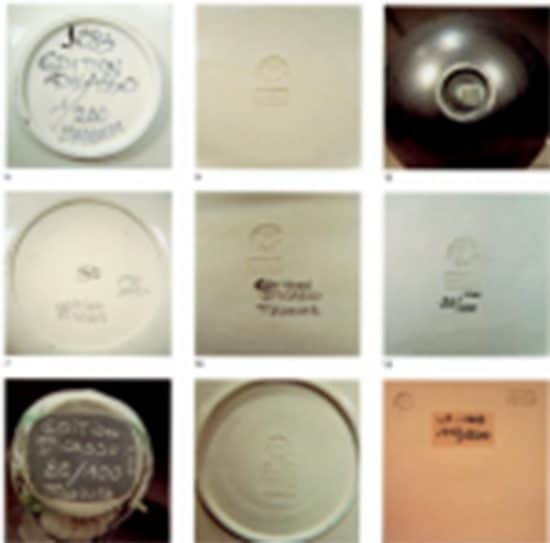
| Signature: | This work is inscribed 'EDITION 45 PICASSO | D'APRÈS PICASSO | MADOURA | GR' in black ink on the underside. |
| ID # | w-8355 |
|
$310,000
|
|
"Service Poisson" (meaning "Fish Service") stands out as a quintessential example of Picasso's playful yet profound engagement with this medium. Conceived in 1947, this series is not merely a collection of individual dishes but a comprehensive dining set. It embodies Picasso's innovative approach to functional art, transforming utilitarian objects into works of significant aesthetic and artistic value. The "Service Poisson" is a meticulously documented limited edition, typically comprising 300 sets, which firmly establishes each piece as a collectible artwork rather than a mere utilitarian item.
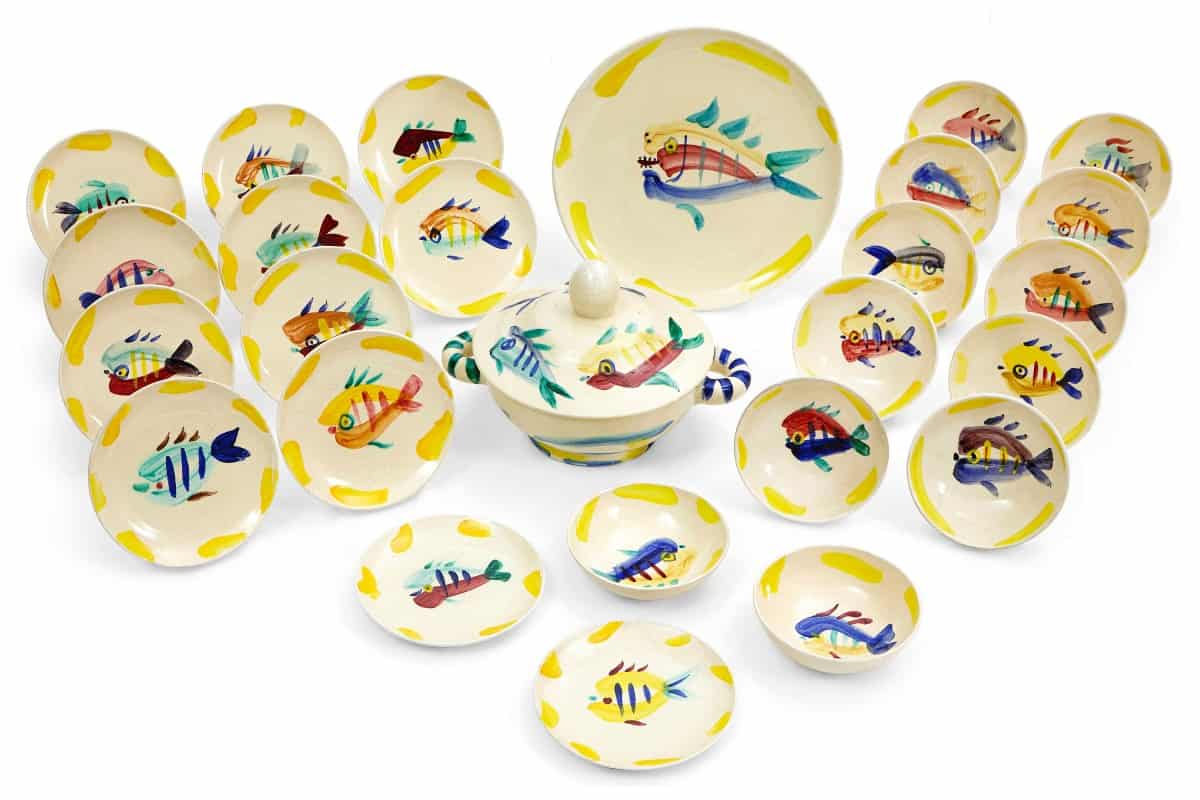
The "Service Poisson" is a complete and cohesive ceramic set, meticulously designed to serve as a comprehensive dining service. A typical suite from this series comprises 26 individual pieces, including one ceramic platter, one ceramic soup tureen, twelve ceramic plates, and twelve ceramic bowls. This structured composition elevates the collection from a mere assortment of decorative items to a fully conceived, albeit artistic, functional dining service.
The pieces are primarily crafted from white earthenware clay, which provides a clean, neutral canvas. This choice of material allows Picasso's vibrant and expressive decorations to stand out prominently, creating a striking visual contrast. The individual bowls within the set are characteristically round, designed with practical dimensions of approximately 7.75 inches (19.7 cm) in diameter and 2.3 inches (5.8 cm) in height. The accompanying plates generally measure about 9 inches (22.9 cm) in diameter. The platter, serving as a central piece for the service, is notably larger, measuring around 38 cm in diameter. A substantial and prominent component of the set is the soup tureen, with approximate dimensions of 10 x 16 x 11.25 inches (25.4 x 40.6 x 28.5 cm), making it a significant focal point of the collection.
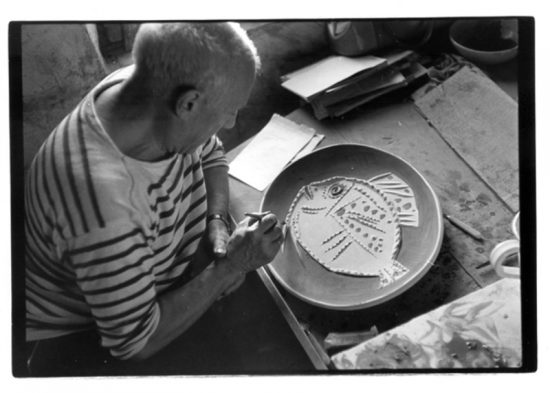
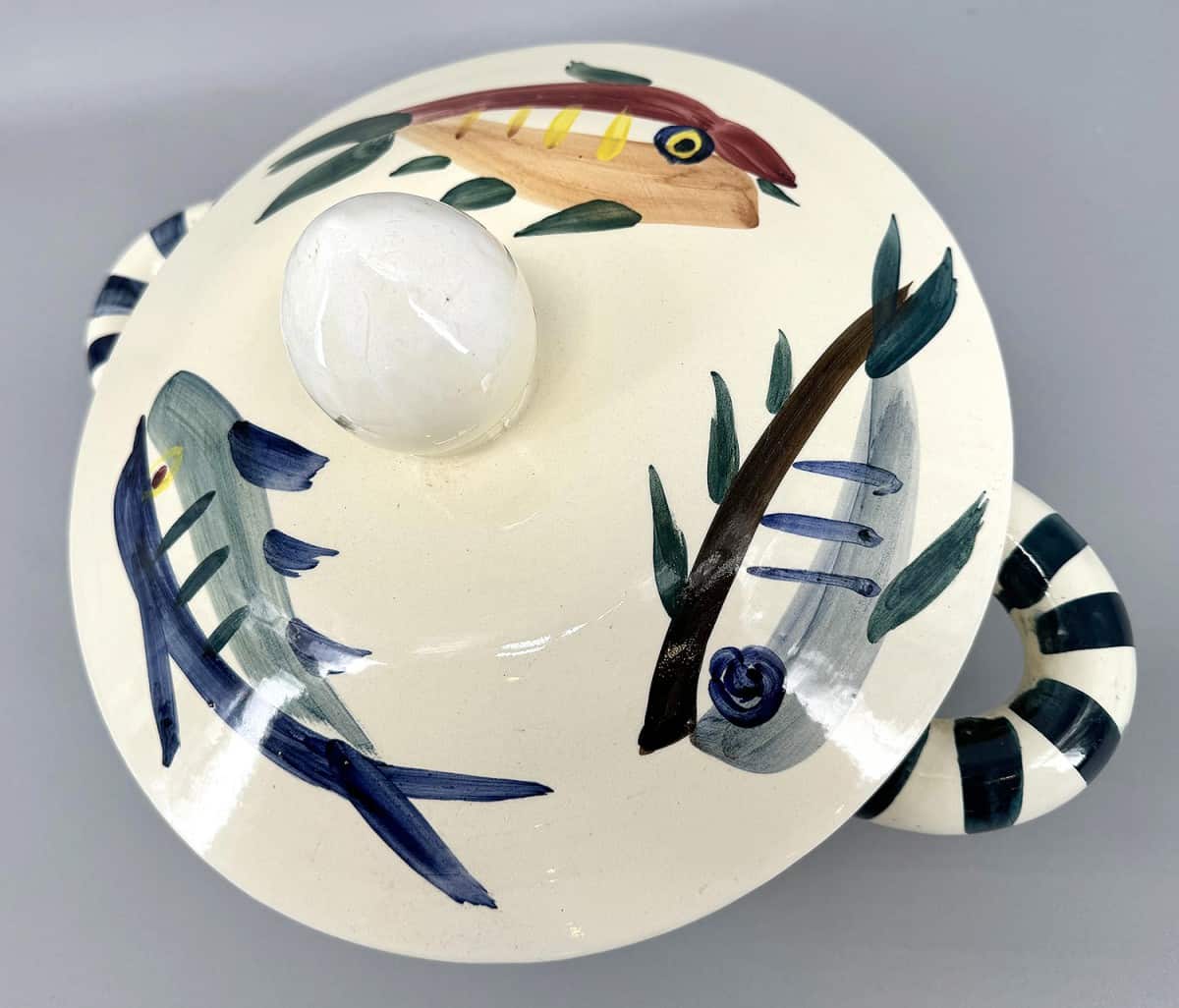
The central decorative element consistently featured across the "Service Poisson" pieces is a stylized fish. This motif is rendered with a distinctly whimsical form and an expressive eye, characteristics that are emblematic of Picasso's broader exploration of Mediterranean themes and his playful artistic sensibility. The fish is often depicted with a "sweeping blue back and an orange belly," contributing to its vibrant and dynamic appearance.
While the core fish motif provides thematic unity for the "Service Poisson," its specific presentation can vary subtly across the different forms within the set. For instance, a common depiction on bowls features a "colorful fish surrounded by five sweeping gestural brush marks in yellow just below the rim." It is important to note that Picasso explored the fish motif extensively throughout his ceramic oeuvre, creating other distinct designs beyond the "Service Poisson" set. Examples include "Poisson Chiné" (A.R. 170), which features a stylized fish rendered in "bold, textured strokes" and "vibrant earthy tones—greens, browns, and creams," or a "spotted yellow and blue fish with an orange eye" (A.R. 168) on a platter adorned with "dots of yellow, green, orange, and blue glaze." These variations underscore Picasso's iterative approach to themes, even within a specific motif, demonstrating his continuous exploration of form and color.
The "Service Poisson" ceramics are distinguished by their vibrant and modernized color palette, a notable departure from the more subdued aesthetics often associated with traditional ceramic art. The decorations are prominently painted in rich hues of cobalt, rose, yellow, brown, and black. Descriptions of the full set further specify the use of engobes and oxides in yellow, red, blue, green, and black, applied under glaze, which collectively create a diverse and lively visual effect. The application of colors "under glaze" is a crucial technical aspect, ensuring the durability and permanence of the decoration while imparting a lustrous, smooth finish. The use of "engobes and oxides" refers to colored clay slips and metallic compounds applied before glazing and firing. This technique allows for a broad spectrum of earthy and vibrant tones, contributing significantly to the characteristic texture, depth, and painterly quality observed in Picasso's ceramic designs.
The designs on the "Service Poisson" ceramics are characterized by a dynamic and expressive application of paint. This includes "sweeping gestural brush marks" and "bold, textured strokes," which imbue the static ceramic forms with a palpable sense of movement, energy, and vitality. This painterly approach, applied directly onto a three-dimensional surface, is a hallmark of Picasso's ceramic work, demonstrating his fusion of painting and sculpture. The apparent playfulness of the fish motif, with its whimsical form and expressive eye, might initially suggest a purely decorative or lighthearted intent. However, a deeper consideration reveals a profound engagement with art history. Picasso consciously drew inspiration from ancient Greek "fish plates," a classical trope originating in Attica and Southern Italy. His reinterpretation of this historical precedent, by "modernizing his take with bright colors" and departing from the traditional terracotta red and black palette, indicates a deliberate and sophisticated artistic dialogue. This infusion of his unique artistic flourish into a venerable tradition adds significant intellectual and historical layers to the aesthetic appeal of the "Service Poisson."
All pieces in the "Service Poisson" set are consistently made of white earthenware clay, serving as the foundational material for these artistic creations. The decoration is described as "hand-painted," indicating a direct artistic touch in the application of the designs, even if the underlying ceramic forms were mass-produced. Picasso's ceramic work was fundamentally a collaborative effort, embodying a symbiotic relationship between the artist and the skilled artisans at Madoura. While Picasso provided the original designs, sculpted models, and applied initial artistic interventions, professional potters at Madoura played a crucial role. They would create the blank ceramic objects for him to work with, and for simpler forms like plates and bowls—which constitute the majority of the "Service Poisson" set—reproductions were typically made using ceramic molds, then meticulously painted by artisans to resemble Picasso's original designs. This partnership was vital, as Madoura provided Picasso with the "necessary infrastructure, materials, and skilled artisans" to translate his ceramic visions into tangible works.
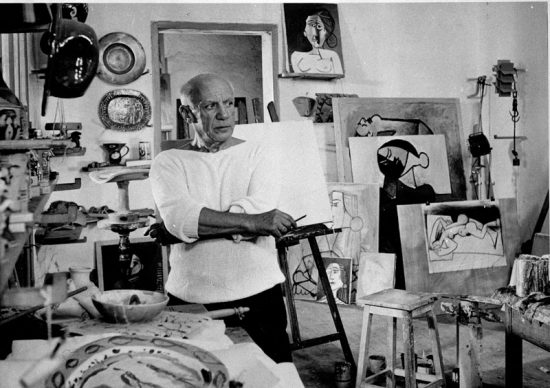
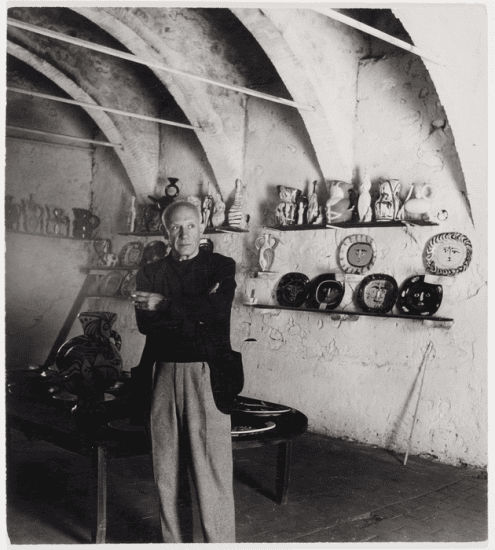
Picasso's collaboration with the Madoura Pottery studio in Vallauris, beginning in 1947, was not a fleeting interest but one of the longest and most fruitful partnerships of his entire career, spanning over 25 years until 1971. This sustained engagement allowed for deep experimentation, the development of new techniques, and a truly vast output of ceramic works. The move to the South of France in the late 1940s and his subsequent deep dive into ceramics at Madoura was a deliberate artistic choice. The Madoura studio provided a unique and highly conducive environment, offering the "necessary infrastructure, materials, and skilled artisans" that Picasso needed to experiment freely. This exceptional resource and collaborative spirit at Madoura enabled Picasso to push artistic boundaries in ceramics and, crucially, even influenced his approach in other mediums like painting and sculpture. The presence and exchange of ideas with other renowned artists who visited Madoura, such as Marc Chagall, Fernand Léger, and Jean Cocteau, further underscore a vibrant, experimental, and mutually enriching atmosphere during this period.
Picasso was profoundly "intrigued by the possibilities of ceramic art," perceiving it as an "exciting medium that allowed him to explore new forms and techniques." Despite his lack of formal training in pottery, he "threw himself into this new style," initially experimenting with simpler forms such as decorated plates and bowls—like those found in the "Service Poisson"—before advancing to more complex pitchers, vases, and sculptures incorporating abstract organic and zoomorphic shapes.
Pablo Picasso (1881-1973), a monumental figure in 20th-century art, widely celebrated for his revolutionary contributions to painting and sculpture, extended his boundless creative energy into the realm of ceramics. His engagement with pottery, which commenced in 1947, marked a significant and remarkably prolific chapter in his career. This period, primarily centered at the Madoura Pottery studio in Vallauris, a town nestled in the South of France, spanned over 25 years, resulting in the creation of thousands of unique ceramic pieces and over 600 distinct limited-run patterns. This deep and sustained immersion into an unfamiliar medium, despite having no prior formal experience in pottery, underscores Picasso's unique artistic audacity. His willingness to experiment and push the boundaries of ceramic art from a position of no prior training in the craft demonstrates a fundamental aspect of his genius: his boundless curiosity and his readiness to transcend traditional disciplinary boundaries. For Picasso, the chosen medium consistently served as a vehicle for his artistic vision rather than a constraint, challenging the conventional hierarchical separation of "fine art" from "craft" and contributing to the re-evaluation and elevation of ceramic art within the broader fine art discourse.
Catalogue Raisonné & COA:
Pablo Picasso ceramic Service Poisson (“Fish” Service), 1947 is fully documented and referenced in the below catalogue raisonnés and texts (copies will be enclosed as added documentation with the invoices that will accompany the sale of the work).