
Details
| Artist: | Pablo Picasso (1881 - 1973) |
|---|---|
| Title: | Nature morte au citron et un pichet rouge (Still Life with Lemon and Red Pitcher), c. 1960 |
| Medium: | Color Aquatint on BFK Rives Paper |
| Image Size: | 16 1/4 in x 13 in (41.1 cm x 32.2 cm) |
| Sheet Size: | 25 7/8 in x 19 3/4 in (65.8 cm x 50.4 cm) |
| Framed Size: | 29 in x 35 in |
| Edition: | Numbered from the edition of 300 in pencil in the lower left; with the blindstamp of the printer and publisher, Atelier Crommelynck, Paris. |
| Signature: | This work is hand-signed by Pablo Picasso (Malaga, 1881 - Mougins, 1973) in pencil in the lower right margin. |
| Price: |
|
| Availability | This Pablo Picasso Aquatint is for sale |
| Item # | W-8857 |
Historical Description
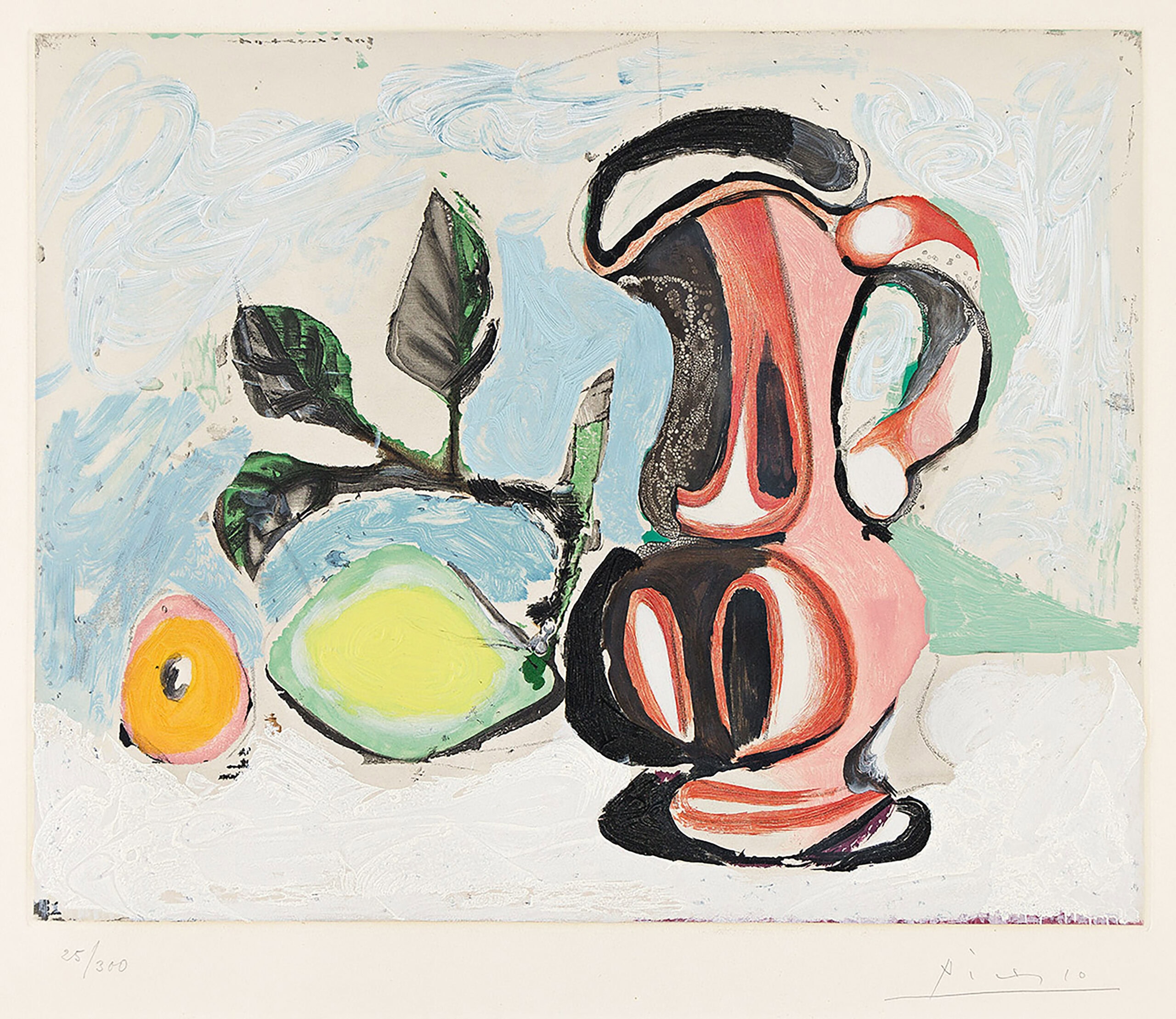
Pablo Picasso’s Nature morte au citron et un pichet rouge (Still Life with Lemon and Red Pitcher), c. 1960, is a wonderfully animated still life in which a handful of familiar domestic objects become an exuberant arrangement of color, contour, and painterly movement. Dominating the right side of the composition is an extraordinary red and pink pitcher whose exaggerated curves give it an almost bodily presence. Broad passages of coral red, rose, black, white, and gray wrap around the vessel, while the sweeping black contour at its top creates a dramatic visual rhythm that immediately draws the eye. To the left, Picasso places a brilliant yellow-green lemon attached to a dark leafy branch, its rounded form providing a striking counterpoint to the verticality and complexity of the pitcher. A smaller orange-colored fruit appears nearby, adding another concentrated burst of warmth. Pale blue brushwork moves freely through the background like air or clouds, while areas of mint green, white, and exposed paper prevent the composition from becoming visually heavy. Particularly compelling is the way Picasso refuses to separate drawing from color: black outlines expand and contract, forms overlap, and areas of color frequently seem to possess an energy independent of the objects they describe. The pitcher, lemon, fruit, and branch remain immediately recognizable, yet none is treated conventionally. Instead, Picasso transforms an intimate tabletop arrangement into something far more psychologically and visually charged. The result is unmistakably Picasso: spontaneous yet controlled, familiar yet strange, and filled with the restless energy that allowed him to continually reinvent even the most traditional subjects.
The color aquatint medium is particularly effective in Nature morte au citron et un pichet rouge. Picasso uses aquatint not to produce smooth, mechanically consistent areas of color, but to preserve the tactile quality and immediacy of painting and drawing. The pale blue background retains visible gestures and directional movement, while the red and pink passages of the pitcher range from transparent, delicate tones to dense areas bounded by emphatic black. The lemon appears almost luminous through its concentration of yellow surrounded by pale green, while the branch and leaves introduce darker passages that anchor the left side of the composition. White areas and exposed paper become active components rather than simply empty spaces, allowing the composition to breathe. The combination of painterly color and forceful graphic contour is especially important: the aquatint retains the feeling of Picasso working directly through color while simultaneously preserving the structural authority of his drawing. The result demonstrates how effectively printmaking could translate the physical vitality of Picasso’s paintings into an editioned work without sacrificing their spontaneity.
Imagine living with Picasso’s Nature morte au citron et un pichet rouge every day. This is the kind of Picasso that can introduce tremendous color and personality into a room while remaining surprisingly easy to live with. From across a space, the red and pink pitcher immediately becomes the focal point, balanced beautifully by the luminous yellow-green lemon and the sweeping dark branch at the left. The pale blues, mint greens, whites, and softer passages surrounding these stronger colors give the composition an airy quality that keeps it from feeling overly dense. As you move closer, however, the seemingly straightforward still life becomes much more complicated. You begin to notice the irregular contours of the pitcher, the changes in pressure and density within the black lines, the painterly movement of the blue background, the delicate transitions around the lemon, and the areas where color seems to escape the objects it is supposed to describe. That combination of immediate visual pleasure and close-up complexity makes the work particularly rewarding to live with. It could bring warmth and sophistication to a contemporary living room, dining room, library, or kitchen, while its combination of classical still-life subject matter and radical execution could create an equally compelling dialogue within a more traditional interior. The imagery is intimate and domestic, but Picasso’s treatment gives it extraordinary presence—the kind of work that can feel cheerful and inviting at first glance while continuing to reveal the intelligence and experimentation behind its apparent spontaneity.
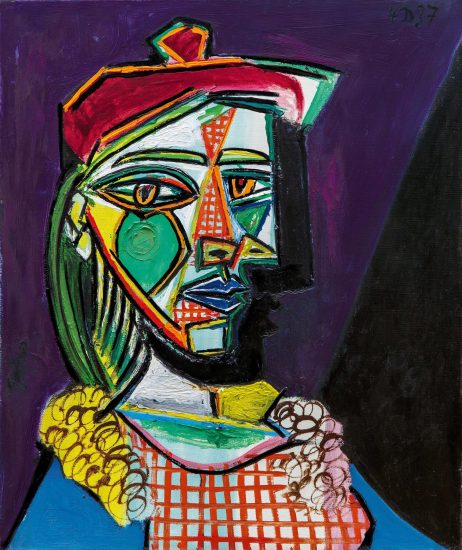
The origins of Nature morte au citron et un pichet rouge are particularly interesting because the aquatint returns to imagery Picasso had explored in an oil painting from January 1937. The late 1930s were an extraordinarily significant period in Picasso’s life and art, and his still lifes from this era often possess a tension between domestic intimacy and radical formal experimentation. Here, the familiar components of a still life—a pitcher, citrus fruit, leaves, and tabletop setting—become vehicles for Picasso’s continuing exploration of distortion, color, and the relationship between object and body. The pitcher is especially striking. Its swollen curves, narrow passages, and sensuous red and pink forms make it feel almost animate, while the lemon and fruit retain a directness and simplicity that counterbalance its complexity. When this imagery was revisited through aquatint, the composition acquired a new painterly vitality through the interaction of color, paper, and printed surface.
Picasso’s involvement with printmaking was one of the most sustained and experimental aspects of his career. He worked extensively in etching, drypoint, aquatint, lithography, linocut, and other graphic processes, repeatedly challenging the assumption that a print was simply a reproductive version of a painting or drawing. For Picasso, each technique offered its own vocabulary. Etching could preserve the immediacy of line; lithography allowed him to explore drawing and tonal variation; linocut encouraged bold simplification; and aquatint provided extraordinary opportunities for fields of tone and color. He frequently collaborated closely with highly skilled printers, treating the workshop as another arena for experimentation rather than merely a place where finished designs were reproduced.
The collaboration with Atelier Crommelynck in Paris was particularly important to Picasso’s later printmaking. Working with master printers allowed him to pursue technically demanding graphic works while remaining deeply involved in the creative process. In Nature morte au citron et un pichet rouge, the richness of the aquatint is essential to the work’s character. The medium permits broad painterly passages to coexist with forceful black contours and delicate tonal variations, creating a surface that retains much of the immediacy associated with Picasso’s painting. Rather than simply reproducing an earlier still life, the printmaking process gives the composition another life. Color becomes more concentrated, individual forms become more graphic, and the interaction between printed pigment and the white paper introduces a new sense of openness and luminosity.
Created circa 1960, Nature morte au citron et un pichet rouge (Still Life with Lemon and Red Pitcher) is an original color aquatint on BFK Rives paper. This impression is numbered from the edition of 300 in pencil in the lower left margin and is hand-signed by Pablo Picasso in pencil in the lower right margin. The work was printed and published by Atelier Crommelynck, Paris, and bears the Atelier Crommelynck blindstamp. The aquatint was created after Picasso’s original oil on canvas Nature morte au pichet, painted on January 16, 1937, allowing Picasso’s earlier still-life imagery to be reconsidered through the very different possibilities of color printmaking.
Catalogue Raisonné & COA:
Pablo Picasso Still Life with Lemon and Red Pitcher (Nature morte au citron et un pichet rouge), c.1960, is fully documented and referenced in the below catalogue raisonnés and texts (copies will be enclosed as added documentation with the invoices that will accompany the sale of the work).
1. Alan Wofsy Fine Arts. Picasso's Paintings, Watercolors, Drawings & Sculpture: A Comprehensive Illustrated Catalogue, 1885-1973, Spanish Civil War, 1937-1939. San Francisco: Alan Wofsy Fine Arts, 1997. The original oil on canvas that this aquatint is based on is listed and illustrated as catalogue no. 37:009.
2. A Certificate of Authenticity will accompany our artwork Pablo Picasso Still Life with Lemon and Red Pitcher (Nature morte au citron et un pichet rouge), c.1960.
About the Framing:
Pablo Picasso’s Nature morte au citron et un pichet rouge is presented in museum-grade conservation framing with a complementary moulding, silk-wrapped mats, and optical-grade Plexiglas. The restrained presentation is particularly effective for this composition because it allows the delicate BFK Rives paper and surrounding margins to remain visually open while directing attention toward Picasso’s extraordinary combination of red, pink, yellow, green, blue, black, and white. The silk-wrapped mats create an elegant transition between the artwork and its surroundings without competing with the energetic contours or painterly surface of the aquatint. The finished presentation gives the work a sophisticated presence while preserving the freshness, spontaneity, and remarkable color relationships that make this Picasso still life so appealing.
Pablo Picasso (Spanish, 1881–1973) was one of the defining artists of twentieth-century art, continually reinventing his visual language across painting, drawing, printmaking, sculpture, and ceramics. Although Picasso is frequently associated with portraiture, the human figure, Cubism, and his representations of women, the still life remained an essential subject throughout his career. It provided him with a laboratory in which familiar objects could be dismantled, simplified, distorted, and reconstructed without losing their fundamental identity. Pitchers, bottles, bowls, fruit, flowers, tables, and other objects of everyday life recur throughout his work, yet Picasso rarely treated them as passive arrangements. Instead, he gave them weight, movement, personality, and sometimes an almost human presence. A pitcher could suggest the curves of a body, a piece of fruit could become an intensely concentrated field of color, and the relationships between ordinary objects could carry emotional associations extending well beyond traditional still-life painting.
Looking to Sell Pablo Picasso Still Life with Lemon and Red Pitcher (Nature morte au citron et un pichet rouge)?
If you are looking to sell a Pablo Picasso aquatint, Masterworks Fine Art is interested in acquiring Still Life with Lemon and Red Pitcher and other important Picasso prints.
Send us photographs of your Picasso aquatint, including the framed artwork and the signature, for a Picasso aquatint valuation. We can assess your artwork and determine whether it qualifies for a confidential direct purchase offer.
Sell My Pablo Picasso Still Life with Lemon and Red Pitcher
Availability
This Pablo Picasso Aquatint is for sale. Collectors can buy this work immediately. Upon purchase, we ship as soon as overnight or your preferred shipping method. Learn more about shipping.
Artwork Subject Matter
Pablo PicassoStill Life with Lemon and Red Pitcher (Nature morte au citron et un pichet rouge) |
|
| Color Aquatint on BFK Rives Paper | |
| from the edition of 300 in pencil in the lower left; with the blindstamp of the printer and publisher, Atelier Crommelynck, Paris. | |
| hand-signed by Pablo Picasso (Malaga, 1881 - Mougins, 1973) in pencil in the lower right margin. | |
|
|
|
|
|
|