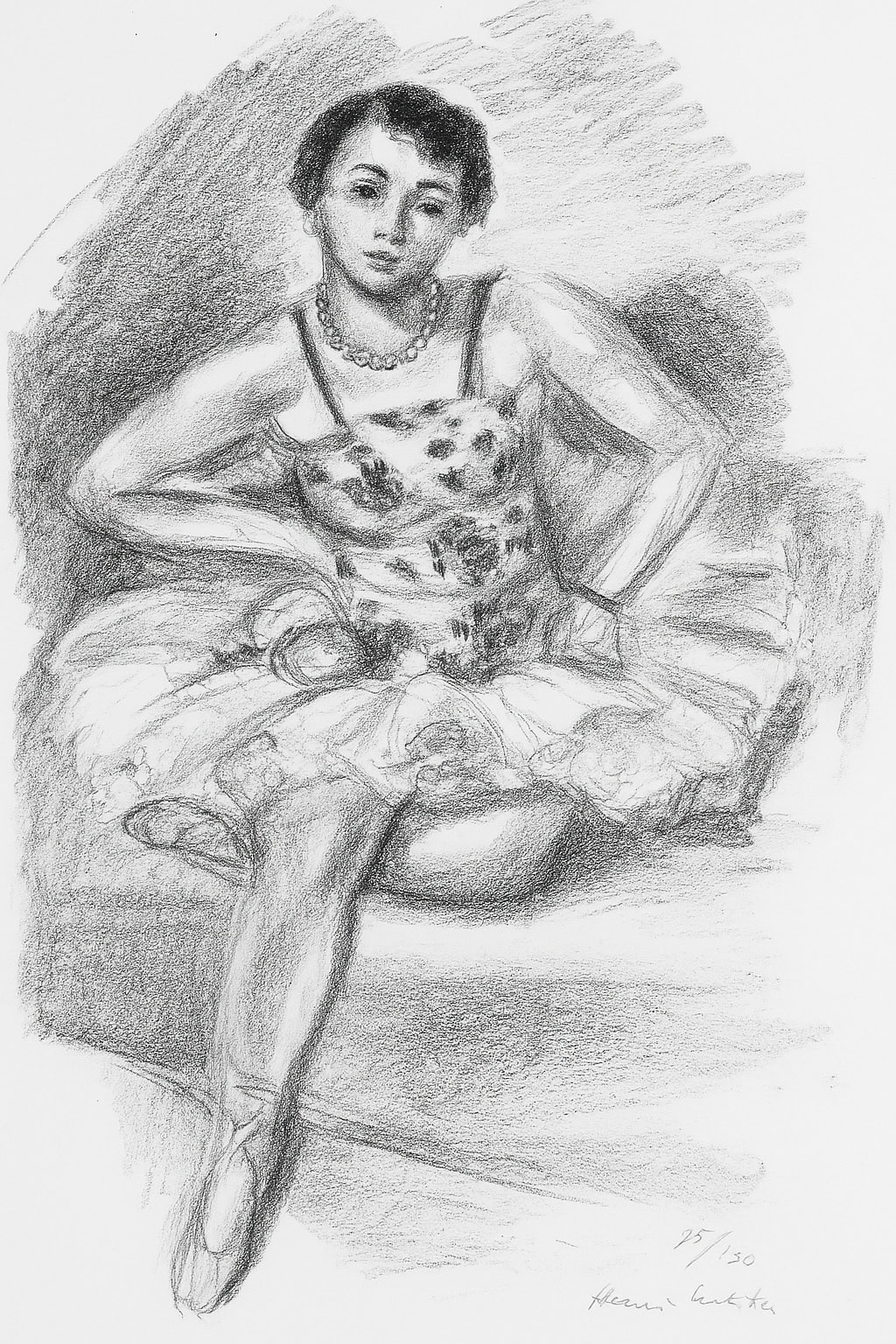
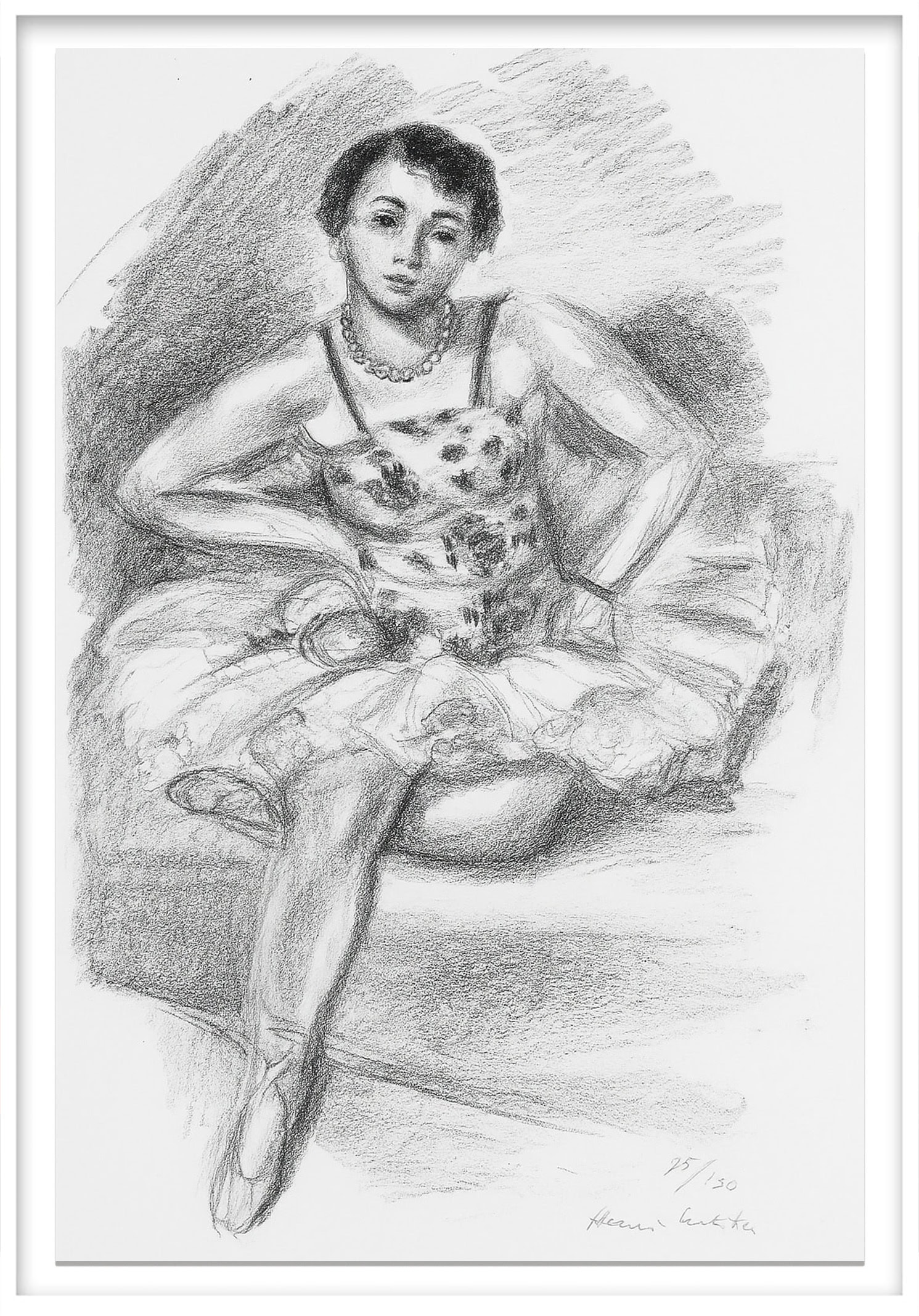
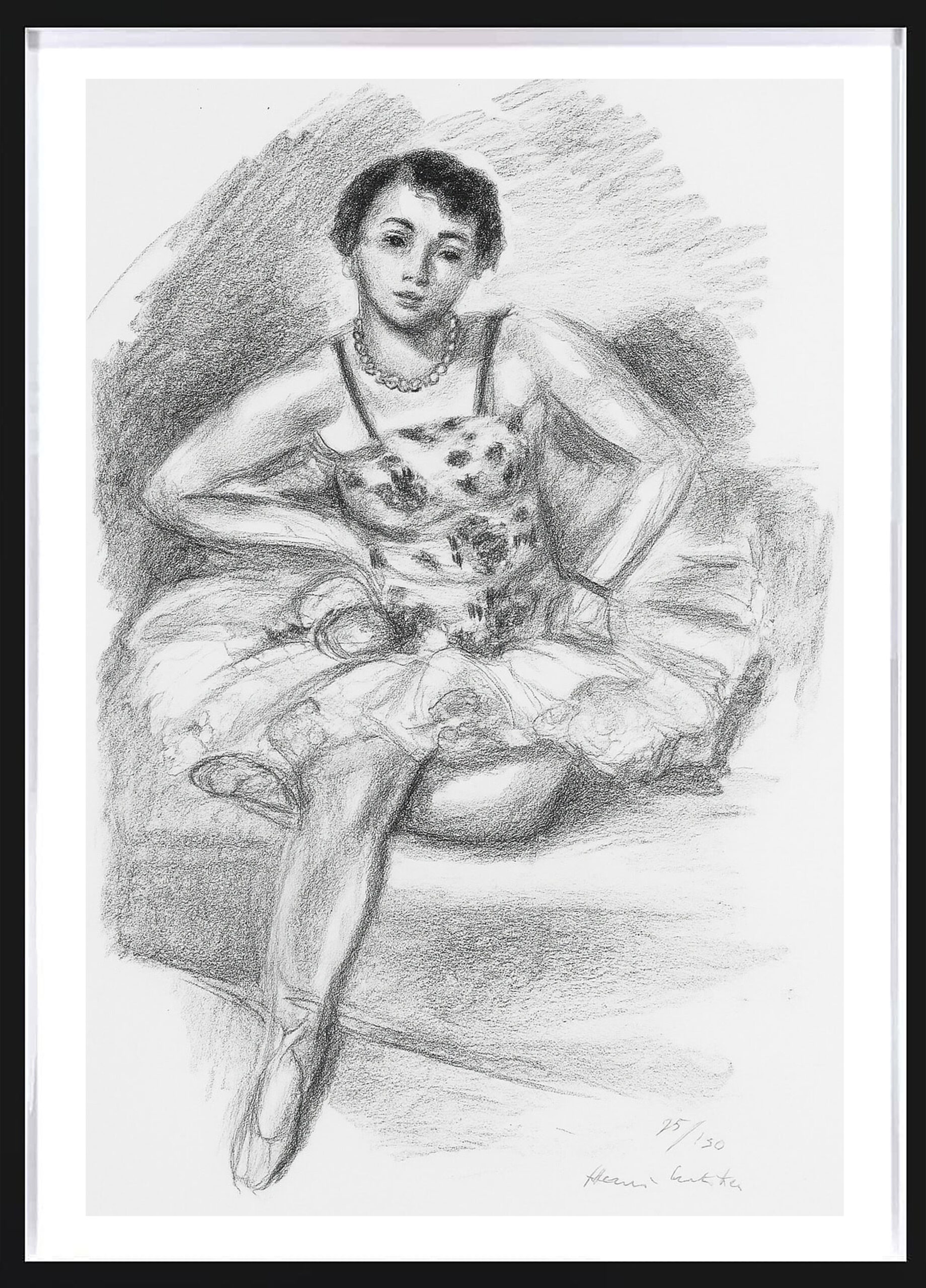
Henri Matisse, Danseuse assise (Seated Dancer), 1927 |
|
| Artist: | Henri Matisse (1869 - 1954) |
|---|---|
| Title: | Danseuse assise (Seated Dancer), 1927 |
| Reference: | D.480 |
| Medium: | Lithograph on Arches Wove Paper |
| Image Size: | 17 1/8 in x 10 3/4 in (43.5 cm x 27.4 cm) |
| Sheet Size: | 19 5/16 in x 12 13/16 in (49 cm x 32.5 cm) |
| Framed Size: | 27 in x 19 in ( 68.6 cm x 48.3 cm) |
| Edition: | Numbered from the edition of 130 in pencil in the lower right. |
| Signature: | This work is hand-signed by Henri Matisse (Le Cateau-Cambrésis, 1869 – Nice, 1954) in pencil in the lower right. |
| ID # | w-8944 |
|
$25,000
|
|
Henri Matisse’s Danseuse assise (Seated Dancer), 1927, is a graceful and contemplative work that reflects the artist’s lifelong fascination with the human figure, particularly the dancer as a symbol of rhythm, balance, and inner poise. In this composition, Matisse turns his gaze not toward the exuberant energy of movement, but toward a quiet moment of stillness, capturing a dancer in repose with the same sensitivity and elegance that defined his greatest figure studies.
The sitter is depicted in a natural, unguarded pose — seated with a relaxed posture that conveys both physical presence and meditative calm. Matisse distills the figure into a harmony of flowing lines and gentle curves, his mastery of draftsmanship evident in the way a few well-placed strokes can suggest volume, grace, and the inner life of the model. There is no excess detail, only the essential contours that evoke the dignity and subtle lyricism of the dancer’s form.
What makes Danseuse assise especially captivating is the way it embodies Matisse’s belief that art should be a source of serenity and joy. The figure exudes a quiet confidence, her body at rest yet charged with a latent energy, as if she carries within her the memory of movement. The dancer’s stillness becomes a metaphor for Matisse’s own pursuit of equilibrium in art: the ability to convey vitality without agitation, to capture life’s intensity within a framework of clarity and calm.
Created during the interwar years, this work reflects Matisse’s mature period, when he was refining the lessons of Fauvism into a more distilled and elegant visual language. By 1927, his line had achieved a remarkable economy and expressiveness — every curve is imbued with meaning, every gesture of the hand reveals the artist’s sensitivity to rhythm and proportion. The dancer is not merely a subject, but a vehicle through which Matisse communicates his devotion to beauty, balance, and the timeless grace of the human form.
Danseuse assise (Seated Dancer) stands as both an intimate portrait and an archetype: the dancer as muse, as symbol of discipline and harmony, and as an enduring emblem of Matisse’s vision. In its elegant simplicity, the work encapsulates the artist’s genius for transforming line and form into something universal — a serene meditation on presence, poise, and the quiet power of art.
Created c. 1927, Danseuse assise (Seated Dancer) is hand signed by Henri Matisse (Le Cateau-Cambrésis, 1869 - Nice, 1954) in pencil in the lower right and numbered from the edition of 130 in pencil in the lower right.
Catalogue Raisonné & COA:
This work is fully documented and referenced in the below catalogue raisonnés and texts (copies will be enclosed as added documentation with the invoices accompanying the final sale of the work):
1. Duthuit, Claude. Henri Matisse. Paris, 1983. Listed and illustrated as cat. no. 480.
2. A Certificate of Authenticity will accompany this work.
About the Framing:
Museum grade conservation framed in a complementary moulding with silk mats and optical grade Plexiglas.