Andy Warhol, Dracula from Myths Series, 1981 |
|
| Artist: | Andy Warhol (1928 - 1987) |
|---|---|
| Title: | Dracula from Myths Series, 1981 |
| Reference: | FS II.264 |
| Series: | Myths Series, 1981 |
| Medium: | Original screenprint on Lenox Museum Board |
| Image Size: | 38 x 38 in (96.5 x 96.5 cm) |
| Sheet Size: | 38 x 38 in (96.5 x 96.5 cm) |
| Framed Size: | approx. 48 x 48 in (121.9 x 121.9 cm) |
| Signature: | Hand-signed by Andy Warhol (Pennsylvania, 1928 - New York, 1987) in pencil in lower right. |
| ID # | w-3519 |
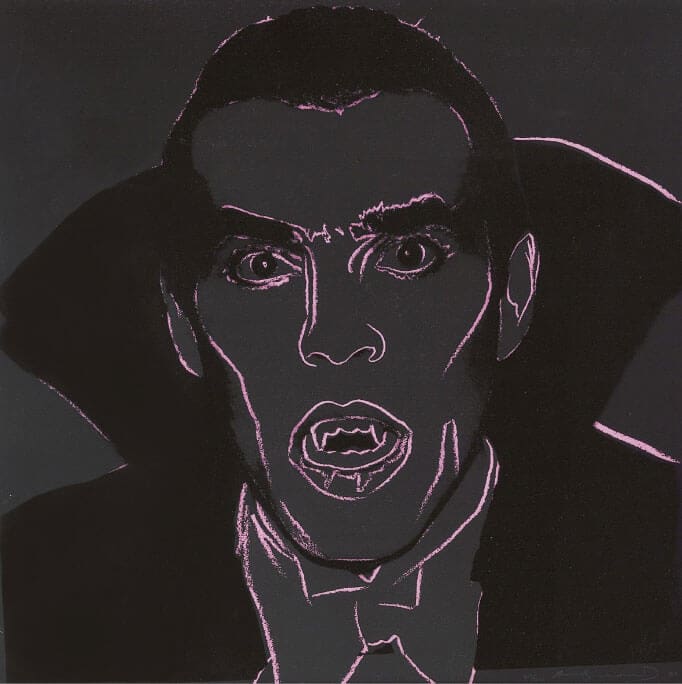
Andy Warhol, Dracula from Myths Series, 1981.
The enduring popularity of Bram Stoker's Dracula is undeniable; traveling from generation to generation with slight revisions along the way, Dracula remains a haunting mythological figure shrouded in mystery. Warhol's print captures Dracula in a more menacing pose, as he faces the viewer head-on, fangs bared as if ready to feed his hunger. Warhol's use of dark hues of black and grey are appropriate for his subject, as Dracula cannot reveal himself in light but only in the shroud of darkness. Only a few lines of neon pink delineate Dracula's form, which is clearly apparent to the viewer despite the dark nature of the print. While clearly fascinated with every aspect of popular culture, Warhol appears to have a special fascination for the character of Dracula to the extent that he created a film Blood for Dracula (1974) prior to his Myths series of prints.
Created in 1981, this original screenprint is numbered from the edition of 200; aside from 30 Artist's Proofs, 5 Printer's Proofs, 5 Exhibition Proofs. This work is also hand signed by Andy Warhol (Pennsylvania, 1928 - New York, 1987) in pencil in the lower right. Printed on Lenox Museum Board by Rupert Jasen Smith, New York and published by Ronald Feldman Fine Arts Inc, New York.
Andy Warhol Myths 1981:
During the 1980s, Warhol embraced the notion of art as a commodity, exploring the intersections between art, commerce, and popular culture. He was intrigued by the influence of mass media and the proliferation of celebrity culture, which led him to create artworks that celebrated and critiqued these phenomena simultaneously. The "Myth" series was an embodiment of this exploration, as Warhol delved into the realm of iconic figures, employing techniques that captured the essence of celebrity and consumerism.
Warhol's approach to art was inherently influenced by his background in commercial illustration and advertising. He understood the power of visual communication and the importance of capturing attention in a crowded marketplace. In this sense, his art incorporated elements that could be interpreted as salesy, aiming to attract viewers and provoke a response. The bold and recognizable imagery of the "Myth" series, featuring iconic figures such as Superman, Mickey Mouse, and Santa Claus, tapped into the collective consciousness and immediate recognition associated with these cultural symbols.
Warhol's intention in creating the "Myth" series was multi-faceted. On one hand, it can be interpreted as a commentary on the pervasive influence of consumer culture and the idolization of celebrities. By depicting these iconic figures repeatedly, Warhol highlighted the ways in which popular icons are perpetuated and mythologized in society, thereby questioning the authenticity and manufactured nature of fame.
On the other hand, the "Myth" series also functioned as a reflection of Warhol's own position within the art market. By creating highly recognizable and marketable works, he was able to capitalize on the allure of celebrity culture and consumer demand. This approach, which can be seen as salesy, aligned with Warhol's understanding of the art market and the need for artists to navigate the commercial aspects of the art world.
DOCUMENTED AND ILLUSTRATED IN:
1. Feldman, Frayda and Jörg Schellmann, A Catalogue Raisonne, 4th ed. Listed as catalogue raisonné no. II.264 on pp. 122-123.
ABOUT THE FRAMING:
Framed to museum grade conservation standards in a modern complementary moulding with silk mats and optical grade Plexiglas.