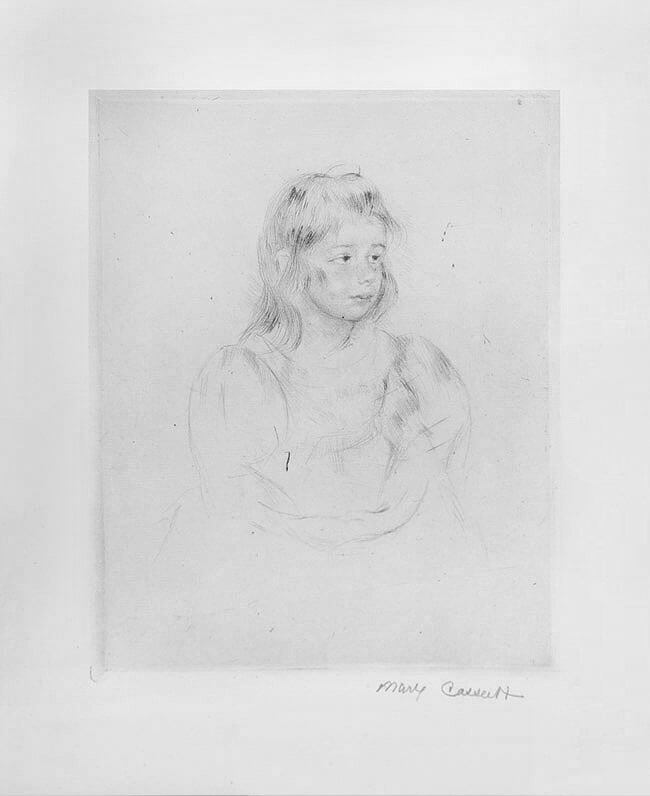
Cassatt, Mary, The Party Dress,1904
|
|
|
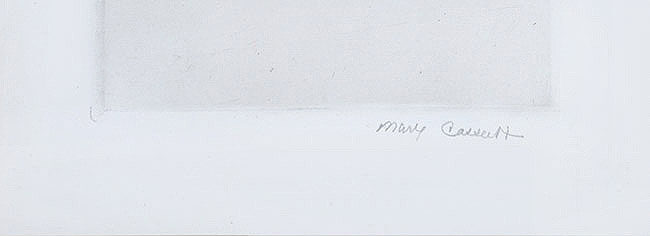
Signed Mary Cassatt, Etching, The Party Dress,1904 ![]() |
| Artist: | Cassatt, Mary (1845 - 1926) |
|---|---|
| Title: | The Party Dress,1904 |
| Reference: | Breeskin 191 |
| Medium: | Original Drypoint Etching on watermarked Vanderley laid paper |
| Image Size: | 8 1/2 in x 5 3/4 in (21.3 cm x 14.6 cm) |
| Sheet Size: | 14 in x 8 1/4 in (35.6 cm x 21 cm) |
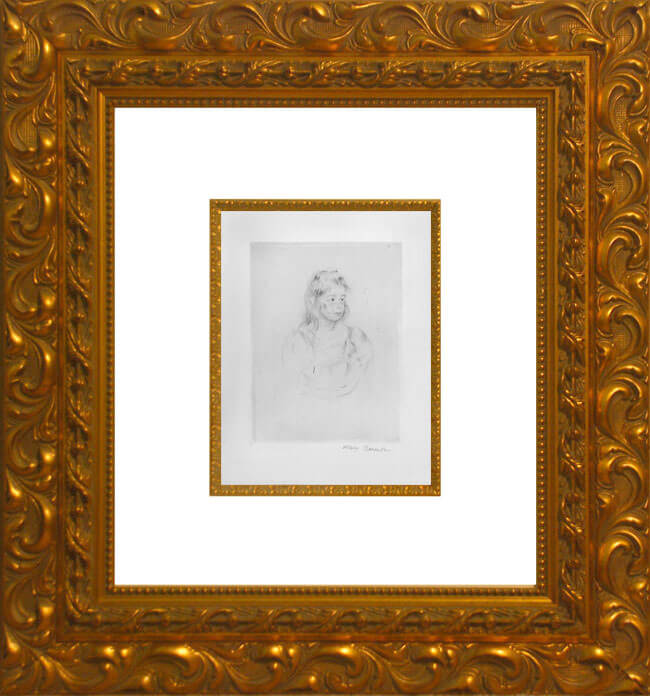
| Framed Size: | 27 3/4 in x 24 3/4 in (70.5 cm x 63 cm) |
| Signed: | This work is hand-signed by Mary Cassatt (Pennsylvania, 1844 - Paris, 1926) in pencil in the lower right margin. |
| Condition: | This work is in excellent condition, with deckle edges on all sides. |
|
Gallery Price
|
Item# 3242
|
| Questions? | |
|
One of a small number of prints hand signed by Cassatt, this lovely work clearly depicts Cassatts masterful skill at portraiture. Conveying a beautiful girl in her party dress, Cassatt chooses to focus on the unique facial features of her subject, highlighting the individual nature of the girl's face rather than the clothing that she dons. |
|
|
Read more about our pricing |
|
|
Gallery Price: This is a common gallery retail price Read more about our pricing |
|
|
Request Invitation: We have openings for a few new members each day. Members receive exclusive offers on our entire inventory. |
|
| Historical Description: | |
A young girl sits quietly, her hands folded upon her lap. She is all dressed up in a beautiful dress with poofed sleeves, her "party dress." Despite the title of this piece, the viewer's eye is not drawn to the party dress but rather to the young girl's lovely face. Cassatt (Pennsylvania, 1844 - Paris, 1926) depicts her subject in three quarter view, gazing off to her left as if seeking out a parent for reassurance. The girl's face is etched with incredible detail and appears as a true portrait; the girl retains unique facial features such as a slightly turned up nose, delicate lips, and dark, mysterious eyes. The viewer can only imagine that the young girl is preparing for an outing but must sit patiently for a portrait first. Cassatt contrasts the detailed, shaded face of her subject with the loose lines of the dress, further highlighting the young girl's facial features and expression. Created in c.1904, this original drypoint etching is printed on Vanderley watermarked laid paper with deckle edges on all sides. This piece is hand-signed by Mary Cassatt (Pennsylvania, 1844 - Paris, 1926) in pencil in the lower right margin. Catalogue Raisonné & COA: 1. Breeskin, A.D. (1979). Mary Cassatt: A Catalogue Raisonné of the Graphic Work. Smithsonian Institution Press: Washington, D.C. Listed and illustrated as catalogue raisonné no. 191. 2. A Certificate of Authenticity will accompany this work. About the Framing: | |
About Us: Masterworks Fine Art strives to be the best source of fine art for our clients and collectors all over the world. We believe the most direct way to accomplish this is by establishing a lifetime of personal and professional relationships with our clients. More About Us »
Do you own a similar Cassatt to sell? We offer free evaluations.
Biography of Mary Cassatt
Mary Cassatt (1845 - 1926)
Mary Cassatt captures the personal lives of women through her drawings and etchings. Cassatt especially concentrated on the bond between mother and child. Under the guidance of Impressionist artists, Cassatt's works became increasingly popular.
Mary Cassatt was born in Allegheny City (Pennsylvania) and died in Le Mesnil-Theribus (Oise). The daughter of a banker, she moved with her family to Paris in 1851. From 1853 to 1855 she lived at Heidelberg and Darmstadt. From 1861-1865 she studied at the Pennsylvania Academy of Fine Arts in Philadelphia, then in the studio of Charles Chaplin in Paris. In 1868 she exhibited for the first time at the Salon. While studying at the Academy Raimondi in Parma in 1871, she copied Correggio and Parmigianino and became an admirer of Velazquez and Rembrandt. In 1873 she traveled to Madrid, Seville, Belgium and the Netherlands, and made copies especially of Velazquez and Rubens, before finally settling in Paris. There she met Edgar Degas in 1877, who suggested her joining the Impressionists. Her work was greatly influenced by Degas and Renoir, taking as principal subject portraits of women and children. Cassatt took part in the IV to VI and again in the VIII Impressionist exhibition. Her own work was shown by Durand-Ruel in 1891. In 1898 she visited the United States, went to Italy and Spain in 1901, and for the last time to the United States in 1908. In 1910 she became a member of the National Academy of Design in New York. In 1914 she was awarded the gold medal of the Pennsylvanian Academy of Art. Cassatt gradually lost her sight and was compelled to give up painting. It was due to her efforts that French Impressionism became known and understood in America, and also thanks to her initiative that the Havemeyer collection, now at the New York Metropolitan Museum, came into being.


Print Page
Email to Friend


