Signed original prints, drawings, paintings, and sculptures for sale
fine art home > BUY ORIGINALS > GEORGES BRAQUE > Lithograph

Braque, Georges, La Forêt (The Forest) from Lettera amorosa, 1963


Signed Georges Braque, Lithograph, La Forêt (The Forest) from Lettera amorosa, 1963

Braque Lithograph Signed, La Forêt (The Forest) from Lettera amorosa, 1963

Place your cursor over the thumbnails below to view the full-size image:

Braque Lithograph Signed, La Forêt (The Forest) from Lettera amorosa, 1963 (thumbnail 1) Braque Lithograph Signed, La Forêt (The Forest) from Lettera amorosa, 1963 (thumbnail 2) Braque Lithograph Signed, La Forêt (The Forest) from Lettera amorosa, 1963 (thumbnail 3)

Click each room to better visualize its scale and beauty in different contexts.:


 (thumbnail room-view)
 (thumbnail room-view)
 (thumbnail room-view)
 (thumbnail room-view)
Artist: Braque, Georges (1882 - 1963)
Title: La Forêt (The Forest) from Lettera amorosa, 1963
Reference: Vallier 187
Medium:
Original Color Lithograph
Image Size: 10 7/16 in x 8 1/2 in (26.5 cm x 21.5 cm)
Sheet Size: 15 in x 11 1/4 in (38.1 cm x 28.6 cm)
Framed Size: 29 1/2 in x 25 1/8 in (74.9 cm x 63.8 cm)
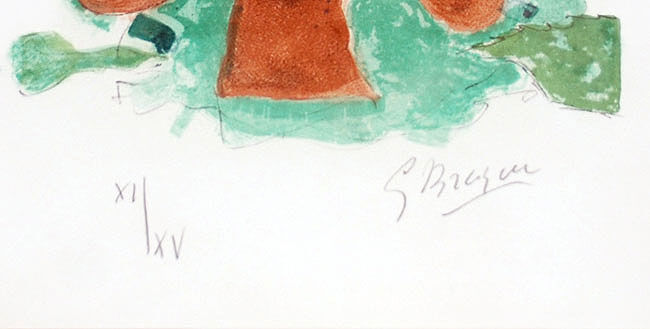
Signed: This work is hand-signed by Georges Braque (Argenteuil, Val-d'Oise, 1882-Paris, 1963) in pencil in the lower right margin.
Edition: This work is numbered XI/XV in pencil in the lower left (from the edition of XV (15) artist’s proofs numbered in Roman numerals, aside from the edition of 75 signed and numbered in Arabic numerals, a few Hors Commerce impressions on Arches, and 3 Hors Commerce impressions on Japon nacre). Printed by Mourlot, Paris on Arches paper and published by Edwin Engelberts, Geneva.
Condition: This work is in excellent condition.
Gallery Price 
$6,000
Item# 3229
Questions? Submit Best Offer Purchase Now

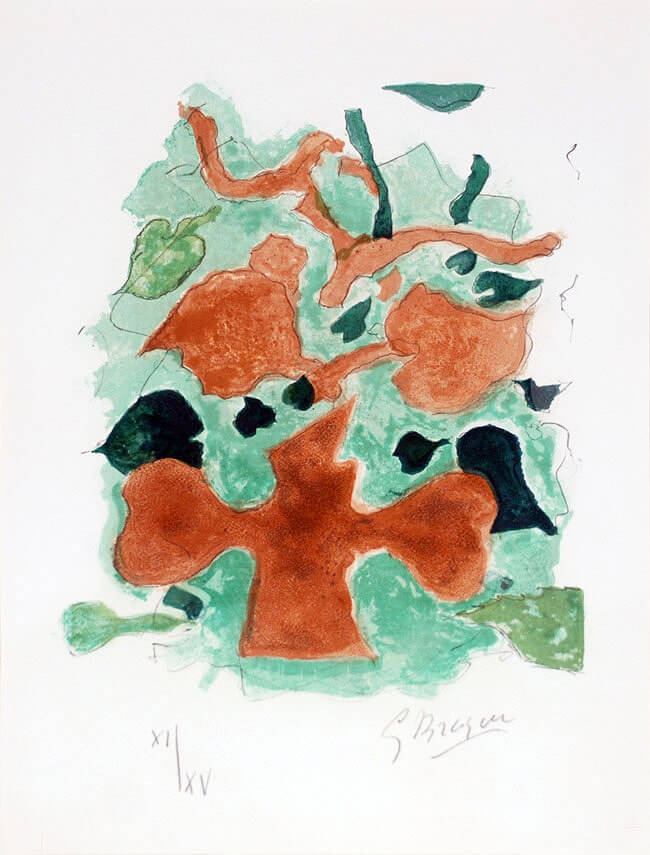
Exemplifying a softer side of Braque, this exquisite image of the forest relays an impression of peace and calm. Through his earthy color palette and effortless strokes, Braque relays the impression that we have entered a mysterious forest, surrounded by green foliage.


Read more about our pricing
Gallery Price: This is a common gallery retail price
Read more about our pricing
 

Request Invitation:

We have openings for a few new members each day. Members receive exclusive offers on our entire inventory.

Historical Description:
Appropriately entitled La Forêt (The Forest) this piece abounds with earthy tones of brown and green. Braque utilizes soft, abstract figures to convey this forest, causing the viewer to ponder the exact image depicted. The central, brown figure appears as a tree, rooted to the ground with branches stemming from the trunk. The viewer can make out distinct, green leaf-like shapes to the left and the right of this tree, and feels as if he or she is confronting the forest head-on, as if one simply stumbled into the forest and became immersed within the foliage.

Created in 1963, this work is one of 29 lithographs created for the illustrated book Lettera amorosa. It is hand-signed by Georges Braque (Argenteuil, Val-d'Oise, 1882 - Paris, 1963) in pencil in the lower right margin and numbered XI/XV in pencil in the lower left (from the edition of XV (15) artist's proofs numbered in Roman numerals, aside from the edition of 75 signed and numbered in Arabic numerals, a few Hors Commerce impressions on Arches, and 3 Hors Commerce impressions on Japon nacre). Printed by Mourlot, Paris on Arches paper and published by Edwin Engelberts, Geneva

Catalogue Raisonné & COA:
This work is fully documented and referenced in the below catalogue raisonnés and texts (copies will be enclosed as added documentation with the invoices that will accompany the final sale of the work).

1. Vallier, Dora, Braque: The Complete Graphics Catalogue Raisonné listed as catalogue no. 187 on pgs. 267-182 and illustrated on pg. 275

2. A Certificate of Authenticity will accompany this work.

About the Framing:
This work is framed to museum-grade, conservation standards, presented in a complimentary moulding and finished with silk-wrapped mats and optical grade Plexiglas.

Style: Picasso Cubism, Cubist 20th Century French Modern Master
 

About Us: Masterworks Fine Art strives to be the best source of fine art for our clients and collectors all over the world. We believe the most direct way to accomplish this is by establishing a lifetime of personal and professional relationships with our clients. More About Us »

Do you own a similar Braque to sell? We offer free evaluations.

Biography of Georges Braque

Georges BraqueGeorges Braque (1882 - 1963)

Georges Braque was born on May 13, 1882, in Argenteuil-sur-Seine, France. He grew up in Le Havre and studied evenings at the Ecole des Beaux-Arts there from about 1897 to 1899. He left for Paris to study under a master decorator to receive his craftsman certificate in 1901. From 1902 to 1904, he painted at the Académie Humbert in Paris, where he met Marie Laurencin and Francis Picabia. By 1906, Braque's work was no longer Impressionist but Fauve in style; after spending that summer in Antwerp with Othon Friesz, he showed his Fauve work the following year in the Salon des Indépendants in Paris. His first solo show was at Daniel-Henri Kahnweiler's gallery in 1908. From 1909, Pablo Picasso and Braque worked together in developing Cubism; by 1911, their styles were extremely similar. In 1912, they started to incorporate collage elements into their paintings and to experiment with the papier collé (pasted paper) technique. Their artistic collaboration lasted until 1914. Braque served in the French army during World War I and was wounded; upon his recovery in 1917, he began a close friendship with Juan Gris.

After World War I, Braque's work became freer and less schematic. His fame grew in 1922 as a result of an exhibition at the Salon d'Automne in Paris. In the mid-1920s, Braque designed the decor for two Sergei Diaghilev ballets. By the end of the decade, he had returned to a more realistic interpretation of nature, although certain aspects of Braque's Cubism always remained present in his work. In 1931, Braque made his first engraved plasters and began to portray mythological subjects. His first important retrospective took place in 1933 at the Kunsthalle Basel. He won First Prize at the Carnegie International, Pittsburgh, in 1937.

During World War II, Braque remained in Paris. His paintings at that time, primarily still lifes and interiors, became more somber. In addition to paintings, he also made Braque etchings, lithographs, engravings, prints and sculpture. From the late 1940s, he treated various recurring themes, such as birds, ateliers, landscapes, and seascapes. In 1954, he designed stained-glass windows for the church of Varengeville. During the last few years of his life, Braque's ill health prevented him from undertaking further large-scale commissions, but he continued to paint, make lithographs, and design jewelry. He died on August 31, 1963, in Paris.

Braque Lithograph Signed, La Forêt (The Forest) from Lettera amorosa, 1963