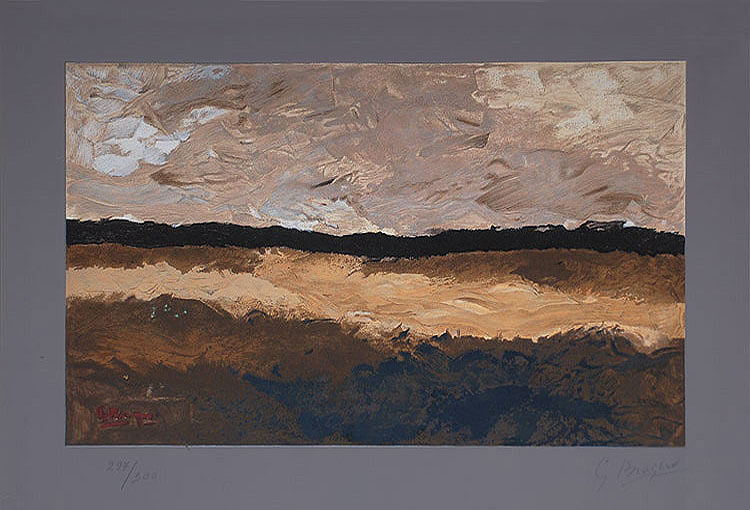

Georges Braque, Les Champs, 1962 |
|
| Artist: | Georges Braque (1882 - 1963) |
|---|---|
| Title: | Les Champs, 1962 |
| Reference: | Maeght 1045 |
| Medium: | Original Color Lithograph |
| Image Size: | 10 7/8 in x 17 3/4 in (27.6 cm x 45 cm) |
| Sheet Size: | 22 in x 15 in (56.3 cm x 38.4 cm) |
| Framed Size: | 39 1/4 in x 34 in (99.7 cm x 86.4 cm) |
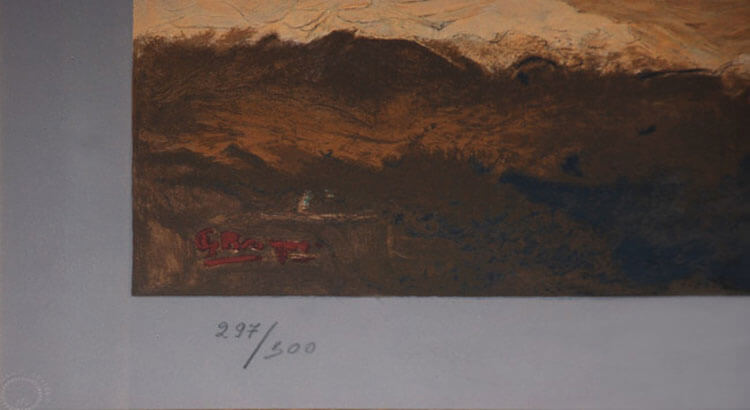
| Edition: | Numbered from the edition of 300 in pencil in the lower left margin. |
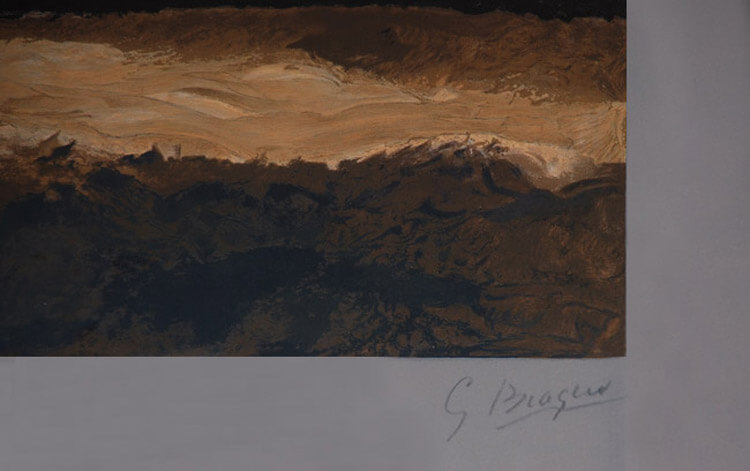
| Signature: | This work is hand signed by Georges Braque (Argenteuil-sur-Seine, 1882- Paris, 1963) in pencil in the lower right margin. |
| ID # | w-3030 |
Featuring earthly tones of brown, beige and black, Georges Braque Les Champs, 1962 features an extremely volatile landscape complete with mysterious fields and clouds. The quality of the brushstrokes which look thick and heavy with paint give a three dimensional feel to the image, as well as lending complex texture. Variations of colors and shadows cast darker tones onto the scene. The thick band of darkness down the middle cuts sharply through the lithograph. The use of full margins further accentuates the expressive, as well as tonal qualities of the work. This composition is most likely a rendering of a home Braque owned near the Normandy Coast around 1930. While the work resembles the extremely dramatic coastline of northern France, it also functions as an abstract composition featuring a sense of energy and movement which is unique to Braque's later career.
This stunning seascape scene figures in a series of lithographs published by Maeght Éditeur, Paris which were inspired by Georges Braque's watercolors, gouaches, and paintings. Created in 1962, this original color lithograph is hand signed by Georges Braque (Argenteuil-sur-Seine, 1882- Paris, 1963) in pencil in the lower right margin, and numbered out of an edition of 300 in pencil in the lower left margin.
Catalogue Raisonné & COA:
Georges Braque Les Champs, 1962 is fully documented and referenced in the below catalogue raisonnés and texts (copies will be enclosed as added documentation with the invoices that will accompany the final sale of the work).
1. Vallier, Dora; Braque: The Complete Graphics Catalogue Raisonné, 1982, listed and illustrated as catalogue raisonné no. 1045 on page 296.
2. A Certificate of Authenticity will accompany this work.
About the Framing:
Georges Braque Les Champs, 1962 is framed to museum-grade, conservation standards, presented in a complimentary moulding and finished with silk-wrapped mats and optical grade Plexiglas.
Subject Matter: Landscape
