Signed original prints, drawings, paintings, and sculptures for sale
fine art home > BUY ORIGINALS > FRIEDENSREICH HUNDERTWASSER > Ceramic Screenprint

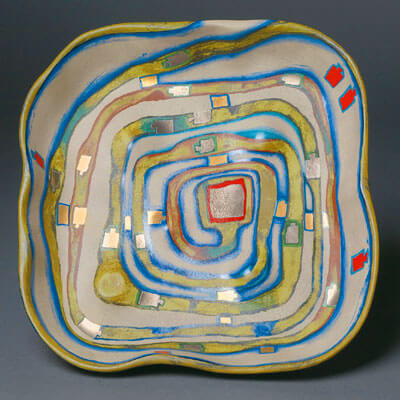
Hundertwasser, Friedensreich, Spiralental, 1983


Signed Friedensreich Hundertwasser, Ceramic Screenprint, Spiralental, 1983

Hundertwasser Ceramic Screenprint Signed, Spiralental, 1983

Place your cursor over the thumbnails below to view the full-size image:

Hundertwasser Ceramic Screenprint Signed, Spiralental, 1983 (thumbnail 1)
Artist: Hundertwasser, Friedensreich (1928 - 2000)
Title: Spiralental, 1983
Reference: Catalogue of Works No. 857
Medium:
Original Rosenthal ceramic dish color screenprint with metal embossings
Image Size: DIMENSIONS: 14 1/8 in x 14 1/8 in x 2 1/2 in (36 cm x 36 cm x 6 1/2 cm)
Signed: Signed by Hundertwasser (Vienna, 1928- RMS Queen Elizabeth 2, 2000) in black on the verso.
Edition: Signed, dated, and numbered on the verso 'Hundertwasser | 1983 | 857 Spiralental | 1159/2000' with the Rosenthal Edition stamp on verso. Also included is the Rosenthal Edition Original wooden box.
Condition: This work is in excellent condition.
Gallery Price 
$10,000
Item# 2735
Questions? Submit Best Offer Purchase Now

As the leitmotif of Hundertwasser's art, the spiral here symbolizes life and death. This stunning dish designed specially for Rosenthal ceramics conveys an organic spiral whose undulating form varies in width, obeying the laws of natural growth. With its wavy surface and flecks of metal, this piece is truly eye catching, capturing the light and relaying a hypnotic sense of motion.


Read more about our pricing
Gallery Price: This is a common gallery retail price
Read more about our pricing
 

Request Invitation:

We have openings for a few new members each day. Members receive exclusive offers on our entire inventory.

Historical Description:

Curved lines rotate and undulate, creating a spiral beautifully lacking a perfect sense of balance or proportion. Hundertwassers (Vienna, 1928- RMS Queen Elizabeth 2, 2000) lines appear to have minds of their own as they snake around each other over the uneven surface of the dish. Brilliant flecks of metal capture the light and contribute to the overall topsy turvy nature of this piece. According to the Rosenthal certificate, "The spiral is the leitmotif of Friedensreich Hundertwassers art. For him, the spiral symbolizes life and death. This ceramic dish, which Hundertwasser has designed specially for Rosenthal, has the appearance of a growing organism which becomes alternately thinner and thicker…Hundertwasser's spiral obeys the law of vegetable growth. Here it is his intention to make the observer aware of the unison in which human creatures can live with their natural, organic environment."

Created in 1983, this original Rosenthal ceramic dish, color screenprint with metal embossing is signed, dated, and numbered on the verso 'Hundertwasser | 1983 | 857 Spiralental | 1159/2000' with the Rosenthal Edition stamp on the verso. Also included is the Rosenthal Edition original wooden box.

Catalogue Raisonné & COA:
This work is fully documented and referenced in the below catalogue raisonnés and texts (copies will be enclosed as added documentation with the invoices that will accompany the final sale of the work).

1. Rosenthal certificate of authenticity, serial number 01159.

2. Official web page of Friedensreich Hundertwasser (1928-2000): http://www.hundertwasser.at/english/oeuvre/ankunst/apa_keramikporzellan.php

3. A Certificate of Authenticity will accompany this work.

 

About Us: Masterworks Fine Art strives to be the best source of fine art for our clients and collectors all over the world. We believe the most direct way to accomplish this is by establishing a lifetime of personal and professional relationships with our clients. More About Us »

Do you own a similar Hundertwasser to sell? We offer free evaluations.

Biography of Friedensreich Hundertwasser

The eccentric and playfully self-advertising Viennese artist known as Friedensreich Hundertwasser was born as Friedrich Stowasser on 15 December 1928. He did not assume his nom d'artiste until 1949 ('sto' meaning 'one hundred' in Slavic languages and 'Wasser' meaning 'water'). Even in adolescence Stowasser brought home reports from school attesting to his 'exceptional feeling for colour and form'. After taking the examinations qualifying for university entrance, Hundertwasser spent three months at the Viennese Art Academy studying under Professor Robin Christian Andersen. Hundertwasser was, however, more indebted to the work of Egon Schiele and Walter Kampmann, which he saw at their exhibitions, than to the brief period of academic instruction. Hundertwasser travelled extensively in Italy, where he met René Brô, whom he accompanied to Paris. Hundertwasser had thought of continuing formal training at the École des Beaux-Arts but spent only one day at that institution. Instead he found the numerous and adventurous trips he took to Morocco, Tunisia, Nepal, Tokyo and Siberia inspirational for the path he intended to follow. Taking Viennese Jugendstil as his point of departure, Hundertwasser developed an abstract, decorative, two-dimensional and vibrantly colourful, utterly distinctive style distinguished by ornamental spiral and labyrinth forms, circles, meanders and biomorphic shapes. During the 1960s Hundertwasser was extremely successful, with a 1962 retrospective in the Austrian pavilion at the Venice Biennale and a 1964 retrospective mounted by the Kestner Gesellschaft in Hannover. In addition, the first comprehensive catalogue of his œuvre was published. Active in the ecological movement, Hundertwasser was committed to making life liveable in a humane environment that was close to nature. He furthered his aims by issuing manifestos and making provocative public appearances, for instance giving a speech in the nude (1968) in Vienna. Between 1968 and 1972 Hundertwasser rehauled the old sailing vessel 'San Giuseppe T' at docks in the Venice lagoon, rechristened it 'Regentag' ['Rainy Day'], and going to see in it several times. So versatile and prolific was Hundertwasser that he also designed coins and stamps for Austria, Senegal and the UN from the 1970s. Moreover, Hunderwasser was the first European artist to have work carved by Japanese master carvers. In 1981 Hundertwasser was appointed head of the master classes for painting at the Viennese Art Academy. The famous Hundertwasser House in Vienna, begun in 1983, attests to Hunderwasser's skill as an architect. The year before he died, Hundertwasser was working on a catalogue raisonné of his works and presented the Uelzen Station architectural project. Hundertwasser died on a cruise ship off New Zealand in 2000.