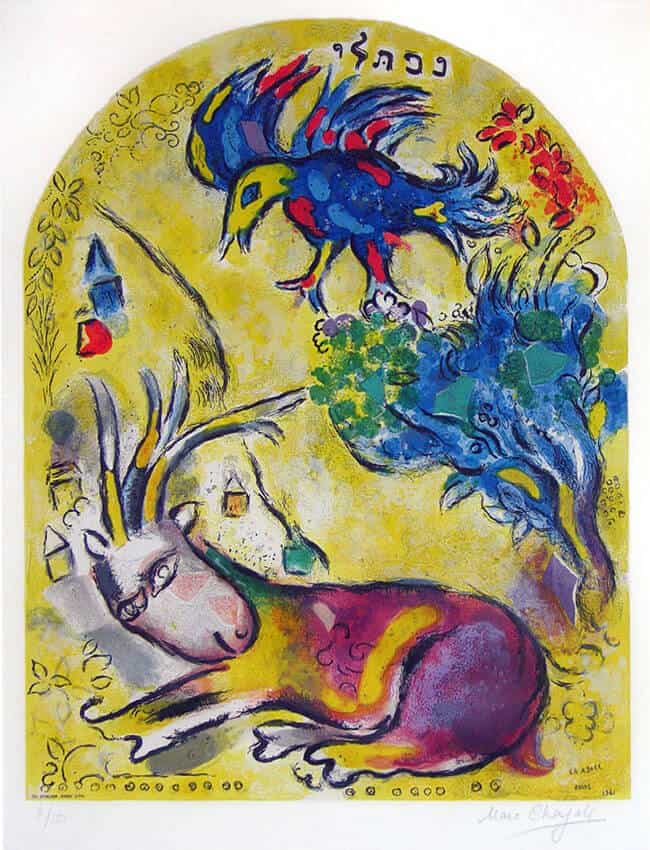
Chagall, Marc, The Tribe of Naphtali, from The Twelve Maquettes of Stained Glass Windows for Jerusalem (1964)
![]() |
![]() |
Signed Marc Chagall, Lithograph, The Tribe of Naphtali, from The Twelve Maquettes of Stained Glass Windows for Jerusalem (1964) ![]() |
| Artist: | Chagall, Marc (1887 - 1985) |
|---|---|
| Title: | The Tribe of Naphtali, from The Twelve Maquettes of Stained Glass Windows for Jerusalem (1964) |
| Medium: | Original Color Lithograph |
| Image Size: | 24 in x 18 in (61 cm x 46 cm) |
| Sheet Size: | 29 1/4 in x 20 3/4 in (74.3 cm x 52.53 cm) |
| Framed Size: | 43 3/4 in x 36 5/8 in (111.1 cm x 93 cm) |
| Signed: | The work is hand signed by Marc Chagall (1887-1985) in pencil in the lower right margin. |
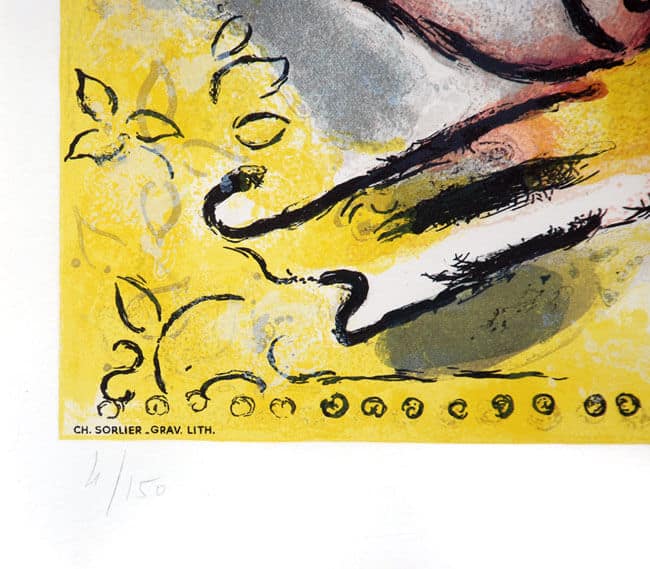
| Edition: | Numbered 4/150 in pencil in the lower left. |
| Condition: | Remarkably vivid color with rich saturation, this work is in excellent condition; the best impression with the most saturated and vivid colors we have ever encountered on this rare work. |
| Price: Item# 2646 | $SOLD Please visit the rest of our Chagall fine art collection |
| Historical Description: | |
|---|---|
| This particular image - and by far, the finest example - has extremely vivid
and highly saturated colors; particularly beautiful are the strong sunny yellows
and brilliant sapphire blues. The dramatic color, coupled with bold religious
imagery, makes this an extraordinary work within the Jerusalem series, and a
work that has seldom come on the market in the last 7-10 years.
Created in 1964, this image is part of a series of twelve lithographs which
Chagall designed after the stain glass windows he created for the synagogue
of the Hadassah-Hebrew Medical Center, located just outside of Jerusalem. The
work was engraved and printed by Charles Sorlier in collaboration with Marc
Chagall on Arches wove paper; the Arches watermark appears vertically in the
right margin. On the lower right hand on the reverse side of the sheet, there
is printed text which reads, "MARC CHAGALL, MAQUETTE DU VITRAIL 'JUDAH',
pour Jérusalem, repuroudite en lithographie, Ch Sorlier, graveur - Mourlot,
Imp." The engraver's signature also appears in the plate in the lower left
hand side. As a traditional biblical reference, the goat holds a vast history of symbolism in the Jewish faith - on Yom Kippur, the festival of the Day of Atonement, two goats were chosen and lots were drawn for them. One was sacrificed and the other allowed to escape into the wilderness, symbolically carrying with it the sins of the community (from this comes the word "scapegoat"). Contrasted with a brilliantly colored rooster who hovers above, these animals more commonly symbolized ideas of prosperity and abundance. The overwhelming aura of the piece is echoed by the shimmering yellow that radiates and glows from the work. Floral accents throughout give the scene a cheerful and whimsical energy that only serves to accentuate the excellent condition in which we find this piece. Truly one of Chagall's finest in the series! Catalogue Raisonné & COA: 1) Leymarie, Jean, Marc Chagall The Jerusalem Windows, 1975, listed on pages
25-31. About the Framing: | |
| This particular image - and by far, the finest example - has extremely vivid
and highly saturated colors; particularly beautiful are the strong sunny yellows
and brilliant sapphire blues. The dramatic color, coupled with bold religious
imagery, makes this an extraordinary work within the Jerusalem series, and a
work that has seldom come on the market in the last 7-10 years.
Created in 1964, this image is part of a series of twelve lithographs which
Chagall designed after the stain glass windows he created for the synagogue
of the Hadassah-Hebrew Medical Center, located just outside of Jerusalem. The
work was engraved and printed by Charles Sorlier in collaboration with Marc
Chagall on Arches wove paper; the Arches watermark appears vertically in the
right margin. On the lower right hand on the reverse side of the sheet, there
is printed text which reads, "MARC CHAGALL, MAQUETTE DU VITRAIL 'JUDAH',
pour Jérusalem, repuroudite en lithographie, Ch Sorlier, graveur - Mourlot,
Imp." The engraver's signature also appears in the plate in the lower left
hand side. As a traditional biblical reference, the goat holds a vast history of symbolism in the Jewish faith - on Yom Kippur, the festival of the Day of Atonement, two goats were chosen and lots were drawn for them. One was sacrificed and the other allowed to escape into the wilderness, symbolically carrying with it the sins of the community (from this comes the word "scapegoat"). Contrasted with a brilliantly colored rooster who hovers above, these animals more commonly symbolized ideas of prosperity and abundance. The overwhelming aura of the piece is echoed by the shimmering yellow that radiates and glows from the work. Floral accents throughout give the scene a cheerful and whimsical energy that only serves to accentuate the excellent condition in which we find this piece. Truly one of Chagall's finest in the series! Catalogue Raisonné & COA: 1) Leymarie, Jean, Marc Chagall The Jerusalem Windows, 1975, listed on pages
25-31. About the Framing: | |
| Style: | 20th Century Modern Master, Lovers, French and Russian |
About Us: Masterworks Fine Art strives to be the best source of fine art for our clients and collectors all over the world. We believe the most direct way to accomplish this is by establishing a lifetime of personal and professional relationships with our clients. More About Us »
Do you own a similar Chagall to sell? We offer free evaluations.
Biography of Marc Chagall
Marc Chagall (1887 - 1985)
Marc Chagall was born July 7, 1887, in Vitebsk, Russia. From 1907 to 1910, he studied in Saint Petersburg, at the Imperial Society for the Protection of the Arts and later with Léon Bakst. In 1910, he moved to Paris, where he associated with Guillaume Apollinaire and Robert Delaunay and encountered Fauvism and Cubism. He participated in the Salon des Indépendants and the Salon d'Automne in 1912. His first solo show was held in 1914 at Der Sturm gallery in Berlin.
Chagall visited Russia in 1914, and was prevented from returning to Paris by the outbreak of war. He settled in Vitebsk, where he was appointed Commissar for Art in 1918. He founded the Vitebsk Popular Art School and directed it until disagreements with the Suprematists resulted in his resignation in 1920. He moved to Moscow and executed his first stage designs for the State Jewish Chamber Theater there. After a sojourn in Berlin, Chagall returned to Paris in 1923 and met Ambroise Vollard. His first retrospective took place in 1924 at the Galerie Barbazanges-Hodebert, Paris. During the 1930s, he traveled to Palestine, the Netherlands, Spain, Poland, and Italy. In 1933, the Kunsthalle Basel held a major retrospective of his work.
During World War II, Chagall fled to the United States. The Museum of Modern Art, New York, gave him a retrospective in 1946. He settled permanently in France in 1948 and exhibited in Paris, Amsterdam, and London. During 1951, he visited Israel and executed his first sculptures. The following year, the artist traveled in Greece and Italy. During the 1960s, Chagall continued to travel widely, often in association with large-scale commissions he received. Among these were windows for the synagogue of the Hadassah-Hebrew University Medical Center, Jerusalem, installed in 1962; a ceiling for the Paris Opéra, installed in 1964; a window for the United Nations building, New York, installed in 1964; murals for the Metropolitan Opera House, New York, installed in 1967; and windows for the cathedral in Metz, France, installed in 1968. An exhibition of the artist's work from 1967 to 1977 was held at the Musée du Louvre, Paris, in 1977-78, and a major retrospective was held at the Philadelphia Museum of Art in 1985. During his lifetime he also created popular lithographs, such as Maternity. Chagall died March 28, 1985, in Saint-Paul-de-Vence, France.
"When Matisse dies," Pablo Picasso remarked, "Chagall will be the only painter left who understands what color really is." Picasso claimed he was not a fan of the "flying violins and all the folklore, but his canvases are really painted, not just thrown together." He followed up by saying, "There's never been anybody since Renoir who has the feeling for light that Chagall has."
The Haggerty Museum describes The Bible Chagall prints as showing "Chagall's fluid forms, dreamlike sense of space and unique style. In his choice of subject matter, Chagall reveals his reading of the Old Testament in its moments of triumph, sorrow, and prophecy."
English
Español
Français


