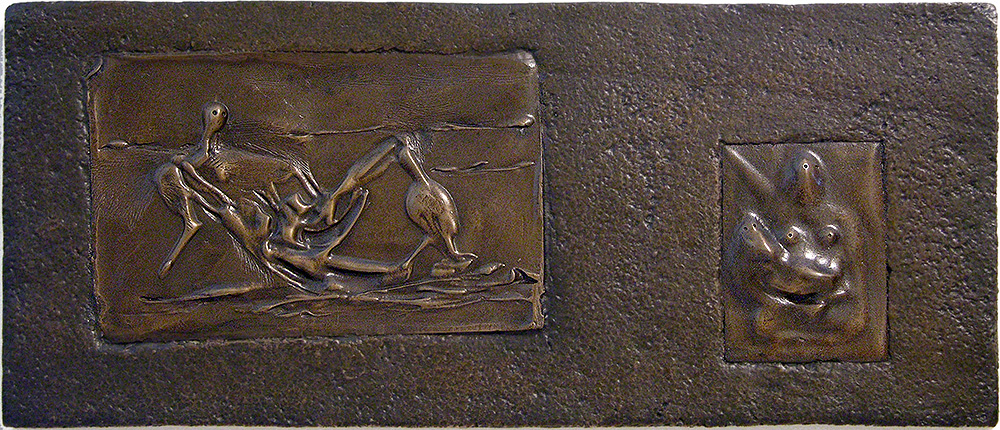
Moore, Henry, 3/4 Mother & Child and Reclining Figure, 1977
|
|
|
Signed Henry Moore, Sculpture, 3/4 Mother & Child and Reclining Figure, 1977 ![]() |
| Artist: | Moore, Henry (1898 - 1986) |
|---|---|
| Title: | 3/4 Mother & Child and Reclining Figure, 1977 |
| Medium: | Sculpted bronze / bronze sculpture |
| Image Size: | 16 1/2 in x 7 in (41.9 cm x 17.8 cm) |
| Framed Size: | 31 in x 21 1/2 in (78.8 cm x 54.6 cm) |
| Signed: | Hand-inscribed by Henry Moore (1898 - 1986) in the upper left edge/lip, Moore |
| Edition: | Inscribed in the upper left edge/lip, 5/9; out of the total edition of 9 cast by the Morris Singer Foundry |
| Condition: | Cast bronze in excellent condition |
| Illustrated In: | Henry Moore - Complete Sculpture, Volume 5 1974 - 1980. (1983) Bowness, A. (Ed.). Lund Humphries: London. Listed and illustrated as catalogue raisonné no. 728. |
|
Gallery Price
|
Item# 2506
|
| MFA SALE | 50% Off: $45,000 |
|
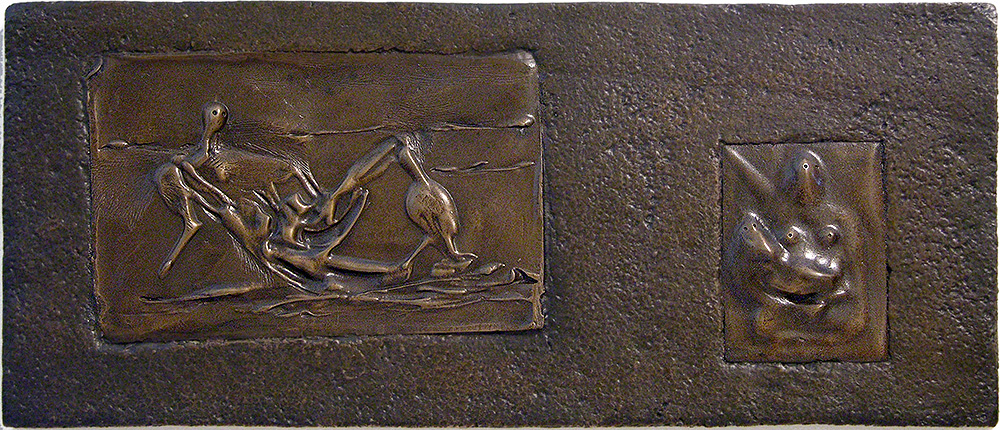
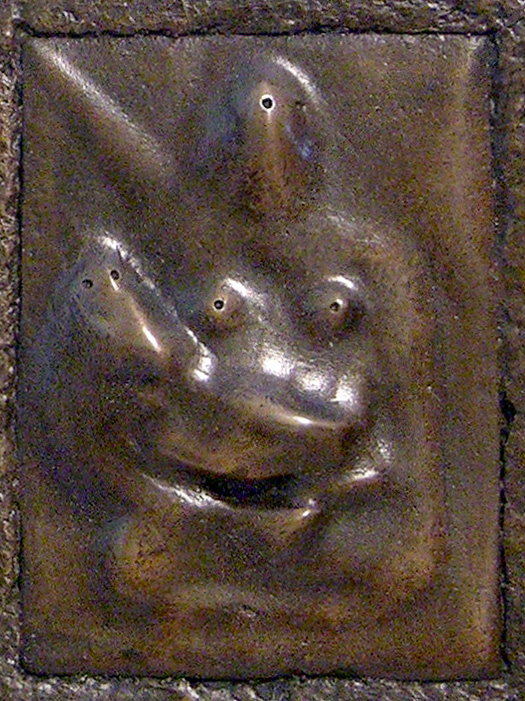
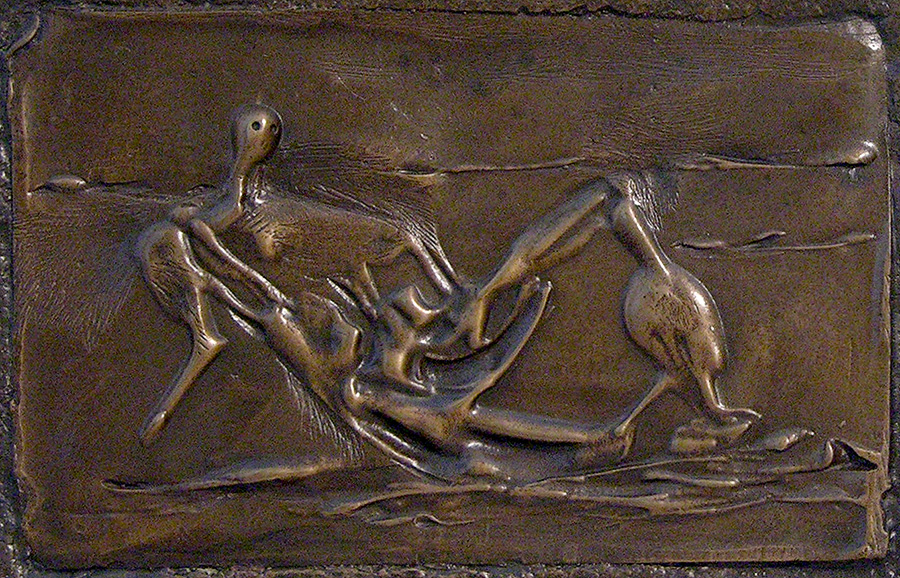
This beautiful cast bronze relief celebrates Henry Moore's fascination and appreciation of motherhood, femininity, and childhood. Abstracting the human form, Moore creates a work that appears as a figural study in which the mother and child meld together, their forms difficult to distinguish from one another as they appear as an effortlessly cohesive unit. |
|
|
Read more about our pricing |
|
|
Gallery Price: This is a common gallery retail price Read more about our pricing |
|
|
Request Invitation: We have openings for a few new members each day. Members receive exclusive offers on our entire inventory. |
|
| Historical Description: | |
This stunning work appears as a figural study cast in bronze; nostalgic and personal undertones can be felt through Moore's expressive line and manner in which the figures are raised slightly from the surface. One the left we see a small panel of the Reclining Figure; propped against one arm, the other rests listless on a raised knee. With both indented and raised elements, the composition shows Moore's artistry with the bronze medium and his ability to translate organic, fluid forms through sculpture. The small panel on the right features the Mother & Child; she swaddles and carries her baby in the way most women would. However, with such minimal detail, we are still able to assume the emotion, feeling, and tenderness that Moore has been able to capture with this intimate composition. Both panels are textured and transformative under the light - the small shadows cast by the raised silhouettes make way for illusory movement, breathing life into the bronze and evoking a more emotional and vivid reaction to its audience. Created in 1977 by the Morris Singer Foundry, this original cast bronze sculpture is hand-inscribed by Henry Moore (1898 - 1986) in the upper left edge/lip, 'Moore'. Numbered 5/9 from the total edition of 9. EXHIBITED: Provenance: Illustrated in: | |
| Style: | British Bronze Sculptor |
About Us: Masterworks Fine Art strives to be the best source of fine art for our clients and collectors all over the world. We believe the most direct way to accomplish this is by establishing a lifetime of personal and professional relationships with our clients. More About Us »
Do you own a similar Moore to sell? We offer free evaluations.
Biography of Henry Moore
Henry Moore (1898 - 1986)
British sculptor known for his large, semiabstract sculptures of the human figure. Henry Moore is considered the most prominent British sculptor of the 20th century, and his work had a strong influence on contemporary figural sculpture.
Moore was born in Castleford, Yorkshire, on July 30, 1898. From 1919 to 1925 he studied at the Leeds School of Art and the Royal College of Art in London. His early works, executed in the 1920s, show the influences of pre-Columbian art of the Americas, the massive figures of the Italian Renaissance artists Masaccio and Michelangelo, and the streamlined shapes of the Romanian-born French sculptor Constantin Brancusi. In the 1930s, the work of Pablo Picasso and of contemporary abstract artists were strong influences; many of Moore's works of that period are highly abstract, consisting of simplified, rounded pieces carved from wood, with numerous indentations and holes often spanned with veils of thin metal wires. The most important and lasting influence on Moore's work, however, was the world of nature. "The human figure," he later wrote, "is what interests me most deeply, but I have found principles of form and rhythm from the study of natural objects, such as pebbles, rocks, bones, trees, plants."
In his mature works, beginning with Reclining Figure (1936, City Art Gallery, Wakefield, England), Moore employed swelling shapes, undulating extensions, and rounded indentations that mirror natural forms. His favored themes include mother-and-child and family groups, fallen warriors, and, most characteristically, the reclining human figure, which he continued to depict throughout his career, working in wood, stone, and—after 1950—in bronze, and later in marble. These works range from the realistic—such as Draped Reclining Figure (1953, Time-Life Building, London), a massive Henry Moore sculpture of a woman reclining on her elbows—to the abstract—such as Internal and External Forms (1954, Albright-Knox Gallery, Buffalo, New York), a large, rounded bronze sculpture pierced by a hollow interior containing a second abstract metal form.
Unlike Moore's usually preparatory sketches for his sculpture, a series of drawings of Londoners huddled in tube stations during World War II air raids stand on their own as works of art. These so-called shelter drawings (1940 ff.) poignantly express the impact of war on defenseless civilians. One of the largest collections of Henry Moore sculptures, drawings, and prints is owned by the Art Gallery of Ontario, Toronto.
Among his major public commissions are outdoor sculptures for the UNESCO headquarters in Paris (1958); Lincoln Center of the Performing Arts, New York City (1965); the City Hall of Toronto, Ontario (1966); and the East Building of the National Gallery of Art, Washington, D.C. (1978). Moore died in Much Hadham, England, August 31, 1986.


Print Page
Email to Friend