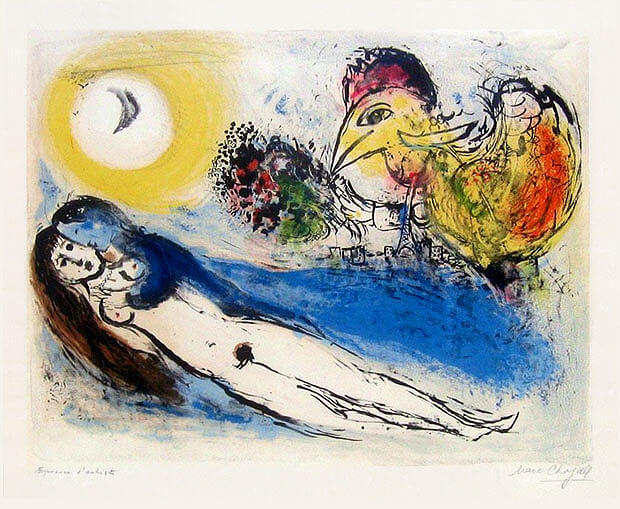
Marc Chagall, Bonjour sur Paris (Good Morning Over Paris), 1952 |
|
| Artist: | Marc Chagall (1887 - 1985) |
|---|---|
| Title: | Bonjour sur Paris (Good Morning Over Paris), 1952 |
| Medium: | Original Color Chagall Lithograph Printed on Arches wove paper |
| Image Size: | 20 3/4 in x 15 3/4 in (52.7 cm x 40 cm) |
| Sheet Size: | 26 in x 19 3/4 in (66 cm x 50.2 cm) |
| Framed Size: | 41 3/4 in x 36 3/4 in (106 cm x 93.3 cm) |
| Signature: | Hand signed by Marc Chagall (1887-1985) in pencil in the lower right margin |
| ID # | w-1640 |
Chagall enraptures us amidst an early dawn in this scene over Paris. With two lovers along the River Seine and an iconic rooster dominating the Parisian skyline, this piece evokes a peaceful and romantic tranquility.
Bonjour sur Paris was created in Paris, 1952 and published by Mourlot Press in 1955. Printed on Arches wove paper and annotated epreuve d'artiste (or, Artist's Proof) in pencil in the lower left margin aside from the total numbered edition of 75. Hand signed by Marc Chagall (1887 - 1985) in pencil in the lower right margin. Collector's ink stamp in blue in the lower left, verso; inscription in pen and ink on the reverse.
Known as the universal symbol of fertility, the red rooster is featured here as a compliment to the two lovers reclining along the river Seine in Paris. The twilight crescent moon is on the verge of fading into dawn as the early morning mist permeates the overall composition in a delicate yet brilliant blue. The bright yellows flatter the subtle reds detailed in the rooster's feathers and floral touches throughout the piece. The Parisian landscape is barely visible as our attention here is drawn moreso toward the main theme surrounding ideas of love and passion, using Paris as merely a romantic backdrop to Chagall's swirling canvas of color.
It is fully documented and referenced in the below catalogue raisonnés and texts (copies will be enclosed as added documentation with the invoices that will accompany the final sale of the work).
1) Gauss, Ulrike, ed. Marc Chagall: The Lithographs, La Collection Sorlier, illustrated on pg. 76 as cat. no. 71 and detailed on pg. 77.
2) Mourlot, Fernand and André Sauret, ed. The Lithographs of Chagall, 1960, listed as cat. no. 71 on pg. 101.
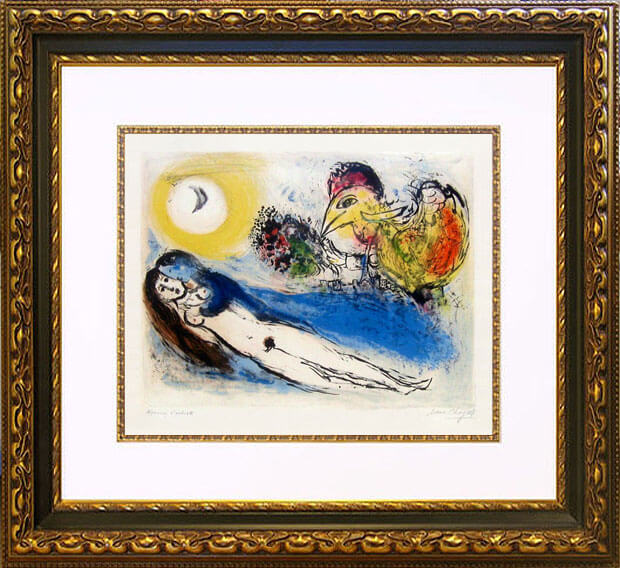
Framed with archival materials to museum quality, this work is set in a robust, gold-leaf frame with organic, sculptural details. The brilliancy of the gold in the moulding enhances the bright hues in this work while the floral elements and detail compliment the subject matter of this piece. Complete with white, silk-wrapped mattes and a matching gold inner fillet, Bonjour sur Paris is set behind an archival Plexiglas cover.
