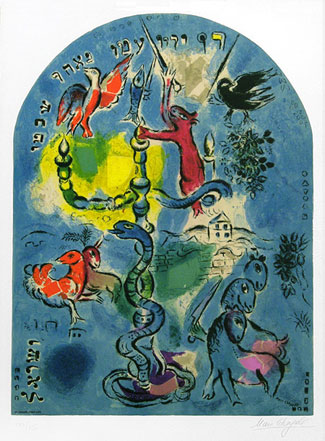
Marc Chagall, The Tribe of Dan, from The Twelve Maquettes of Stained Glass Windows for Jerusalem, 1964 |
|
| Artist: | Marc Chagall (1887 - 1985) |
|---|---|
| Title: | The Tribe of Dan, from The Twelve Maquettes of Stained Glass Windows for Jerusalem, 1964 |
| Series: | Twelve Maquettes of Stained Glass Windows, 1964 |
| Medium: | Original Color Chagall Lithograph |
| Image Size: | 24 in x 18 in (61 cm x 46 cm) |
| Sheet Size: | 29 in x 20 1/2 in (74 cm x 52 cm) |
| Framed Size: | Approx. 43 in x 35 3/4 in (109.2 cm x 90.8 cm) |
| Signature: | Hand signed by Marc Chagall (1887-1985) in pencil in the lower right margin |
| ID # | w-1976 |
A bright and beautiful work, this lithograph is from the series of twelve pieces inspired by the synagogue of the Hadassah-Hebrew Medical Center. Located just outside of Jerusalem, the synagogue commissioned Chagall to create twelve stain glass windows. Each window represents a different tribe. The tribe of Dan is particularly beautiful for its luminescent quality, beautiful organic and animal imagery, and most significantly, for its reverent symbolism and spiritual qualities.
Created in 1964, this work is printed on Arches wove paper and is published by Fernand Mourlot, Paris. On the lower right hand on the reverse side of the sheet, there is the printed text which states the title and reads in part, "Gouache sur Papier, Repuroudite en lithographie, Ch Sorlier, Graveur - Mourlot, Imp." Printed in collaboration with Charles Sorlier, this work is numbered in the lower left 40/150. This work is signed by Chagall in pencil in the lower right.
Chagall scholar and Jerusalem Windows expert Jean Leymarie states of this work, "A majestic three-branched candelabrum forms the central axis of this predominantly dark-blue composition. It rises both as the tree of life and as the tree of justice, and perhaps also as a symbol of sovereignty. Its flaming lights create an area of diffused yellow between the red animals, compensated by a green space below. Around the candelabrum twines the horned viper, dangerous serpent of the desert…" (Leymarie 49)
Catalogue Raisonné & COA:
It is fully documented and referenced in (copies will be enclosed as added documentation with the invoices that I will enclose with the sale of the work) :
1) Leymarie, Jean, Marc Chagall: The Jerusalem Windows, 1975, listed on page 49 with image on page 54.
2) Sorlier, Charles, Chagall Lithographs 1974-1979, 1984, listed as CS 18 on page 209.
3) Sorlier, Charles, Marc Chagall: The Illustrated Books, 1990, image listed on page 180.
4) Martin Lawrence Galleries Catalogue, Marc Chagall, 1999, listed as CS 18 on pg 60.
About the Framing:
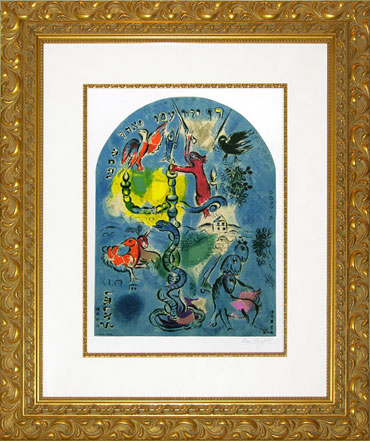
Conservation framed in a wonderfully fresh bright gold frame. The bright rich tones within the print are perfectly completed by the brightly stylish frame moulding. Framing in finished with a bright white linen matte, matching gold inner fillet, and Plexiglas cover. All materials are archival and museum quality.
NOTE: Our master framer custom frames all our works specifically for our company. If our selection of framing is not to your taste, we can easily custom frame the work to meet your needs.
