Signed original paintings, lithographs, etchings, drawings, sculptures for sale
Chagall lithograph
Picasso etching
Renoir etchings
Rembrandt etching
Vasarely sculptures
HOME > INVENTORY > CHAGALL > L'Ange (The Angel), 1960

CHAGALL, Marc, L'Ange (The Angel), 1960

Marc Chagall was born July 7, 1887, in Vitebsk, Russia. From 1907 to 1910, he studied in Saint Petersburg, at the Imperial Society for the Protecti… [Read biography »]

Print this pageEmail to a friend

Signed Marc Chagall (1887 - 1985), Original Color Lithograph, L'Ange (The Angel), 1960

CHAGALL signed, L\'Ange (The Angel), 1960

Place your cursor over the thumbnails below to view the full-size image:

CHAGALL signed, L\'Ange (The Angel), 1960 (thumbnail 1)CHAGALL signed, L\'Ange (The Angel), 1960 (thumbnail 2)CHAGALL signed, L\'Ange (The Angel), 1960 (thumbnail 3)CHAGALL signed, L\'Ange (The Angel), 1960 (thumbnail 4)
Artist: Chagall, Marc (1887 - 1985)
Title: L'Ange (The Angel), 1960
Medium: Original Color Lithograph
Image Size: 12 1/4 in x 10 1/4 in (31.12 cm x 26.04 cm)
Sheet Size: 20 7/8 in x 12 13/16 in (53 cm x 32.5 cm)
Framed Size: 35 in x 32 in (88.9 cm x 81.28 cm)
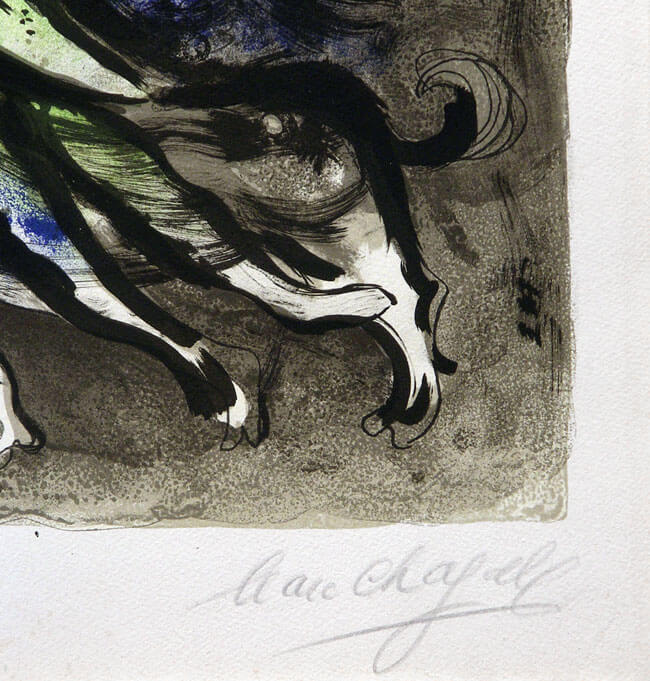
Signed: Hand signed by Marc Chagall (1887 - 1985) in pencil in the lower right
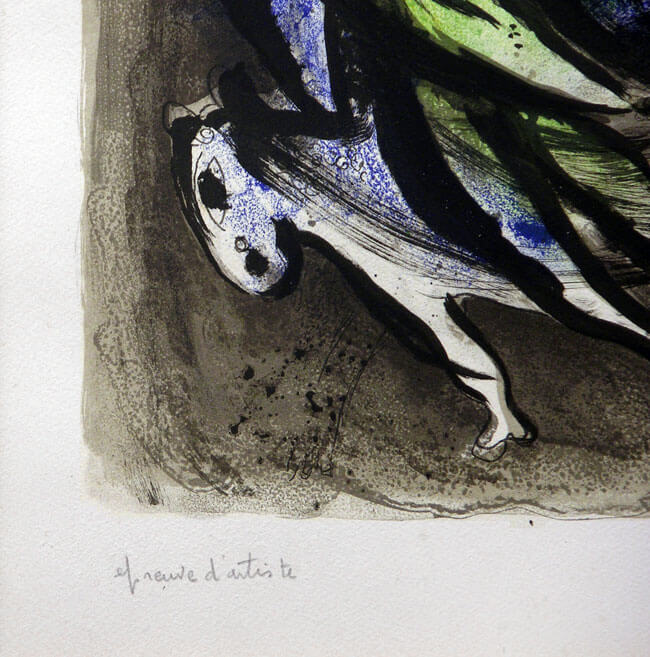
Edition: Annotated 'epreuve d'artiste (artist proof)' in pencil in the lower left margin [aside from the edition of 100]
Condition: Excellent
Price 
:

Item# 1671
$19,000


To speak directly with the Director, Alex Adelman, please call (510) 777-9970 / 1-800-805-7060.
 
Description:

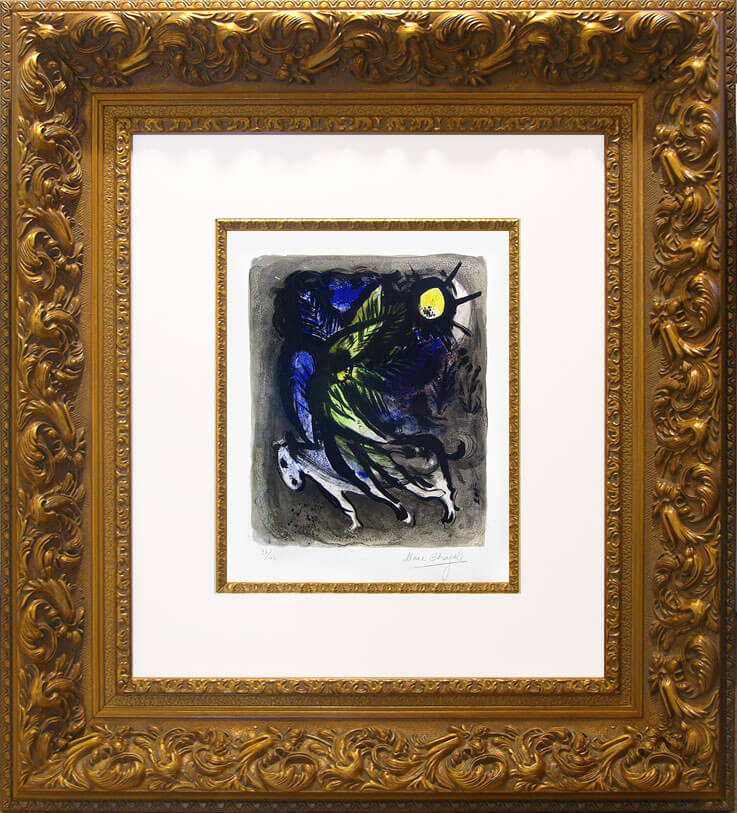
Using bold expressive forms, Chagall creates a poignant image depicting an angel and heifer.  Using darkened tones, the artist forces the viewer to draw closer to the work creating an intimate relationship between viewer and composition.

Created in 1960, this image was one of nine color lithographs created to accompany the first volume of The Lithographs of Chagall by Fernand Mourlot.  The work is pulled from an edition of forty aside from the book edition of 100 and is printed on Arches paper.

Emerging from the dark sepia background, the sun explodes highlighting the face and wings of the angel.  Chagall surrounds the angel and heifer with a tranquil blue that conveys a sense of new beginnings and hope free from the barren landscape that surrounds them.  As the angel serves as the focal point of the image, he/she appears focused upon aiding in the passage of the heifer across the ominous landscape.

“It is possible to be gifted in the handling of lines, even on the architectural level.  But what is most important is the blood, and the blood is, for the artist, the colour.  Colour and all its distinctions are the pulse of the organism.  Colour is the pulse of a work of art…  The same can be said about colour as is said about music: “The depth of colour goes through the eyes and remains within the soul, in the same way that music enters the ear and stays in the soul.” [Marc Chagall, excerpt from lecture in Chicago, February 1958]

Catalogue Raisonné & COA:
It is fully documented and referenced in the below catalogue raisonnés and texts (copies will be enclosed as added documentation with the invoices that will accompany the final sale of the work):

   1. Mourlot, Fernand, The Lithographs of Chagall 1957-1962, 1963, listed on page 92 and 96-97 as image 288.

   2. Cramer, Patrick, Marc Chagall: The Illustrated Books, 1995, listed on pages 148-149 as No. 43.

   3. Gauss, Ulrike, Marc Chagall The Lithographs La Collection Sorlier, 1999, listed on page 128 as image 288

About the Framing:
Framed in museum-quality, archival materials, this work is set in a Baroque-style gold leaf frame.  The shimmering tones of the gold moulding complements the bold tones in the work, found in the greens, blues, and thick black strokes throughout.  L’Ange is completed with white, linen-wrapped mats and a matching gold inner fillet, finished behind an archival Plexiglas® cover.

Style: Modern Master
 

Biography of Marc Chagall

Marc ChagallMarc Chagall (1887 - 1985)

Marc Chagall was born July 7, 1887, in Vitebsk, Russia. From 1907 to 1910, he studied in Saint Petersburg, at the Imperial Society for the Protection of the Arts and later with Léon Bakst. In 1910, he moved to Paris, where he associated with Guillaume Apollinaire and Robert Delaunay and encountered Fauvism and Cubism. He participated in the Salon des Indépendants and the Salon d'Automne in 1912. His first solo show was held in 1914 at Der Sturm gallery in Berlin.

Chagall visited Russia in 1914, and was prevented from returning to Paris by the outbreak of war. He settled in Vitebsk, where he was appointed Commissar for Art in 1918. He founded the Vitebsk Popular Art School and directed it until disagreements with the Suprematists resulted in his resignation in 1920. He moved to Moscow and executed his first stage designs for the State Jewish Chamber Theater there. After a sojourn in Berlin, Chagall returned to Paris in 1923 and met Ambroise Vollard. His first retrospective took place in 1924 at the Galerie Barbazanges-Hodebert, Paris. During the 1930s, he traveled to Palestine, the Netherlands, Spain, Poland, and Italy. In 1933, the Kunsthalle Basel held a major retrospective of his work.

During World War II, Chagall fled to the United States. The Museum of Modern Art, New York, gave him a retrospective in 1946. He settled permanently in France in 1948 and exhibited in Paris, Amsterdam, and London. During 1951, he visited Israel and executed his first sculptures. The following year, the artist traveled in Greece and Italy. During the 1960s, Chagall continued to travel widely, often in association with large-scale commissions he received. Among these were windows for the synagogue of the Hadassah-Hebrew University Medical Center, Jerusalem, installed in 1962; a ceiling for the Paris Opéra, installed in 1964; a window for the United Nations building, New York, installed in 1964; murals for the Metropolitan Opera House, New York, installed in 1967; and windows for the cathedral in Metz, France, installed in 1968. An exhibition of the artist's work from 1967 to 1977 was held at the Musée du Louvre, Paris, in 1977-78, and a major retrospective was held at the Philadelphia Museum of Art in 1985. During his lifetime he also created popular lithographs, such as Maternity. Chagall died March 28, 1985, in Saint-Paul-de-Vence, France.
