Signed original paintings, lithographs, etchings, drawings, sculptures for sale
Chagall lithograph
Picasso etching
Renoir etchings
Rembrandt etching
Vasarely sculptures
HOME > INVENTORY > CHAGALL > Le soir d'été (The Summer Evening), 1968

CHAGALL, Marc, Le soir d'été (The Summer Evening), 1968

Marc Chagall was born July 7, 1887, in Vitebsk, Russia. From 1907 to 1910, he studied in Saint Petersburg, at the Imperial Society for the Protecti… [Read biography »]

Print this pageEmail to a friend

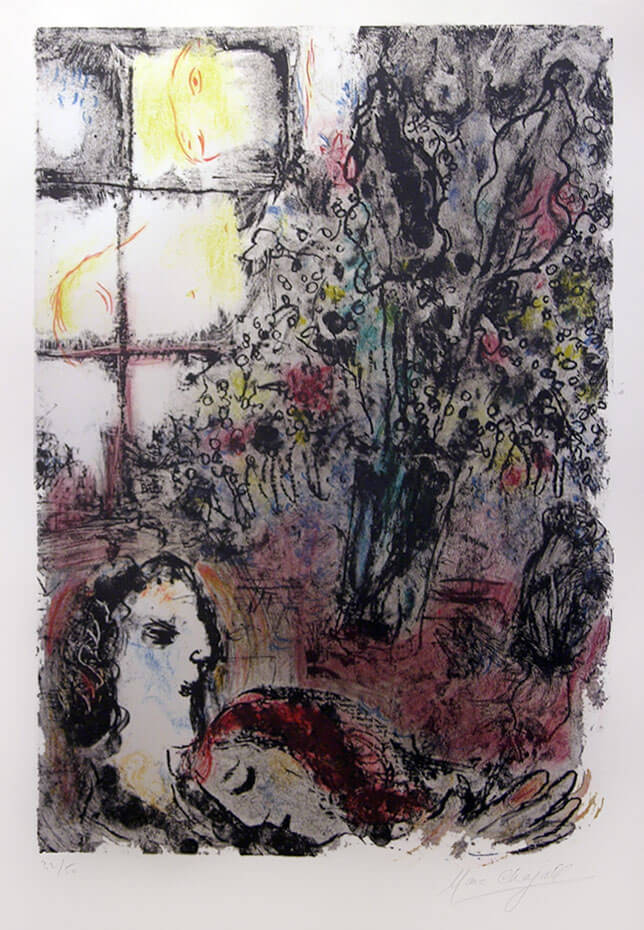
Signed Marc Chagall (1887 - 1985), Original Color Lithograph, Le soir d'été (The Summer Evening), 1968

CHAGALL signed, Le soir d\'été (The Summer Evening), 1968

Place your cursor over the thumbnails below to view the full-size image:

CHAGALL signed, Le soir d\'été (The Summer Evening), 1968 (thumbnail 1)CHAGALL signed, Le soir d\'été (The Summer Evening), 1968 (thumbnail 2)CHAGALL signed, Le soir d\'été (The Summer Evening), 1968 (thumbnail 3)CHAGALL signed, Le soir d\'été (The Summer Evening), 1968 (thumbnail 4)
Artist: Chagall, Marc (1887 - 1985)
Title: Le soir d'été (The Summer Evening), 1968
Medium: Original Color Lithograph
Image Size: 23.6 in x 16.5 in (60 cm x 42 cm)
Sheet Size: 29.7 in x 20.7 in (75.5 cm x 52.5 cm)
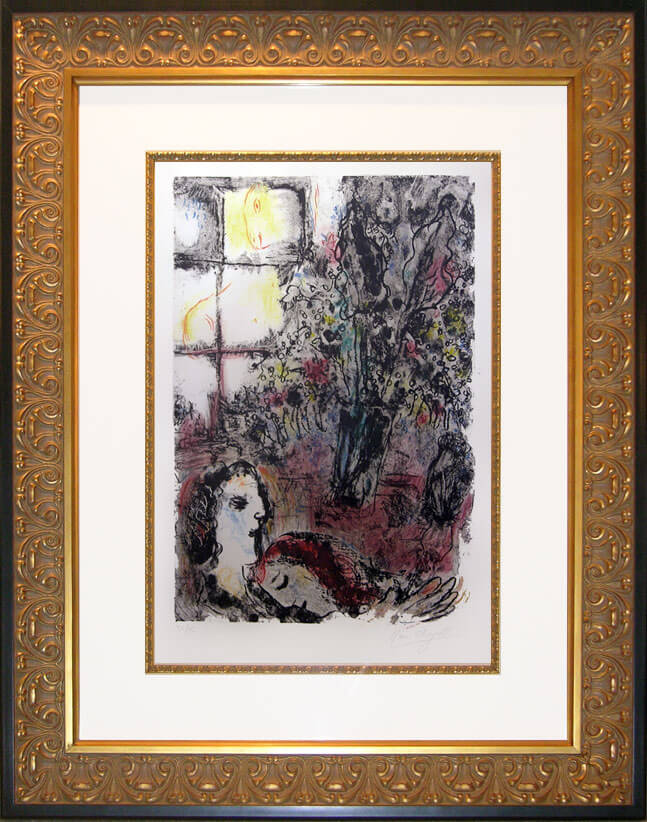
Framed Size: 45 in x 36 in (114.3 cm x 91.44 cm)
Signed: Hand signed by Marc Chagall (1887 - 1985) in pencil in the lower right
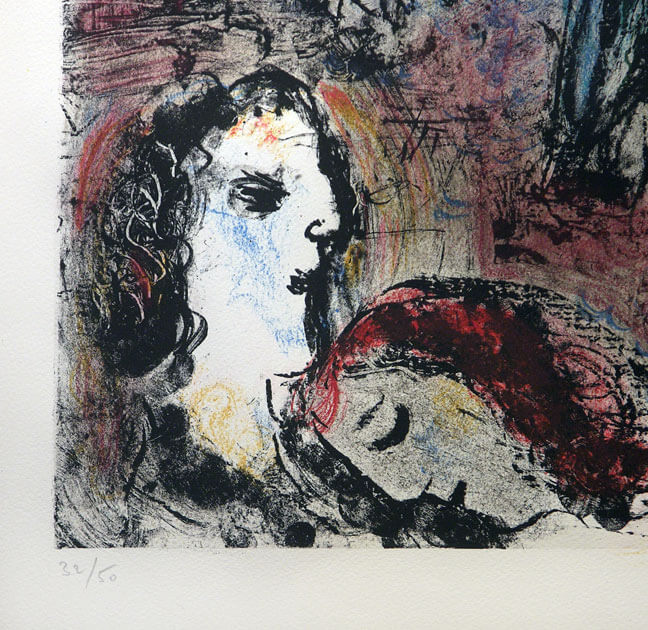
Edition: Numbered 32/50 in pencil in the lower left
Condition: Excellent
Price:

Item# 1660
$SOLD  Please visit the rest of our CHAGALL inventory »
Description:

Incredibly bold and bright with rich color saturation throughout the entire print, The Summer Evening is full of Chagall's traditional iconography most widely recognized in his color lithographs. Featuring a lush bouquet with highly expressive strokes and abundant detail, we also see a profile study of an embracing couple along the lower margin who are before a stunning window. Having been inspired by his immediate Parisian surroundings during this period, this work also reflects the complete sensory experience one can find while immersed one of Chagall's opulent and colorful prints.

Created in Paris in 1968, this work is hand signed by Marc Chagall (1887 - 1985) in pencil in the lower right margin and numbered 32/50 in pencil in the lower left margin. Printed on Vélin d'Arches paper out of the total edition of 50 (aside from a few artist's proofs) .

Catalogue Raisonné & COA:
It is fully documented and referenced in (copies will be enclosed as added documentation with the invoices that will accompany the final sale of the work) :

1. Gauss, Ulrike, ed. Marc Chagall, The Lithographs - la Collection Sorlier. Listed as catalogue raisonné no. 545 on pg. 257 and illustrated on pg. 259.

2. Sorlier, Charles. Chagall Lithographs, vol. III 1962 - 1968, Crown Publishers, Inc.: New York, 1986. Listed and illustrated as catalogue raisonné no. 545 on pg. 159.

About the Framing:
Framed in museum-quality, archival materials, this work is set in a Spanish-style black and gold leaf frame. The shimmering tones of the gold moulding complements the cool tones in the work, found in the solid block colors of the paper collage. Lilacs is completed with white, linen-wrapped mats and a matching gold inner fillet, finished behind an archival Plexiglas® cover.

Style: Modern Master

Biography of Marc Chagall

Marc ChagallMarc Chagall (1887 - 1985)

Marc Chagall was born July 7, 1887, in Vitebsk, Russia. From 1907 to 1910, he studied in Saint Petersburg, at the Imperial Society for the Protection of the Arts and later with Léon Bakst. In 1910, he moved to Paris, where he associated with Guillaume Apollinaire and Robert Delaunay and encountered Fauvism and Cubism. He participated in the Salon des Indépendants and the Salon d'Automne in 1912. His first solo show was held in 1914 at Der Sturm gallery in Berlin.

Chagall visited Russia in 1914, and was prevented from returning to Paris by the outbreak of war. He settled in Vitebsk, where he was appointed Commissar for Art in 1918. He founded the Vitebsk Popular Art School and directed it until disagreements with the Suprematists resulted in his resignation in 1920. He moved to Moscow and executed his first stage designs for the State Jewish Chamber Theater there. After a sojourn in Berlin, Chagall returned to Paris in 1923 and met Ambroise Vollard. His first retrospective took place in 1924 at the Galerie Barbazanges-Hodebert, Paris. During the 1930s, he traveled to Palestine, the Netherlands, Spain, Poland, and Italy. In 1933, the Kunsthalle Basel held a major retrospective of his work.

During World War II, Chagall fled to the United States. The Museum of Modern Art, New York, gave him a retrospective in 1946. He settled permanently in France in 1948 and exhibited in Paris, Amsterdam, and London. During 1951, he visited Israel and executed his first sculptures. The following year, the artist traveled in Greece and Italy. During the 1960s, Chagall continued to travel widely, often in association with large-scale commissions he received. Among these were windows for the synagogue of the Hadassah-Hebrew University Medical Center, Jerusalem, installed in 1962; a ceiling for the Paris Opéra, installed in 1964; a window for the United Nations building, New York, installed in 1964; murals for the Metropolitan Opera House, New York, installed in 1967; and windows for the cathedral in Metz, France, installed in 1968. An exhibition of the artist's work from 1967 to 1977 was held at the Musée du Louvre, Paris, in 1977-78, and a major retrospective was held at the Philadelphia Museum of Art in 1985. During his lifetime he also created popular lithographs, such as Maternity. Chagall died March 28, 1985, in Saint-Paul-de-Vence, France.