Signed original paintings, lithographs, etchings, drawings, sculptures for sale
Chagall lithograph
Picasso etching
Renoir etchings
Rembrandt etching
Vasarely sculptures
HOME > INVENTORY > CHAGALL > The Tribe of Zebulun from The Twelve Maquettes Of Stained Glass Windows For Jerusalem, 1964

CHAGALL, Marc, The Tribe of Zebulun from The Twelve Maquettes Of Stained Glass Windows For Jerusalem, 1964

Marc Chagall was born July 7, 1887, in Vitebsk, Russia. From 1907 to 1910, he studied in Saint Petersburg, at the Imperial Society for the Protecti… [Read biography »]

Print this pageEmail to a friend

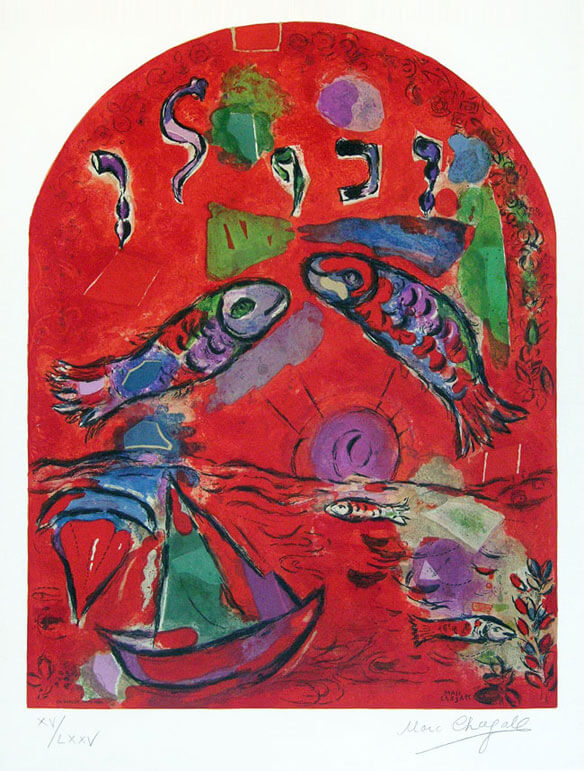
Signed Marc Chagall (1887 - 1985), Original Color Lithograph, The Tribe of Zebulun from The Twelve Maquettes Of Stained Glass Windows For Jerusalem, 1964

CHAGALL signed, The Tribe of Zebulun from The Twelve Maquettes Of Stained Glass Windows For Jerusalem, 1964

Place your cursor over the thumbnails below to view the full-size image:

CHAGALL signed, The Tribe of Zebulun from The Twelve Maquettes Of Stained Glass Windows For Jerusalem, 1964 (thumbnail 1)CHAGALL signed, The Tribe of Zebulun from The Twelve Maquettes Of Stained Glass Windows For Jerusalem, 1964 (thumbnail 2)CHAGALL signed, The Tribe of Zebulun from The Twelve Maquettes Of Stained Glass Windows For Jerusalem, 1964 (thumbnail 3)CHAGALL signed, The Tribe of Zebulun from The Twelve Maquettes Of Stained Glass Windows For Jerusalem, 1964 (thumbnail 4)
Artist: Chagall, Marc (1887 - 1985)
Title: The Tribe of Zebulun from The Twelve Maquettes Of Stained Glass Windows For Jerusalem, 1964
Medium: Original Color Lithograph
Image Size: 24 in X 18 in (61 cm x 46 cm)
Sheet Size: 29.25 in X 20.68 in (74.3 cm x 52.53 cm)
Framed Size: 44 in x 37 1/3 in (111.76 cm x 94.8 cm)
Signed: Hand signed by Marc Chagall (1887-1985) in pencil in the lower right margin
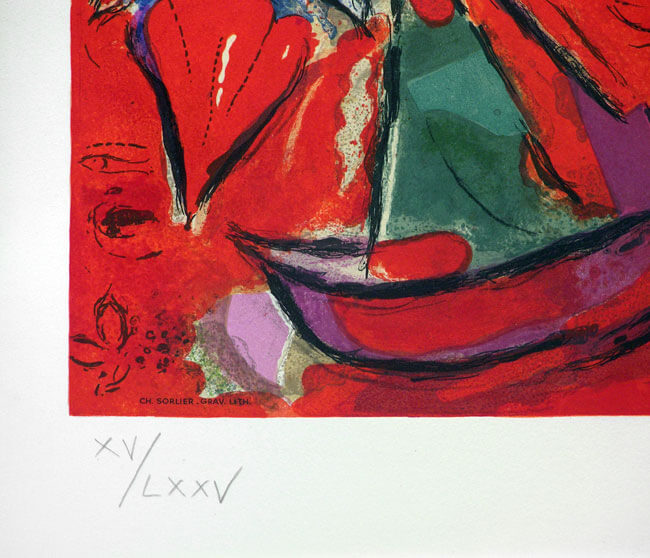
Edition: Numbered in roman numerals 'XV/LXXV' in pencil in the lower left margin
Condition: Excellent
Price 
:

Item# 1648
$24,000


To speak directly with the Director, Alex Adelman, please call (510) 777-9970 / 1-800-805-7060.
 
Description:

Created in 1964, this image is part of a series of twelve lithographs which Chagall designed after the stain glass windows he created for the synagogue of the Hadassah-Hebrew Medical Center, located just outside of Jerusalem. Hand signed by March Chagall in pencil in the lower right margin, the work was engraved and printed by Charles Sorlier in collaboration with Marc Chagall on Arches wove paper; the Arches watermark appears vertically in the right margin. On the lower right hand on the reverse side of the sheet, there is printed text which reads, "MARC CHAGALL, MAQUETTE DU VITRAIL 'ZEBULUN', pour Jérusalem, repuroudite en lithographie, Ch Sorlier, graveur - Mourlot, Imp." The engraver's signature also appears in the plate in the lower left hand side. This piece is from a larger edition of 150, numbered in roman numerals 'XV/LXXV' in pencil in the lower left margin.

Explosive uses of bold, rich reds swirl throughout the entire composition, allowing for Zebulun's characters to seemingly leap from the work. Highly symbolic and incredibly rich in meaning, the figures also form to create the name, 'Zebulun' in Hebrew letters along the upper area of the piece.

According to Jean Leymarie:

"Issachar and Zebulun, the two youngest children of Leah, are joined together in the blessing of Moses who assigns to the two tribes a prosperous destiny….Jacob blessed Zebulun and Issachar separately, giving the priority to Zebulun…He predicted for him a maritime vocation, and designated him as 'an haven of ships; and his border shall be unto Zion.' The ship is the usual symbol for Zebulun. (77) "

Catalogue Raisonné & COA:
It is fully documented and referenced in (copies will be enclosed as added documentation with the invoices that I will enclose with the sale of the work) :

1) Leymarie, Jean. Marc Chagall: The Jerusalem Windows, Park Lane: New York, 1988. Illustrated and detailed on pgs. 77-87.

2) Sorlier, Charles. Chagall Lithographs, vol. V 1974-79, Crown Publishers: New York, 1984. Listed and illustrated as catalogue raisonné no. CS 16 on pg. 207 with additional details on pgs. 201-2 and 215.

About the Framing:
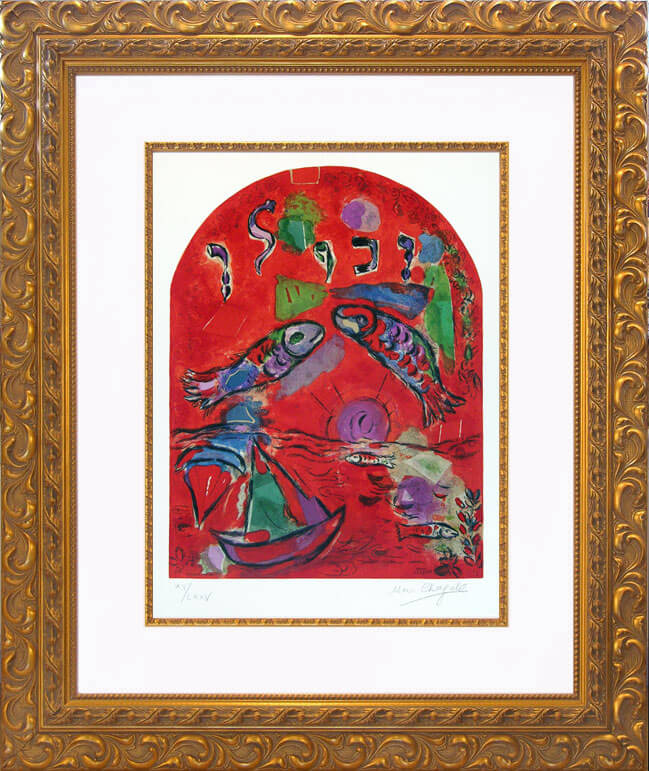
Framed in a robust, Baroque-style gold moulding. Rich, undulating sculptural details gracefully compliment the movement within this work without overtaking or distracting from Chagall's beautiful window. Framing is completed with white, linen-wrapped mats, a matching gold inner fillet set behind an archival Plexiglas® cover.

Style: Modern Master
 

Biography of Marc Chagall

Marc ChagallMarc Chagall (1887 - 1985)

Marc Chagall was born July 7, 1887, in Vitebsk, Russia. From 1907 to 1910, he studied in Saint Petersburg, at the Imperial Society for the Protection of the Arts and later with Léon Bakst. In 1910, he moved to Paris, where he associated with Guillaume Apollinaire and Robert Delaunay and encountered Fauvism and Cubism. He participated in the Salon des Indépendants and the Salon d'Automne in 1912. His first solo show was held in 1914 at Der Sturm gallery in Berlin.

Chagall visited Russia in 1914, and was prevented from returning to Paris by the outbreak of war. He settled in Vitebsk, where he was appointed Commissar for Art in 1918. He founded the Vitebsk Popular Art School and directed it until disagreements with the Suprematists resulted in his resignation in 1920. He moved to Moscow and executed his first stage designs for the State Jewish Chamber Theater there. After a sojourn in Berlin, Chagall returned to Paris in 1923 and met Ambroise Vollard. His first retrospective took place in 1924 at the Galerie Barbazanges-Hodebert, Paris. During the 1930s, he traveled to Palestine, the Netherlands, Spain, Poland, and Italy. In 1933, the Kunsthalle Basel held a major retrospective of his work.

During World War II, Chagall fled to the United States. The Museum of Modern Art, New York, gave him a retrospective in 1946. He settled permanently in France in 1948 and exhibited in Paris, Amsterdam, and London. During 1951, he visited Israel and executed his first sculptures. The following year, the artist traveled in Greece and Italy. During the 1960s, Chagall continued to travel widely, often in association with large-scale commissions he received. Among these were windows for the synagogue of the Hadassah-Hebrew University Medical Center, Jerusalem, installed in 1962; a ceiling for the Paris Opéra, installed in 1964; a window for the United Nations building, New York, installed in 1964; murals for the Metropolitan Opera House, New York, installed in 1967; and windows for the cathedral in Metz, France, installed in 1968. An exhibition of the artist's work from 1967 to 1977 was held at the Musée du Louvre, Paris, in 1977-78, and a major retrospective was held at the Philadelphia Museum of Art in 1985. During his lifetime he also created popular lithographs, such as Maternity. Chagall died March 28, 1985, in Saint-Paul-de-Vence, France.
