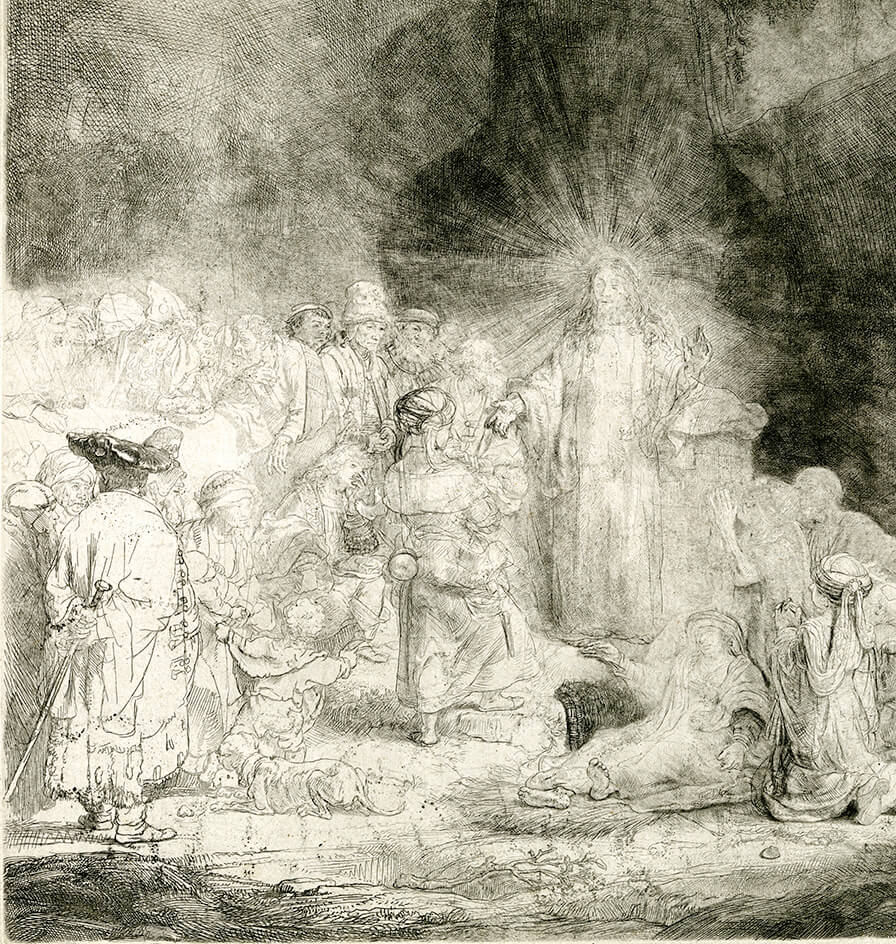

Rembrandt, The Hundred Guilder Print (Christ Healing the Sick), c. 1649 |
|
| Artist: | Rembrandt (1606 - 1669) |
|---|---|
| Title: | The Hundred Guilder Print (Christ Healing the Sick), c. 1649 |
| Reference: | B. 74, H. 236, BB 49-I, B&W 74 |
| Medium: | Drypoint and Etching |
| Image Size: | 15 5/8 in x 11 in (39.7 cm x 27.9 cm) |
| Sheet Size: | 16 1/2 in x 11 3/4 in (41.9 cm x 29.8 cm) |
| Framed Size: | 32 1/2 in x 28 in (82.55 cm x 71.12 cm) |
| Edition: | A Nowell-Usticke state V (of V); printed on a fine laid paper with the Dovecote watermark, dating this piece to c. 1742, before the reworking of the plate by Captain William Baillie in 1775. |
| Signature: | This work is not signed or dated in the plate, as discussed by scholar Nowell-Usticke. |
| ID # | w-8086 |
|
|
|
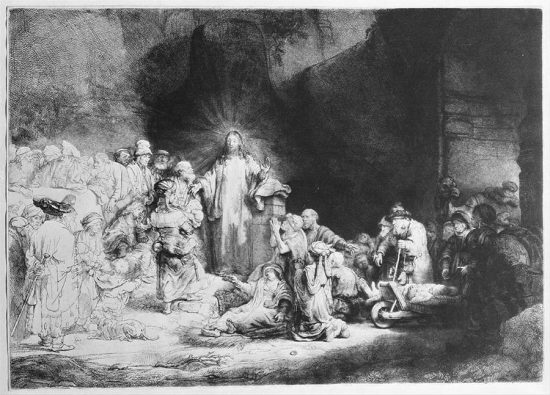
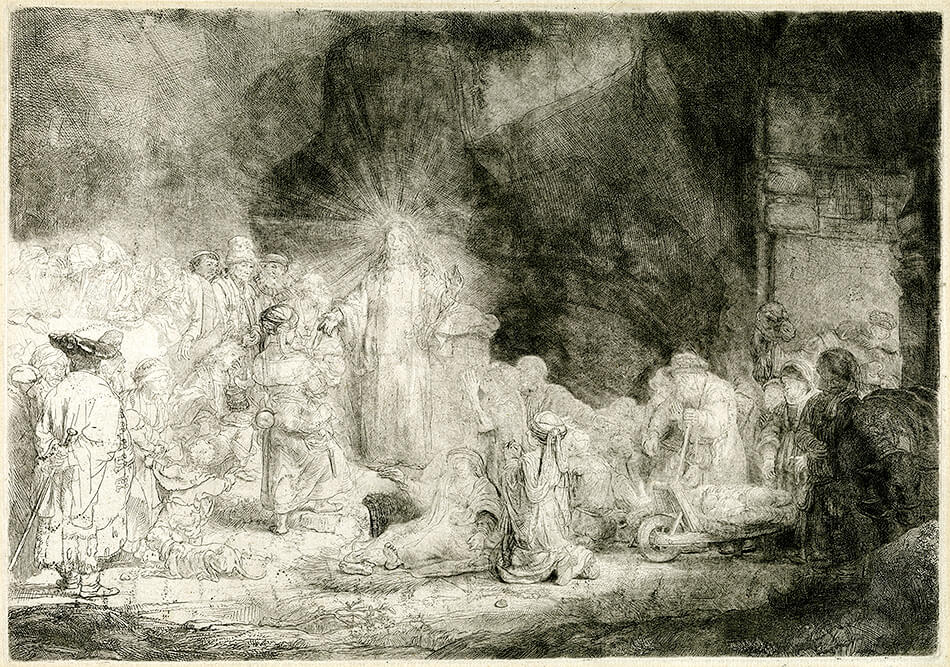
Acclaimed as the apotheosis of Rembrandt's etched works, Rembrandt The Hundred Guilder Print (Christ Healing the Sick), c. 1649, with its large size and incredibly detailed depictions of human expression, is Rembrandt's most desirable print.
While scholars disagree on the exact origin of the notorious title of this print, the fact remains that, from its creation, The Hundred Guilder Print has always been a valuable and much sought after work. Rembrandt scholar Christopher White traces the origin of the title to a print seller named Mariette, who claims to have sold an impression of this print back to Rembrandt himself for 100 Guilders, while engraver Jan Meyssens of Antwerp claimed in a letter dated February 9, 1654 that it had been sold in Holland various times for 100 guilders. Though much time has passed since its creation, this print remains Rembrandt's most valuable etching.
The Hundred Guilder Print depicts a distinct turning point in Rembrandt's artistic style, contributing to the historical importance of this work. Rembrandt's powerful use of light and shadow to create a heightened sense of drama first became strikingly apparent in The Hundred Guilder Print, as we witness Christ illuminated at the center of the composition, standing against a dark and mysterious background. Rembrandt's remarkable ability to capture the unique physical and emotional characteristics of his subjects is also noteworthy in this astounding work. He uses delicate lines to convey realistic human expression as no other artist can, evoking a sense of compassion and humanity from viewers.
Created in c.1649, this particular impression is printed on a fine laid paper with the Dovecote watermark, dating this piece to c. 1742. This work is a remarkable Nowell-Usticke state V (of V) before the reworking of the plate by Captain William Baillie in 1775. Nowell-Usticke notes this to be a very uncommon piece with approximately 125-225 known impressions (Usticke 12, B 74).
Provenance:
1. Prince of Lichnowsky collector's stamp on verso (Lugt 1707)
Catalogue Raisonné & COA:
Rembrandt The Hundred Guilder Print (Christ Healing the Sick), c. 1649 is fully documented and referenced in the below catalogue raisonnés and texts (copies will be enclosed as added documentation with the invoices accompanying the final sale of the work):
1. Ash, Nancy & Shelley Fletcher. Watermarks in Rembrandt's Prints. Washington D.C., 1998. Rembrandt The Hundred Guilder Print (Christ Healing the Sick), c. 1649, Watermark listed and illustrated as catalogue no. 14 Dovecote A.a.
2. Biörklund, George, Rembrandt's Etchings: True and False, 1968. Rembrandt The Hundred Guilder Print (Christ Healing the Sick), c. 1649, Listed and illustrated as catalogue raisonné no. BB 49-I.
3. Boon, K.G., Rembrandt The Complete Etchings, 1965. Rembrandt The Hundred Guilder Print (Christ Healing the Sick), c. 1649, Image listed as plate 216 with full size details.
4. Hind, Arthur, A Catalogue of Rembrandt's Etchings, 1967. Rembrandt The Hundred Guilder Print (Christ Healing the Sick), c. 1649, Listed and illustrated as catalogue raisonné no. 236.
5. Nowell-Usticke, G.W., Rembrandt's Etchings, 1988. Rembrandt The Hundred Guilder Print (Christ Healing the Sick), c. 1649, Listed and illustrated as catalogue raisonné no. B 74.
6. Schwartz, Gary, Rembrandt: All the etchings reproduced in true size, 1977. Rembrandt The Hundred Guilder Print (Christ Healing the Sick), c. 1649, Listed and illustrated as catalogue raisonné no. B 74.
7. White, Christopher and Boon, Karel, Rembrandt's Etchings, Vol. 1, 1969. Rembrandt The Hundred Guilder Print (Christ Healing the Sick), c. 1649, Listed and illustrated as catalogue raisonné no. B 74.
8. White, Christopher and Boon, Karel, Rembrandt's Etchings, Vol. 2, 1969. Rembrandt The Hundred Guilder Print (Christ Healing the Sick), c. 1649, Listed and illustrated as catalogue raisonné no. B 74.
9. White, Christopher, Rembrandt as an Etcher, 1969, Vol. 1. Rembrandt The Hundred Guilder Print (Christ Healing the Sick), c. 1649, Discussed on pages 56-57.
10. White, Christopher, Rembrandt as an Etcher, 1969, Vol. 2. Rembrandt The Hundred Guilder Print (Christ Healing the Sick), c. 1649, Listed as plate 62.
11. A Certificate of Authenticity will accompany our Rembrandt The Hundred Guilder Print (Christ Healing the Sick), c. 1649.
About the Framing:
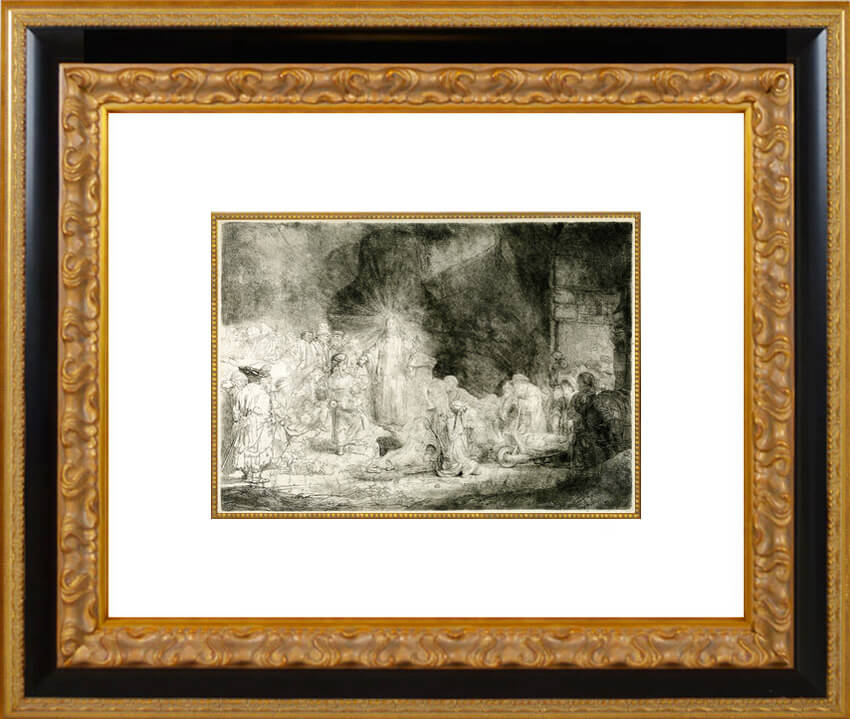
Rembrandt The Hundred Guilder Print (Christ Healing the Sick), c. 1649 is framed to museum-grade, conservation standards, presented in a complimentary moulding and finished with silk-wrapped mats and optical grade Plexiglas.