
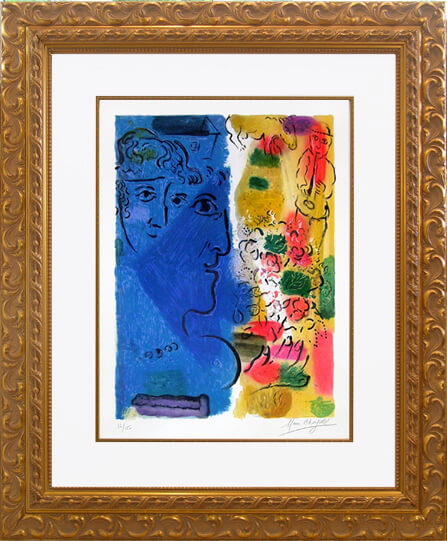
Marc Chagall, Affiche d'Exposition (Profil bleu), 1967 |
|
| Artist: | Marc Chagall (1887 - 1985) |
|---|---|
| Title: | Affiche d'Exposition (Profil bleu), 1967 |
| Medium: | Original Color Chagall Lithograph |
| Image Size: | 25 in x 18 3/4 in (63.5 cm x 47.6 cm) |
| Sheet Size: | 30 in x 22 1/2 in (76.2 cm x 57.2 cm) |
| Framed Size: | 45 in x 38 in (114.3 cm x 96.5 cm) |
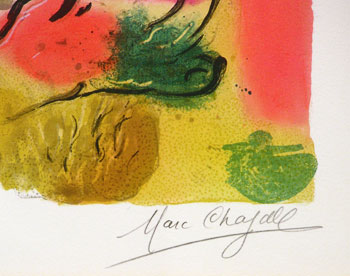
| Signature: | Hand signed by Marc Chagall (1887-1985) in pencil the lower right margin |
| ID # | w-1133 |
This bold and bright work captures the viewer's eye with the use of strong contrasting tones separating each half of the work. Utilizing his skill in depicting dreamlike imagery with a vibrant palette, Chagall creates two scenes in one, with a strong vertical separation along the middle of the image.
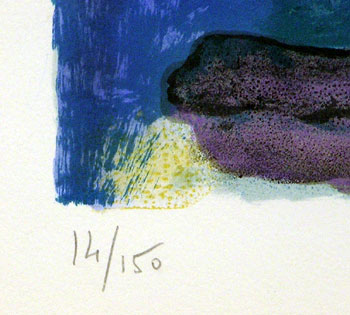
Created in 1967, this original color lithograph is printed on Arches Velin with a Script watermark. Numbered 14/150 in the lower left, this work is signed by Chagall in the lower right. Created for the Chagall exhibition at the Maeght Foundation, this work is from the avant la lettre edition. Printed by Mourlot, Paris, this work was published by Editions Maeght, Paris.
Depicting a scene of simultaneous joy and bright cheer on one side, contrasting with a somber and introspective side, Chagall expresses two halves of his skill in illustrating a sense of mood and feeling. On the left, deep blues occupy the majority of the page, with a face in profile overlapping another face looking out toward the viewer. Each of these portraits appears peaceful and happy in the solitude they reflect. At the right of the page, an extremely opposite sense occurs with bright joyful colors and a lively interaction of images and characters. A man in the upper right happily plays a tune, with a horse standing to his left. Below them, a bursting bouquet of pinks, reds, oranges and yellows spills over toward an outreaching hand of the same vibrant hues. Chagall's use of dreamlike imagery and emotive colors in this work, expresses his sentiment for the harmonious interaction of man and nature.
It is fully documented and referenced in (copies will be enclosed as added documentation with the invoices that I will enclose with the sale of the work) :
1) Cain, Julien, The Lithographs of Chagall (1962 - 1968) , Vol III, 1969, image listed as cat. no. m 476 on pg 111.
2) Gauss, Ulrike, Marc Chagall, The Lithographs, image listed as cat. no. 476 on pg 209.
3) Sorlier, Charles, Chagall's posters: A Catalogue Raisonné, 1975, image listed on pgs 52 and 53.
Conservation framed with archival materials and museum quality, this work is set in an ornate gold leaf frame. The sculptural elements of the moulding compliment the lyrical and loose linear quality of this piece. The bright tone of the framing accentuates the vibrant hues in the image. Completed with cream linen wrapped mattes and a matching gold inner fillet, this work is set behind an archival Plexiglas cover.
