BETA USA Flag, English translation English - Spain Flag, traducción al español Español - France Flag, Traduction en français Français
Signed original prints, drawings, paintings, and sculptures for sale
fine art home > BUY ORIGINALS > HENRI MATISSE


Search artists…

Original Henri Matisse Paintings & Prints

Sort by:

Henri Matisse is recognized as one of the greatest stewards of post-Impressionism and pre-Modernism to emerge from France in the early 20th century. His definitive use of line and color has been able to capture the human form in lush, feminine settings. Through his works, Matisse was able to hint at the direction in which Modern Art was headed; composition, abstraction, and light all became essential elements in his pieces. Moreover, Matisse was able to translate this sensibility into a print medium, allowing Matisse etchings, lithographs, and aquatints to reach a broader audience. [Read biography »]

Previous artist
Next artist
Print this page

 
Title: Odalisque sur la terrasse (Odalisque on the Terrace), 1922
Artist: Matisse, Henri
Reference: Ginestet/Pouillon 633
Medium: Original color aquatint on Arches block watermarked paper
Image Size: 23 1/2 in x 19 in (59.7 cm x 48.3 cm)
Sheet Size: 32 3/4 in x 24 1/2 in (83.2 cm x 62.2 cm)
Framed Size: 42 1/2 in x 39 in (108 cm x 99 cm)
Signed: Hand signed by Henri Matisse (1869 – 1954) in black ink in the lower right margin; also signed by Matisse in the plate in the lower left. 
Edition: Numbered 130/200 in black ink in the lower left margin.  Annotation in the lower left of the plate, ‘gravé par Jacques Villon 1922’
Condition: This work is in good condition with bright, bold colors and a visible plate mark all around; with very wide margins
Price 
:

Item# 818
$78,000
   Submit best offer
No reasonable offer will be refused!
(Sales not combinable and not available on prior sales or trade ups)

To speak directly with the Director, Alex Adelman, please call (510) 777-9970 / 1-800-805-7060.

Full DescriptionPurchase Now
Back to top
 
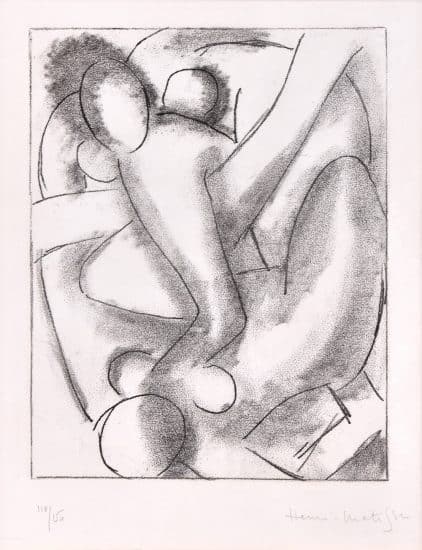
Title: Nu pour Cleveland (Nude For Cleveland), 1932
Artist: Matisse, Henri
Medium: Original Matisse Etching
Image Size: 14 1/2 in. x 11 3/8 in. (36.8 cm x 28.9 cm)
Signed: Hand signed by Henri Matisse (1869 - 1954) in pencil in the lower right margin: 'Henri Matisse'
Edition: Numbered 133 out of 250 in pencil in the lower right margin.
Condition: This work is in excellent condition
Price 
:

Item# 2962
$40,000
   Submit best offer
No reasonable offer will be refused!
(Sales not combinable and not available on prior sales or trade ups)

To speak directly with the Director, Alex Adelman, please call (510) 777-9970 / 1-800-805-7060.

Full DescriptionPurchase Now
Back to top
 
Title: Vierge à l'enfant debout (Virgin and Child), 1949
Artist: Matisse, Henri
Medium: Original Lithograph
Image Size: 8 5/8 in x 15 5/8 in (21.8 cm x 39.5 cm)
Sheet Size: 9 3/8 in x 15 5/8 in (23.5 cm x 39.5 cm)
Framed Size: approx. 20 in x 25 in (50.8 cm x 63.5 cm)
Signed: Hand signed by Henri Matisse (1869 - 1954) in pencil in the lower right margin.
Edition: From the rare edition of 60.
Condition: Vibrant yellow and deeply saturated black, this work is in very good condition; small marginal tear.
Price 
:

Item# 2902
$16,000
   Submit best offer
No reasonable offer will be refused!
(Sales not combinable and not available on prior sales or trade ups)

To speak directly with the Director, Alex Adelman, please call (510) 777-9970 / 1-800-805-7060.

Full DescriptionPurchase Now
Back to top
 
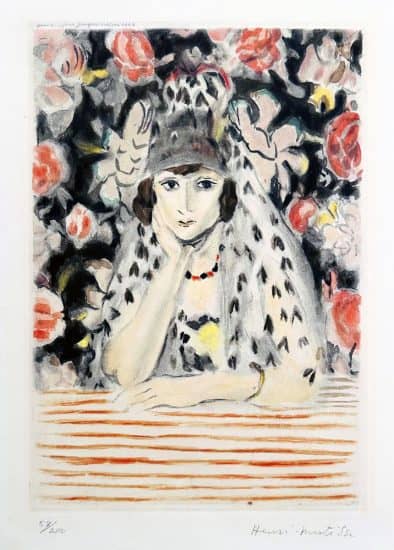
Title: L'Espagnole (The Spaniard), 1928
Artist: Matisse, Henri
Medium: Original Color Aquatint
Image Size: 15 1/2 in x 10 3/4 in (39.6 cm x 27.5 cm)
Sheet Size: 21 in x 15 in (53.3 cm x 38.1 cm)
Framed Size: 35 1/2 in x 30 in (90.17 cm x 76.2 cm)
Edition: Engraved by Jacques Villon from the unsigned edition of 200 by La Chalcographie du Musée du Louvre (blindstamp featured in lower center margin) and published by Bernheim-Jeune, Paris
Condition: Featuring a strong plate mark and bold, vibrant colors, this piece is in very good condition
Price:

Item# 1951
$SOLD!

Full DescriptionThis piece is already sold
Back to top

Signed original Matisse etchings, aquatint, lithograph or drawing at 25-50% off gallery retail prices. These Matisse prints are accompanied with our COA, guaranteeing authenticity for as long as you own it. Historical documentation is included with the purchase.

Styles of Henri Matisse: Fauvism, 20th Century French Modern Master Fauvist

Sell your Matisse fine art with us. We offer free evaluations.

Henri Matisse biography

Henri Émile Benoît Matisse was a French artist, leader of the Fauve group, regarded as one of the great formative figures in 20th-century art, a master of the use of color and form to convey emotional expression.

Henri Matisse was born in December of 1869 in Le Cateau, France. He began painting during a convalescence from an operation, and in 1891 moved to Paris to study art. Matisse became an accomplished painter, sculptor and graphic designer, and one of the most influential artists of the 1900s.

Matisse was born the son of a middle-class family, he studied and began to practice law. In 1890, however, while recovering slowly from an attack of appendicitis, he became intrigued by the practice of painting. In 1892, having given up his law career, he went to Paris to study art formally. His first teachers were academically trained and relatively conservative; Matisse's own early style was a conventional form of naturalism, and he made many copies after the old masters. He also studied more contemporary art, especially that of the impressionists, and he began to experiment, earning a reputation as a rebellious member of his studio classes. Matisse's true artistic liberation, in terms of the use of color to render forms and organize spatial planes, came about first through the influence of the French painters Paul Gauguin and Paul Cezanne and the Dutch artist Vincent van Gogh, whose work he studied closely beginning about 1899. Then, in 1903 and 1904, Matisse encountered the pointillist painting of Henri Edmond Cross and Paul Signac. Cross and Signac were experimenting with juxtaposing small strokes (often dots or “points”) of pure pigment to create the strongest visual vibration of intense color. Matisse adopted their technique and modified it repeatedly, using broader strokes. By 1905 he had produced some of the boldest color images ever created, including a striking picture of his wife, Green Stripe (Madame Matisse) (1905, Statens Museum for Kunst, Copenhagen). The title refers to a broad stroke of brilliant green that defines Madame Matisse's brow and nose. In the same year Matisse exhibited this and similar paintings along with works by his artist companions, including Andre Derain and Maurice de Vlaminck. Together, th,of emotionalism in which they seemed to have indulged, their use of vivid colors, and their distortion of shapes.

While he was regarded as a leader of radicalism in the arts, Matisse was beginning to gain the approval of a number of influential critics and collectors, including the American expatriate writer Gertrude Stein and her family. Among the many important commissions he received was that of a Russian collector who requested mural panels illustrating dance and music (both completed in 1911; now in the Hermitage, Saint Petersburg). Such broadly conceived themes ideally suited Matisse; they allowed him freedom of invention and play of form and expression. His images of dancers, and of human figures in general, convey expressive form first and the particular details of anatomy only secondarily. Matisse extended this principle into other fields; his bronze sculptures, like his drawings and works in several graphic media, reveal the same expressive contours seen in his paintings. Although intellectually sophisticated, Matisse always emphasized theimportance of instinct and intuition in the production of a work of art. He argued that an artist did not have complete control over color and form; instead, colors, shapes, and lines would come to dictate to the sensitive artist how they might be employed in relation to one another. He often emphasized his joy in abandoning himself to the play of the forces of color and design, and he explained the rhythmic, but distorted, forms of many of his figures in terms of the working out of a total pictorial harmony.

From the 1920s until his death, Matisse spent much time in the south of France, particularly Nice, painting local scenes with a thin, fluid application of bright color. In his old age, he was commissioned to design the decoration of the small Chapel of Saint-Marie du Rosaire at Vence (near Cannes), which he completed between 1947 and 1951. Often bedridden during his last years, he occupied himself with decoupage, creating works of brilliantly colored paper cutouts arranged casually, but with an unfailing eye for design, on a canvas surface. Matisse died in Nice on November 3, 1954. Unlike many artists, he was internationally popular during his lifetime, enjoying the favor of collectors, art critics, and the younger generation of artists.

Matisse's work reflects a number of influences: the decorative quality of Near Eastern art, the stylized forms of the masks and sculpture of African, the bright colors of the French impressionists, and the simplified forms of French artist Paul Cezanne and the cubists.

Back to top