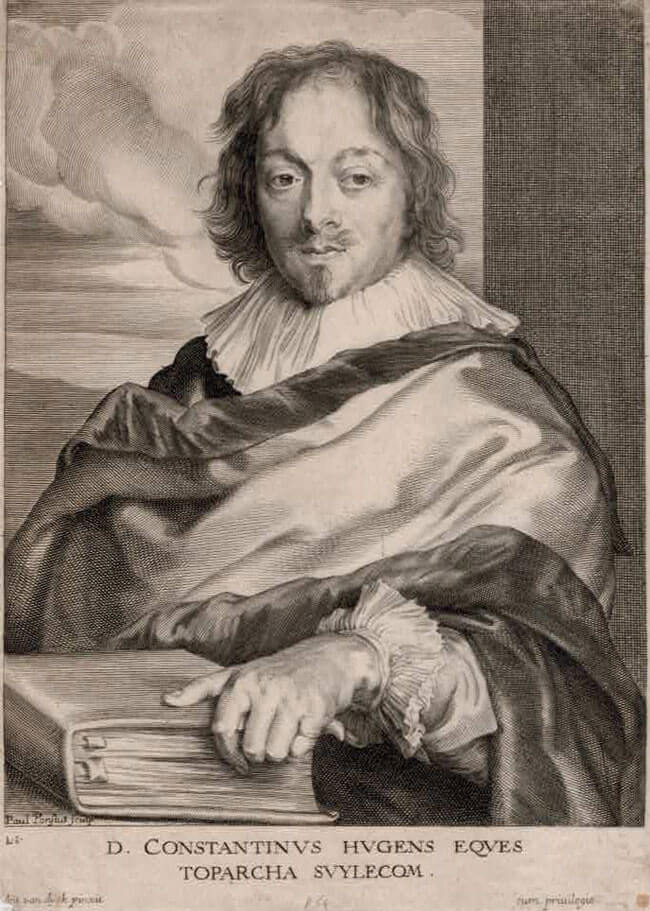
Anthony van Dyck, Constantin Huygens, c. 1675 |
|
| Artist: | Anthony van Dyck (1599 - 1641) |
|---|---|
| Title: | Constantin Huygens, c. 1675 |
| Medium: | Original Engraving |
| Image Size: | 9 7/8 in x 6 7/8 in (25.1 cm x 17.5 cm) |
| Sheet Size: | 9 7/8 in x 6 7/8 in (25.1 cm x 17.5 cm) |
| Framed Size: | approx. 23 in x 20 in (58.4 cm x 50.8 cm) |
| Edition: | A Mauquoy-Hendrickx State VI (of VI) engraved by Paulus Pontius (Antwerp, 1603 - Antwerp, 1658) in collaboration with Anthony van Dyck (Antwerp, 1559 - London, 1641); printed on a fine paper with the Foolscap with Seven Pointed Collar watermark (Mauquoy-Hendrickx no. 132), dating the piece to c. 1675. |
| Signature: | Signed in the plate 'Ant. van dyck pinxit' in the lower left; also signed 'Paul. Pontius fculp' in the plate in the lower left of the image. |
| Condition: | This work is in very good condition; slight tape remnants on verso with minute paper skin in lower left corner; unidentified notation on back. |
| ID # | w-3721 |
|
Price on Request
Questions? |
|
A wonderfully detailed and charismatic portrait, this exquisite work illustrates the technical mastery and artistic vision of Van Dyck. Constantin Huygen's stately yet approachable expression reflects Van Dyck's refined ability to comfort and relax his subjects, resulting in a realistic and acute portrait. Huygens was a Dutch Golden Age poet and composer. He was secretary to two princes of Orange: Frederick Henry (1584 - 1647) and William II (1626 - 1650). He was also the father of famed scientist Christiaan Huygens (1629 - 1695). Costantin Huygens was well trained in art, music, and language and even became a French knight. His work was greatly affected by his wife's death, which sent him into a spiral of grief for many months, but he recovered to continue his poetry writing, making friends with such famous figures as Rene Descartes (1596 - 1650) and Rembrandt (1606 - 1669). Van Dyck depicts Huygens against a clouded background, his hand resting on a large anthology that perhaps contains his poems or compositions. He dons a multi-colored garb, gazing calmly out a the viewer.
This portrait is a Mauquoy-Hendrickx State VI (of VI) engraved by Paulus Pontius (Antwerp, 1603 - Antwerp, 1658) in collaboration with Anthony van Dyck (Antwerp, 1559 - London, 1641) as part of his Iconographie series of engraved portraits of famous people at the time. The plate has been marked in the lower left of the plate "Paul. Pontius fculp" and beneath that "Ant. van dyck pinxit." Also marked "cum privilegio" in the lower right of the plate. Beneath the engraved portrait is the inscription: D. CONSTANTINVS HVGENS EQVES | TOPARCHA SVYLECOM. This piece is printed on a fine paper with the Foolscap with Seven Pointed Collar watermark (Mauquoy-Hendrickx no. 132), dating the piece to c. 1675.
DOCUMENTED AND ILLUSTRATED IN:
1) Mauquoy-Hendrickx. L'Iconographie d'Antoine Van Dyck: Catalogue Raisonne I. Bruxelles: Bibliotheque Royale Albert I, 1991. Listed as catalogue no. 53 on pg. 138.
2) Mauquoy-Hendrickx. L'Iconographie d'Antoine Van Dyck: Catalogue Raisonne II. Bruxelles: Bibliotheque Royale Albert I, 1991. Illustrated as catalogue no. 53 on pg. 36.
3) A Certificate of Authenticity will accompany this work.
ABOUT THE FRAMING:
Framed to archival museum grade conservation standards, this piece is framed in a complementary moulding with silk mats and optical grade Plexiglas.
