Signed original prints, drawings, paintings, and sculptures for sale
fine art home > BUY ORIGINALS > MARC CHAGALL > Lithograph

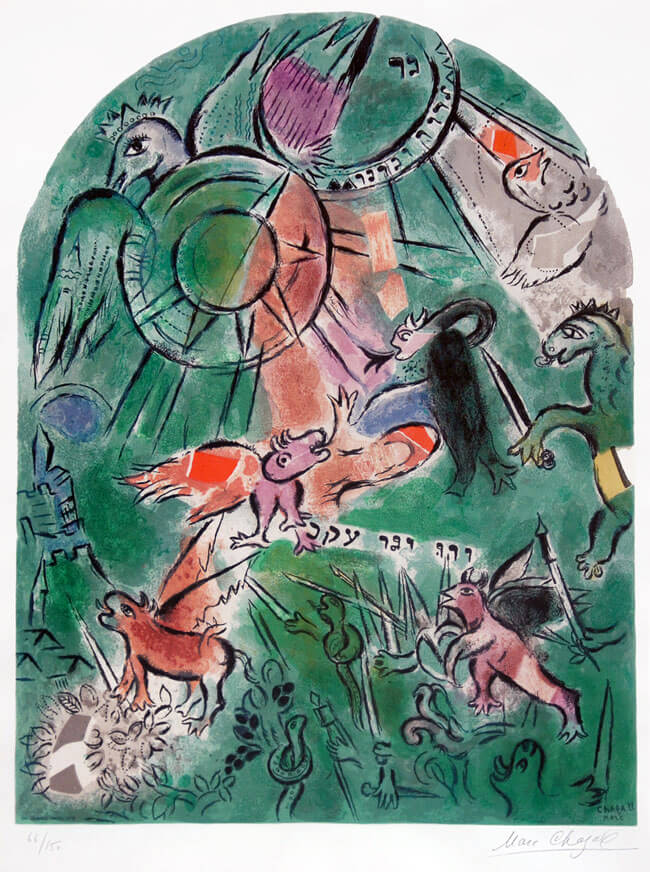
Chagall, Marc, The Tribe of Gad, from The Twelve Maquettes of Stained Glass Windows for Jerusalem (1964)


Signed Marc Chagall, Lithograph, The Tribe of Gad, from The Twelve Maquettes of Stained Glass Windows for Jerusalem (1964)

Chagall Lithograph Signed,  The Tribe of Gad, from The Twelve Maquettes of Stained Glass Windows for Jerusalem (1964)

Place your cursor over the thumbnails below to view the full-size image:

Chagall Lithograph Signed,  The Tribe of Gad, from The Twelve Maquettes of Stained Glass Windows for Jerusalem (1964) (thumbnail 1) Chagall Lithograph Signed,  The Tribe of Gad, from The Twelve Maquettes of Stained Glass Windows for Jerusalem (1964) (thumbnail 2) Chagall Lithograph Signed,  The Tribe of Gad, from The Twelve Maquettes of Stained Glass Windows for Jerusalem (1964) (thumbnail 3) Chagall Lithograph Signed,  The Tribe of Gad, from The Twelve Maquettes of Stained Glass Windows for Jerusalem (1964) (thumbnail 4)

Click each room to better visualize its scale and beauty in different contexts.:


Artist: Chagall, Marc (1887 - 1985), After
Title: The Tribe of Gad, from The Twelve Maquettes of Stained Glass Windows for Jerusalem (1964)
Reference: CS 19
Medium:
Original Color Lithograph
Image Size: 24 in x 18 in (61 cm x 46 cm)
Sheet Size: 29 1/8 in x 20 11/16 in (74 cm x 52.5 cm)
Framed Size: Approx. 43 1/4 in x 36 1/4 in (109.9 cm x 92.1 cm)
Signed: This work is hand signed by Marc Chagall (Vitebsk, 1887- Saint-Paul, 1985) in pencil in the lower right margin.
Edition: Numbered from the edition of 150 in pencil in the lower left margin (total edition of 150 proofs signed and numbered in Arabic numerals, 75 proofs signed and numbered in Roman numerals, and 10 artist's proofs).
Condition: This work is in excellent condition, with bright and fresh colors.
Gallery Price 
$19,000
Item# 3690
Questions? Submit Best Offer Purchase Now

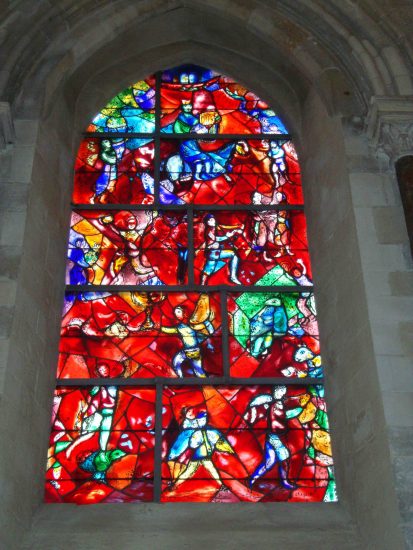
One of twelve maquettes for a series of stained glass windows now installed in a synagogue outside of Jerusalem, The Tribe of Gad shows us a holy battle.


Read more about our pricing
Gallery Price: This is a common gallery retail price
Read more about our pricing
 

Request Invitation:

We have openings for a few new members each day. Members receive exclusive offers on our entire inventory.

Historical Description:

The Tribe of Gad radiates the artist's spiritual conviction, honoring one of the tribes that, with the dying Jacob's blessing, settled the land of Canaan. Over multiple visits to Palestine, Chagall gathered images imbued with the light of the Holy Land. When he was commissioned to create twelve stained glass windows for a synagogue outside of Jerusalem, he met the challenge to translate his masterful graphic work into a new medium. Tracing its lineage back to Gad, the son of Leah's servant, the tribe of Gad is known for its unwavering self-defense, cited in Genesis 49 : 19: "Gad, a troop shall overcome him : but he shall overcome the last." Jean Leymarie notes how Chagall valorizes these famed warriors. Blood reds and muted greens flood the lithograph, whose fragmented composition boils with the energy of battle, bristling with spears and shields (114).

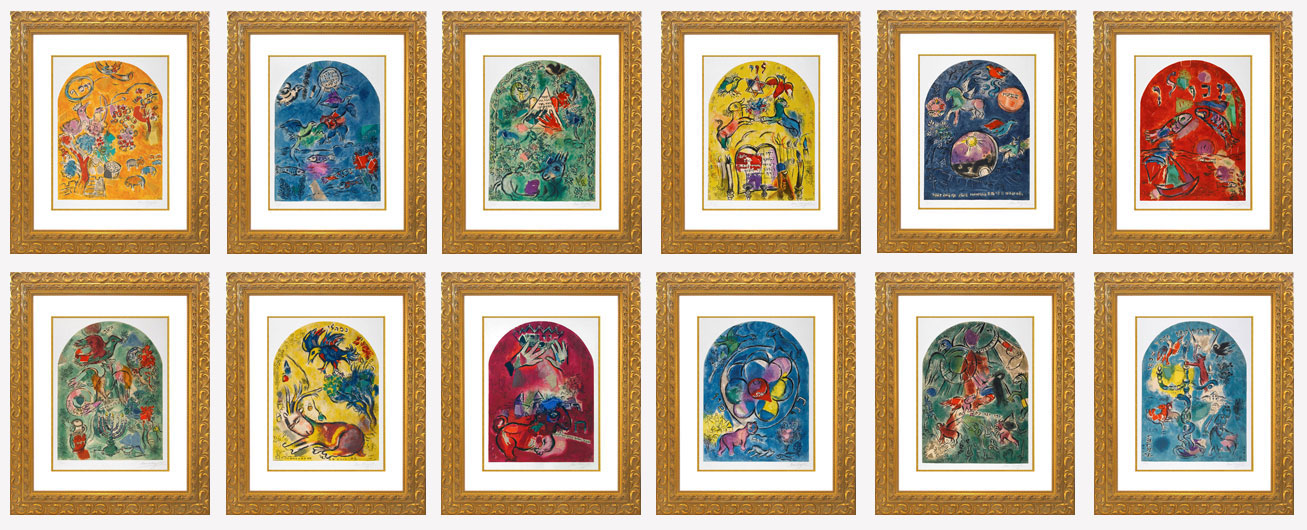
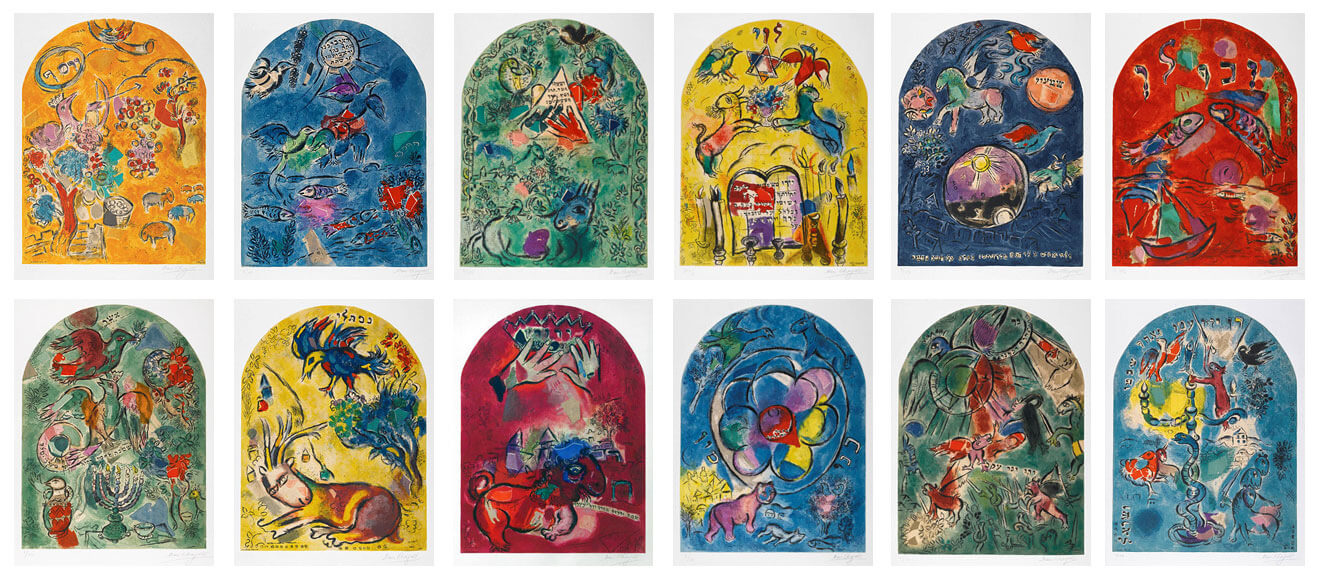
Created in 1964, this image is one in a series of twelve lithographs. Commissioned by the Hadassah-Hebrew Medical Center, Chagall created these works as maquettes for a series of stained glass windows to be installed in the Center's synagogue outside of Jerusalem. The work was engraved by Charles Sorlier, who worked in close collaboration with the artist and is printed on watermarked Arches wove paper. This piece is numbered from the edition of 150 in the lower left (total edition of 150 proofs signed and numbered in Arabic numerals, 75 proofs signed and numbered in Roman numerals, and 10 artist's proofs). This work is hand signed by Marc Chagall (Vitebsk, 1887- Saint-Paul, 1985) in pencil in the lower right margin and signed in the stone, 'CH. SORLIER. GRAV. LITH.' at the lower left of the image.

Catalogue Raisonné & COA:
This work is fully documented and referenced in the below catalogue raisonnés and texts (copies will be enclosed as added documentation with the invoice accompanying the final sale of the work).

1. Leymarie, Jean. Marc Chagall: The Jerusalem Windows. New York: Park Lane, 1988. Listed and illustrated on pp. 113-24.

2. Sorlier, Charles. Chagall Lithographs, 1974-79. New York: Crown Publishers, Inc., 1984. Listed on p. 210 as catalogue no. CS 19.

3. Martin Lawrence Galleries, Marc Chagall, 1999, listed as CS 19 on pg 60.

4. A Certificate of Authenticity will accompany this work.

About the Framing:
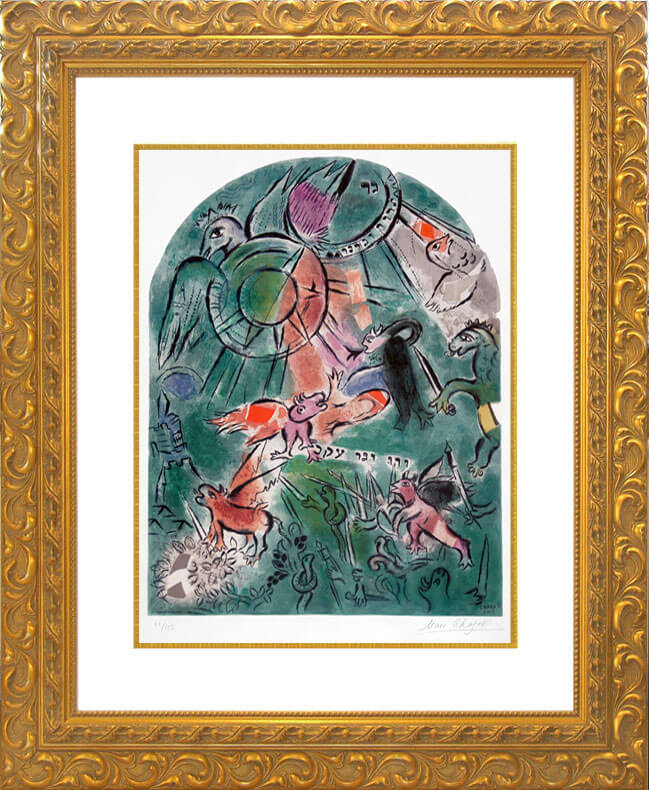
This work is framed to museum-grade, conservation standards, presented in a complementary moulding and finished with silk-wrapped mats and optical grade Plexiglas.

Style: 20th Century Modern Master, Lovers, French and Russian
 

About Us: Masterworks Fine Art strives to be the best source of fine art for our clients and collectors all over the world. We believe the most direct way to accomplish this is by establishing a lifetime of personal and professional relationships with our clients. More About Us »

Do you own a similar Chagall to sell? We offer free evaluations.

Biography of Marc Chagall

Marc ChagallMarc Chagall (1887 - 1985)

Marc Chagall was born July 7, 1887, in Vitebsk, Russia. From 1907 to 1910, he studied in Saint Petersburg, at the Imperial Society for the Protection of the Arts and later with Léon Bakst. In 1910, he moved to Paris, where he associated with Guillaume Apollinaire and Robert Delaunay and encountered Fauvism and Cubism. He participated in the Salon des Indépendants and the Salon d'Automne in 1912. His first solo show was held in 1914 at Der Sturm gallery in Berlin.

Chagall visited Russia in 1914, and was prevented from returning to Paris by the outbreak of war. He settled in Vitebsk, where he was appointed Commissar for Art in 1918. He founded the Vitebsk Popular Art School and directed it until disagreements with the Suprematists resulted in his resignation in 1920. He moved to Moscow and executed his first stage designs for the State Jewish Chamber Theater there. After a sojourn in Berlin, Chagall returned to Paris in 1923 and met Ambroise Vollard. His first retrospective took place in 1924 at the Galerie Barbazanges-Hodebert, Paris. During the 1930s, he traveled to Palestine, the Netherlands, Spain, Poland, and Italy. In 1933, the Kunsthalle Basel held a major retrospective of his work.

During World War II, Chagall fled to the United States. The Museum of Modern Art, New York, gave him a retrospective in 1946. He settled permanently in France in 1948 and exhibited in Paris, Amsterdam, and London. During 1951, he visited Israel and executed his first sculptures. The following year, the artist traveled in Greece and Italy. During the 1960s, Chagall continued to travel widely, often in association with large-scale commissions he received. Among these were windows for the synagogue of the Hadassah-Hebrew University Medical Center, Jerusalem, installed in 1962; a ceiling for the Paris Opéra, installed in 1964; a window for the United Nations building, New York, installed in 1964; murals for the Metropolitan Opera House, New York, installed in 1967; and windows for the cathedral in Metz, France, installed in 1968. An exhibition of the artist's work from 1967 to 1977 was held at the Musée du Louvre, Paris, in 1977-78, and a major retrospective was held at the Philadelphia Museum of Art in 1985. During his lifetime he also created popular lithographs, such as Maternity. Chagall died March 28, 1985, in Saint-Paul-de-Vence, France.

"When Matisse dies," Pablo Picasso remarked, "Chagall will be the only painter left who understands what color really is." Picasso claimed he was not a fan of the "flying violins and all the folklore, but his canvases are really painted, not just thrown together." He followed up by saying, "There's never been anybody since Renoir who has the feeling for light that Chagall has."

The Haggerty Museum describes The Bible Chagall prints as showing "Chagall's fluid forms, dreamlike sense of space and unique style. In his choice of subject matter, Chagall reveals his reading of the Old Testament in its moments of triumph, sorrow, and prophecy."

Chagall Lithograph Signed,  The Tribe of Gad, from The Twelve Maquettes of Stained Glass Windows for Jerusalem (1964)