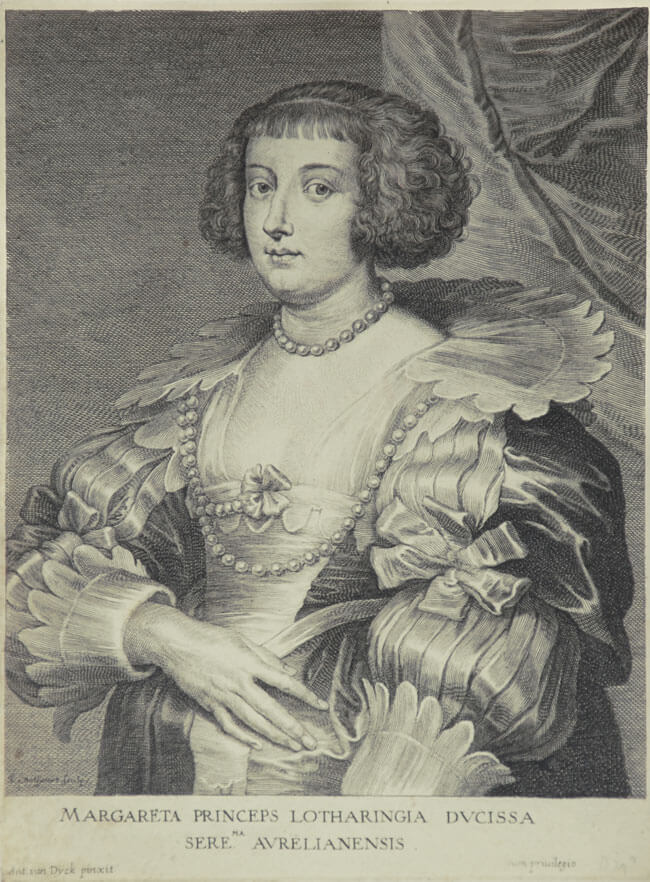
van Dyck, Anthony, Margareta Princeps Lotharingia Ducissa (Marguerite de Lorraine), c. 1645
|
|
|
Anthony van Dyck, Engraving, Margareta Princeps Lotharingia Ducissa (Marguerite de Lorraine), c. 1645 ![]() |
| Artist: | van Dyck, Anthony (1599 - 1641) |
|---|---|
| Title: | Margareta Princeps Lotharingia Ducissa (Marguerite de Lorraine), c. 1645 |
| Medium: | Original Engraving |
| Image Size: | 9 3/4 in x 7 1/8 in (24.8 cm x 18.1 cm) |
| Sheet Size: | 9 3/4 in x 7 1/8 in (24.8 cm x 18.1 cm) |
| Framed Size: | 23 in x 19 3/4 in (58.4 cm x 50.2 cm) |
| Signed: | Signed in the plate 'Ant. van Dyck pinxit' in the lower left. |
| Edition: | A Mauquoy-Hendrickx State IV (of IV) from the Giles Hendrickx edition, engraved by S.a Bolswert (Bolswert, 1586 - Antwerp, 1659) in collaboration with Anthony van Dyck (Antwerp, 1559 - London, 1641). |
| Condition: | This work is in very good condition; some red and blue crayon marks on verso not affecting the image. |
|
Gallery Price
|
Item# 3664
|
| Questions? | |
|
Part of Van Dyck's "Iconographie" series, this portrait truly captures the essence of its subject. Marguerite of Lorraine appears as a stoic beauty, her hand resting gently upon her stomach in a maternal gesture as she gazes out at us, donning an elaborate gown. |
|
|
Read more about our pricing |
|
|
Gallery Price: This is a common gallery retail price Read more about our pricing |
|
|
Request Invitation: We have openings for a few new members each day. Members receive exclusive offers on our entire inventory. |
|
| Historical Description: | |
| A wonderfully detailed and charismatic portrait, this exquisite work illustrates
the technical mastery and artistic vision of Van Dyck. Marguerite of Lorraine's
stately yet approachable expression reflects Van Dyck's refined ability to comfort
and relax his subjects, resulting in a realistic and acute portrait. Marguerite
of Lorraine was a Duchess of Orléans and Alencon by marriage to the Duke
of Orléans. Her story is one of bravery and determination as she fought
for true love. The Duke fell in love with her at a time when their respective
countries of France and Lorraine were enemies. The two ran away and married
in secret in Lorraine, but when the Duke's brother King Louis XIII of France
found out, he nullified their marriage. The two stayed together nonetheless
and were ultimately allowed to remarry upon Louis XIII's death. Marguerite of
Lorraine here appears as a strong, stoic woman, gently grasping her stomach
in a maternal gesture as she dons elaborate, collared garbs.
This portrait is a Mauquoy-Hendrickx State IV (of IV) from the Giles Hendrickx edition, engraved by S.a Bolswert (Bolswert, 1586 - Antwerp, 1659) in collaboration with Anthony van Dyck (Antwerp, 1559 - London, 1641) as part of his Iconographie series of engraved portraits of famous people at the time. The plate has been marked in the lower left of the plate "Ant. van Dyck pinxit" and in the lower right of the plate "Cum privilegio." Beneath the engraved portrait is the inscription: MARGARETA PRNICEPS LOTHARINGIA DVCISSA | SEREMA AVRELIANENSIS.
1) Mauquoy-Hendrickx. L'Iconographie d'Antoine Van Dyck: Catalogue Raisonne
I. Bruxelles: Bibliotheque Royale Albert I, 1991. Listed as catalogue no. 23
on pg. 121.
| |
About Us: Masterworks Fine Art strives to be the best source of fine art for our clients and collectors all over the world. We believe the most direct way to accomplish this is by establishing a lifetime of personal and professional relationships with our clients. More About Us »
Do you own a similar van Dyck to sell? We offer free evaluations.
Biography of Anthony van Dyck
Sir Anthony van Dyck was a Flemish painter who was one of the most important and prolific portraitists of the 17th century. He is also considered to be one of the most brilliant colorists in the history of art.
Van Dyck was born on March 22, 1599, in Antwerp, son of a rich silk merchant, and his precocious artistic talent was already obvious at age 11, when he was apprenticed to the Flemish historical painter Hendrik van Balen. He was admitted to the Antwerp guild of painters in 1618, before his 19th birthday. He spent the next two years as a member of the workshop of the Flemish painter Peter Paul Rubens in Antwerp. Van Dyck's work during this period is in the lush, exuberant style of Rubens, and several paintings attributed to Rubens have since been ascribed to van Dyck.
From 1620 to 1627 van Dyck traveled in Italy, where he was in great demand as a portraitist and where he developed his maturing style. He toned down the Flemish robustness of his early work to concentrate on a more dignified, elegant manner. In his portraits of Italian aristocrats—men on prancing horses, ladies in black gowns—he created idealized figures with proud, erect stances, slender figures, and the famous expressive “van Dyck” hands. Influenced by the great Venetian painters Titian, Paolo Veronese, and Giovanni Bellini, he adopted colors of great richness and jewel-like purity. No other painter of the age surpassed van Dyck at portraying the shimmering whites of satin, the smooth blues of silk, or the rich crimsons of velvet. He was the quintessential painter of aristocracy, and was particularly successful in Genoa. There he showed himself capable of creating brilliantly accurate likenesses of his subjects, while he also developed a repertoire of portrait types that served him well in his later work at the court of Charles I of England.
Back in Antwerp from 1627 to 1632, van Dyck worked as a portraitist and a painter of church pictures. In 1632 he settled in London as chief court painter to King Charles I, who knighted him shortly after his arrival. Van Dyck painted most of the English aristocracy of the time, and his style became lighter and more luminous, with thinner paint and more sparkling highlights in gold and silver. At the same time, his portraits occasionally showed a certain hastiness or superficiality as he hurried to satisfy his flood of commissions. In 1635 van Dyck painted his masterpiece, Charles I in Hunting Dress (Louvre, Paris), a standing figure emphasizing the haughty grace of the monarch.
Van Dyck was one of the most influential 17th-century painters. He set a new style for Flemish art and founded the English school of painting; the portraitists Sir Joshua Reynolds and Thomas Gainsborough of that school were his artistic heirs. He died in London on December 9, 1641.


Print Page
Email to Friend


