Leger Ceramic | Abstract Composition, 1953
Signed original prints, drawings, paintings, and sculptures for sale

Leger, Fernand, Abstract Composition, 1953


Signed Fernand Leger, Ceramic, Abstract Composition, 1953

Leger Ceramic Signed, Abstract Composition, 1953

Place your cursor over the thumbnails below to view the full-size image:

Leger Ceramic Signed, Abstract Composition, 1953 (thumbnail 1)
Artist: Leger, Fernand (1881 - 1955)
Title: Abstract Composition, 1953
Reference: Brunhammer 148
Medium:
Original terracotta plaque; white clay with white, blue, orange, yellow, red, and black enamel.
Image Size: 17 1/2 in x 13 3/16 in x 2 in (44 1/2 cm x 33 1/2 cm x 5 cm)
Framed Size: 31 in x 27 1/4 in (78.7 cm x 69.2 cm)
Signed: Initialed 'F.L.' on the front in black in the lower right.
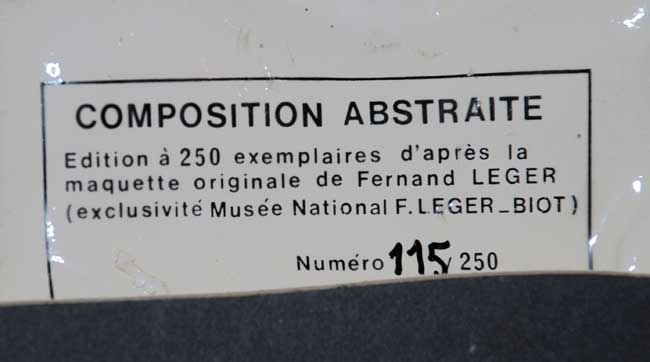
Edition: Annotated on verso in black 'COMPOSITION ABSTRAITE | Edition à 240 exemplaires d'après la | maquette originale de Fernand LEGER | (exclusivité Musée National F LEGER _BIOT)'
Condition: This work is in very good condition with a glossy finish
Gallery Price 
$50,000
Item# 3397
MFA SALE 50% Off: $25,000 
  Submit Best Offer Purchase Now

Combining architectural elements with still life imagery, Leger creates a stunning ceramic plaque. In his signature style, he fragments abstracted objects within a balanced composition.


Read more about our pricing
Gallery Price: This is a common gallery retail price
Read more about our pricing
 

Request Invitation:

We have openings for a few new members each day. Members receive exclusive offers on our entire inventory.

Historical Description:
Created in 1953, this original glazed terracotta plaque was created through collaboration between Fernand Leger (Argentan, 1881 - Gif-sur-Yvette, 1955) and ceramicist Roland Brice. This piece is initialed 'F.L.' on the front in black in the lower right and annotated on verso in black 'COMPOSITION ABSTRAITE | Edition à 240 exemplaires d'après la | maquette originale de Fernand LEGER | (exclusivité Musée National F LEGER _BIOT'. Another example of this work is featured in the collection at the Musée National Fernand Léger, Biot.

Conveying an abstract composition in a sculptural form, Léger contributes a sense of texture and depth to this striking image. In the center of this balanced composition, a vertical white and black form reminiscent of a flute stands erect. Behind this figure, curved colored forms sway and bend and appear as abstract vines growing upwards and loosely twisting around each other. Léger places these figures against a stark white background, highlighting the bold, black lines and bright vibrant colors of these figures. The shiny gloss finish adds a sense of texture and encourages interaction with the piece, catching the light at varied angles depending on the position from which it is viewed.

DOCUMENTED AND ILLUSTRATED IN:
1. Brunhammer, Y. (2005). Fernand Léger: The Monumental Art. 5 Continents Editions: Milan. Listed and illustrated as catalogue raisonné no. 148 on pg. 139. Further discussion on pgs. 132 & 140.

ABOUT THE FRAMING:
Conservation framed with archival materials and museum quality, this work is set in a modern gold frame. The tone of the moulding and shiny finish accentuate the bright hues and contrasting colors in this piece.

Style: 20th Century French Modern Master, pochoir, ceramic and tapestries
 

About Us: Masterworks Fine Art strives to be the best source of fine art for our clients and collectors all over the world. We believe the most direct way to accomplish this is by establishing a lifetime of personal and professional relationships with our clients. More About Us »

  • Leger, La Racine Grise (The Gray Root), c. 1953
  • Leger, Composition from Album of 10 Serigraphs, 1955
  • Leger, Nature Mort Aux Fruits
  • Leger, Femme sur fond jaune (Woman Against Yellow Background), 1952
  • Leger, Composition sur fond jaune
  • Leger, Branches, c. 1955
  • Leger, Composition aux dominos
  • Leger, Chevreuse Août, 1951
  • Leger, Le Puits (The Well), 1951
  • Leger, Les Deux Tournesols (The Two Sunflowers), 1954
  • Leger, La Femme et la Fleur, 1954, S. 136
  • Leger, Les Constructeurs, 1955
  • Leger, L'enfant à l'accordéon, 1953
  • Leger, Femmes et enfants à l'accordéon from Album of 10 Serigraphs, c. 1955
  • Leger, Visage aux deux mains (Face with Two Hands), 1954
  • Leger, Matinée d’ivresse (Morning Rapture) from Les Illuminations, 1949
  • Leger, Abstract Composition, 1953

Do you own a similar Leger to sell? We offer free evaluations.

Biography of Fernand Leger

Fernand LegerFernand Leger (1881 - 1955)

French painter and designer. From c.1909 he participated in the Cubist movement. He is generally considered one of its major masters but his curvilinear and tubular forms (he was for a time called a 'tubist') contrasted with the fragmented forms preferred by Picasso and Braque. The First World War, during which he was gassed whilst serving as a stretcher-bearer, had a profound effect on Leger. His contact with men of different social classes and different walks of life came as a revelation: 'I was abruptly thrust into a reality which was both blinding and new,' he said. Henceforward he made it his ambition to create an art which should be accessible to all ranks of modem society.

In 1920 he met Le Corbusier and Ozenfant and in the early 1920s he was associated with their Purist movement. His paintings were static, with the precise and polished facture of machinery, and he had a fondness for including representations of mechanical parts.During the late 1920s and 1930s he also painted single objects isolated in space and sometimes blown up to gigantic size, In the inter-war years he expanded his range beyond easel painting, with murals and designs for the theatre and cinema. He was also busy as a teacher, notably at his own school, the Academie de I'Art Contemporain, and he traveled widely, making three visits to the USA in the 1930s. The connections he had made there stood him in good stead when he lived in America. During the Second World War he lived in the USA, teaching at Yale University, and at Mills College, California. Acrobats and cyclists were favorite subjects in his paintings of this time. From his return to France in 1945 his painting reflected more prominentlyhis political interest in the working classes. But its static, monumental style remained, with flat, unmodulated colours, heavy black contours, and a continuing concern with the contrast between cylindrical and rectilinear forms. in his later career Leger worked much on large decorative commissions, notably the windows and tapestries for the church at Audincourt (1951). Many honours came to him late in life, and a museum dedicated to him opened at Biot in France in 1957. In the catalogue of the exhibition Leger and Purist Paris' (Tate Gallery, London, 1970), John Golding wrote of Leger: 'No other major twentieth-century artist was to react to, and to reflect, such a wide range of artistic currents and movements . . . And yet he was to remain supremely independent as an artistic personality. Never at any moment in his career could he be described as a follower ... But his originality lay basically in his ability to adapt the ideas and to a certain extent even the visual discoveries of others to his own ends.' He saw the poetic value that lies in the clear delineation of everyday objects, the in trinsic beauty of modem machinery and the things which are mass-produced by machinery, and he favoured proletarian subjects, depicting them with the same clarity and precision as the themes taken from machine culture.