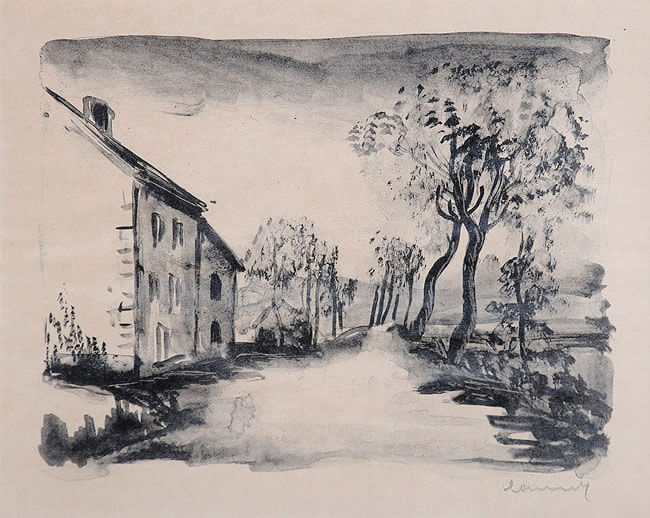
Vlaminck, Maurice de, Nelle-la-Vallée, le Chemin aux Bords du Sausseron
|
|
|
Signed Maurice de Vlaminck, Lithograph, Nelle-la-Vallée, le Chemin aux Bords du Sausseron ![]() |
| Artist: | Vlaminck, Maurice de (1876 - 1958) |
|---|---|
| Title: | Nelle-la-Vallée, le Chemin aux Bords du Sausseron |
| Medium: | Original Lithograph |
| Image Size: | 9 1/2 in x 7 1/2 in (24 cm x 19.4 cm) |
| Framed Size: | approx. 19 1/2 in x 17 1/2 in (49.5 cm x 44.5 cm) |
| Signed: | This work is hand-signed by Maurice de Vlaminck (Paris, 1876- Rueil-la-Gadeliere, 1958) in pencil in the lower right margin. |
| Edition: | A State I a (of II e) impression printed on Japon paper. |
| Condition: | This work is in very good condition. |
|
Gallery Price
|
Item# 3210
|
| Questions? | |
|
This striking black and white print exemplifies Vlaminck's mastery at communicating a sense of mood and environment through his powerful landscape imagery. Upon viewing this piece, we feel both a sense of separation from humanity and a close connection with the natural landscape, as we imagine walking through a remote town surrounded by trees and mountains. |
|
|
Read more about our pricing |
|
|
Gallery Price: This is a common gallery retail price Read more about our pricing |
|
|
Request Invitation: We have openings for a few new members each day. Members receive exclusive offers on our entire inventory. |
|
| Historical Description: | |
| Depicting a quaint village scene, Vlaminck conveys the impression that the viewer
is walking down a dirt road, passing through a small town. The large, three-storied
buildings to the left imply that many residents dwell in this town, yet the
village remains isolated. The viewer feels both a sense of separation from humanity
and a close connection with the natural countryside; trees line the road while
vast fields sprawl off into the distance. The dirt road tapers into the horizon,
conveying a sense of journey and adventure, as if the lone traveler is uncertain
of his or her destination yet willing to explore the unknown.
This work is hand-signed by Maurice de Vlaminck (Paris, 1876- Rueil-la-Gadeliere, 1958) in pencil in the lower right margin. A State I a (of II e) impression printed on Japon paper. Catalogue Raisonné & COA: A Certificate of Authenticity will accompany this work. About the Framing: | |
| Style: | Fauvism, 20th Century Modern Master Fauvist |
About Us: Masterworks Fine Art strives to be the best source of fine art for our clients and collectors all over the world. We believe the most direct way to accomplish this is by establishing a lifetime of personal and professional relationships with our clients. More About Us »
Do you own a similar Vlaminck to sell? We offer free evaluations.
Biography of Maurice de Vlaminck
Maurice de Vlaminck (1876 - 1958)
French painter, born in 1876 in Paris; died in Rueil-la-Gadeliere. Vlaminck said that what he had tried to "press in paint would, in a social context, have entailed throwing a bomb. He derided Classical and Renaissance art, wished to burn the Ecole des Beaux-Arts 'with my vermilions,' and wanted to translate his feelings into paint without a thought of what had been painted before. Vlaminck's father was of Flemish stock, his mother a Lorrainer: they were both musicians. As a young man living in Chatou, Vlaminck was a racing cyclist (champion and professional). In these years he met Derain, who encouraged him to paint full-time: this he attempted, earning money by playing the violin in a theatre. Derain and he formed the Ecole Chatou. Even by 1900 his colour was violent and his brushwork turbulent: he was largely self-taught. Then in 1901 came the famous visit to Bernheim Jeune's van Gogh exhibition, where he declared that van Gogh meant more to him than his own father, and where he was introduced by Derain to Matisse. He exhibited perhaps as early as 1902.
Then came the historic Salon d'Automne exhibition of 1905, when Vlaminck joined Derain, van Dongen, Manguin, Puy, Friesz, Marquet, Rouault, Matisse, and the Fauves. Kandinsky invited him to exhibit at the second New Artists' Association exhibition at Munich and he was represented in Fry's second Post-Impressionist exhibition in London in 1912. Unlike Derain and Matisse, Vlaminck used colour straight from the tube in his Fauve years: it is more intense than Derain, the brush more fully loaded, the strokes less formally structural than Matisse; the spaces are emphatically evoked. After this initial period he became, like many, interested in Cezanne's art around 1906, and then in Cubism (he claims to have initiated Parisian interest in primitive art; this is disputed). In 1910 followed his first one-man show. His later work has pleased critics less. Bright colour is rejected in favour of sombre tones, the wide and deep perspectives are more traditional, the mood sombre. Motoring and racing cars rather than cycling became an interest. He left Paris, living first like van Gogh at Auvers, and then at Verneuil-sur-Avre. His works are mostly undated and their chronology, particularly from the Fauve years, still unsettled. He also wrote poetry, articles (he contributed to Anarchie c. 1900) and extended prose works (e.g. D'un Lit a l'Autre). He painted theatre scenery, made cartoons for tapestry and illustrated books.
K. G. Perls. Vlaminck, New York 1941.
J. Selz. Vlaminck, New York 1963.
Pierre Cabanne. Vlaminck, Paris 1966.


Print Page
Email to Friend


