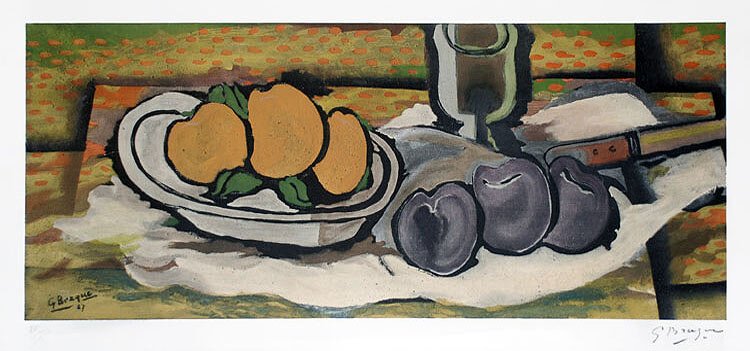
Braque, Georges, Nature morte aux fruits, 1950
|
|
|
Signed Georges Braque, Collotype, Nature morte aux fruits, 1950 ![]() |
| Artist: | Braque, Georges (1882 - 1963) |
|---|---|
| Title: | Nature morte aux fruits, 1950 |
| Medium: | Original color collotype with stencil in colors |
| Image Size: | 28 3/4 in x 11 7/16 in (73 cm x 29 cm) |
| Sheet Size: | 33 1/8 in x 15 15/16 in (84 cm x 40 1/2 cm |
| Framed Size: | 45 1/8 in x 28 1/4 in (114.6 cm x 71.8 cm) |
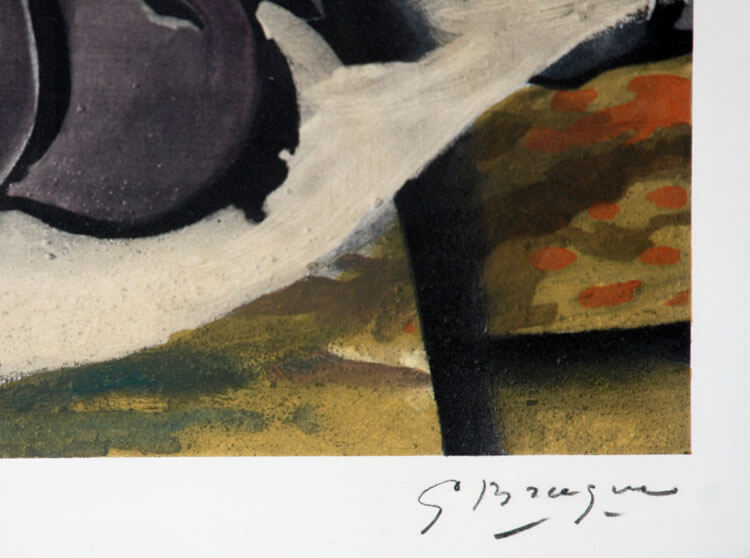
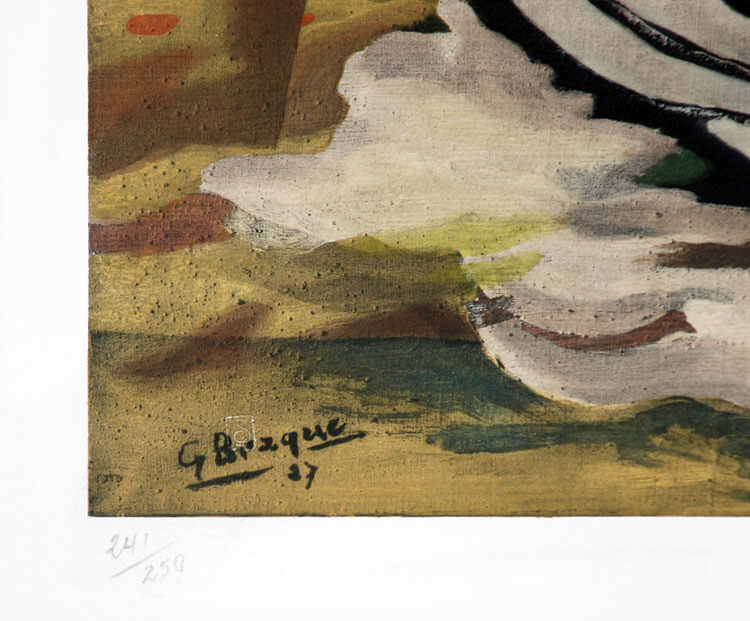
| Signed: | Hand signed by Georges Braque (Argenteuil, Val - d'Oise, 1882 - Paris, 1963) in pencil in the lower right margin; signed in the stone in the lower left in brown. |
| Edition: | Numbered from the edition of 250 in pencil in the lower left margin with the Spitzer blindstamp in the lower left of the image. |
| Condition: | This work is in excellent condition, with bold, vibrant colors. |
|
Gallery Price
|
Item# 3088
|
| MFA SALE | 50% Off: $7,500 |
|
Balancing this lovely still life with two groups of three pieces of fruit, Braque achieves a wonderful, soft sensibility that evokes a sense of quiet contemplation. He offers us a slightly raised vantage point, as we witness the lovely spread laid out before us. His attention to subtle details is also noteworthy, as he includes delicate polka dots on the tablecloth that add a sense of overall charm. |
|
|
Read more about our pricing |
|
|
Gallery Price: This is a common gallery retail price Read more about our pricing |
|
|
Request Invitation: We have openings for a few new members each day. Members receive exclusive offers on our entire inventory. |
|
| Historical Description: | |
Utilizing fluid lines and earthy tones of browns, oranges, and greens, Braque replaces the cubist formality of his early compositions with an organic quality that would come to characterize the artist's later works. Braque provides a distinct foreground and background, including the table upon which the fruit rest as part of the overall composition, and offers the viewer a raised vantage point, as though the viewer is gazing down upon the lovely spread. The composition is well-balanced, as Braque offers two different types of fruit, each grouped in threes. The orange fruit to the viewer's left rests in a bowl while the dark fruit to the right, perhaps plums or apples, sit directly upon the white tablecloth. Braque does not place the fruit on the same plane but positions them at different levels, subtly capturing the viewer's eye. His use of slight decorative elements such as the orange dots against the green backdrop offers a further color contrast that draws the viewer in to this stunning still life work. Published by Guy Spitzer c. 1950, this original color collotype is hand signed by Georges Braque (Argenteuil, Val - d'Oise, 1882 - Paris, 1963) in pencil in the lower right and signed in the stone in brown in the lower left of the image. This work is numbered from the edition of 250 in pencil in the lower left margin with the Spitzer blind stamp in the lower left. DOCUMENTED AND ILLUSTRATED IN: 1. A Certificate of Authenticity is included with this piece.
| |
| Style: | Picasso Cubism, Cubist 20th Century French Modern Master |
About Us: Masterworks Fine Art strives to be the best source of fine art for our clients and collectors all over the world. We believe the most direct way to accomplish this is by establishing a lifetime of personal and professional relationships with our clients. More About Us »
Do you own a similar Braque to sell? We offer free evaluations.
Biography of Georges Braque
Georges Braque (1882 - 1963)
Georges Braque was born on May 13, 1882, in Argenteuil-sur-Seine, France. He grew up in Le Havre and studied evenings at the Ecole des Beaux-Arts there from about 1897 to 1899. He left for Paris to study under a master decorator to receive his craftsman certificate in 1901. From 1902 to 1904, he painted at the Académie Humbert in Paris, where he met Marie Laurencin and Francis Picabia. By 1906, Braque's work was no longer Impressionist but Fauve in style; after spending that summer in Antwerp with Othon Friesz, he showed his Fauve work the following year in the Salon des Indépendants in Paris. His first solo show was at Daniel-Henri Kahnweiler's gallery in 1908. From 1909, Pablo Picasso and Braque worked together in developing Cubism; by 1911, their styles were extremely similar. In 1912, they started to incorporate collage elements into their paintings and to experiment with the papier collé (pasted paper) technique. Their artistic collaboration lasted until 1914. Braque served in the French army during World War I and was wounded; upon his recovery in 1917, he began a close friendship with Juan Gris.
After World War I, Braque's work became freer and less schematic. His fame grew in 1922 as a result of an exhibition at the Salon d'Automne in Paris. In the mid-1920s, Braque designed the decor for two Sergei Diaghilev ballets. By the end of the decade, he had returned to a more realistic interpretation of nature, although certain aspects of Braque's Cubism always remained present in his work. In 1931, Braque made his first engraved plasters and began to portray mythological subjects. His first important retrospective took place in 1933 at the Kunsthalle Basel. He won First Prize at the Carnegie International, Pittsburgh, in 1937.
During World War II, Braque remained in Paris. His paintings at that time, primarily still lifes and interiors, became more somber. In addition to paintings, he also made Braque etchings, lithographs, engravings, prints and sculpture. From the late 1940s, he treated various recurring themes, such as birds, ateliers, landscapes, and seascapes. In 1954, he designed stained-glass windows for the church of Varengeville. During the last few years of his life, Braque's ill health prevented him from undertaking further large-scale commissions, but he continued to paint, make lithographs, and design jewelry. He died on August 31, 1963, in Paris.


Print Page
Email to Friend


