Callot Engraving | The Martyrdom of Saint Sebastian, c. 1634
Signed original prints, drawings, paintings, and sculptures for sale
fine art home > BUY ORIGINALS > JACQUES CALLOT > Engraving

Callot, Jacques, The Martyrdom of Saint Sebastian, c. 1634


Jacques Callot, Engraving, The Martyrdom of Saint Sebastian, c. 1634

Callot Engraving Signed, The Martyrdom of Saint Sebastian, c. 1634

Place your cursor over the thumbnails below to view the full-size image:

Callot Engraving Signed, The Martyrdom of Saint Sebastian, c. 1634 (thumbnail 1) Callot Engraving Signed, The Martyrdom of Saint Sebastian, c. 1634 (thumbnail 2)

Click each room to better visualize its scale and beauty in different contexts.:


 (thumbnail room-view)
 (thumbnail room-view)
 (thumbnail room-view)
 (thumbnail room-view)
Artist: Callot, Jacques (1592 - 1635)
Title: The Martyrdom of Saint Sebastian, c. 1634
Medium:
Engraving
Image Size: 12 13/16 in x 6 1/3 in (32.7 cm x 16.1 cm)
Sheet Size: 13 1/4 in x 7 in (33.7 cm x 17.8 cm)
Framed Size: 31 in x 24 3/4 in (78.7 cm x 62.9 cm)
Signed: Signed in the plate in the lower right 'Callot Jn'
Edition: Printed on a fine laid paper with an unidentified flower and pitcher watermark; annotated 'P. Mariette le fils excud.' in the lower right.
Condition: This work is in excellent condition.
Gallery Price 
$5,000
Item# 3052
MFA SALE 50% Off: $2,500 
  Submit Best Offer Purchase Now

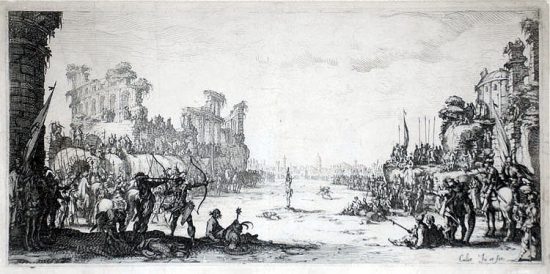
Filled with suspense and drama, this scene portrays the moment in which Saint Sebastian is bound to a stake to be shot at mercilessly from surrounding archers. This piece is remarkable for the sense of balance that Callot achieves within the composition; Sebastian rests at the center with an even amount of figures to his left and right, preparing to let their arrows fly.


Read more about our pricing
Gallery Price: This is a common gallery retail price
Read more about our pricing
 

Request Invitation:

We have openings for a few new members each day. Members receive exclusive offers on our entire inventory.

Historical Description:
Conveying the instance of Saint Sebastian's martyrdom, Callot (Nancy, 1592- Nancy, 1635) depicts the cruel moment in which the saint is bound to a stake to be shot at mercilessly by surrounding archers. Callot creates a well-balanced composition with a developed sense of depth and perspective. Sebastian stands in the center of the composition, a small but recognizable figure identified by the arrows already piercing his body and the desolate plot of land that surrounds him that designates him as the target. He is surrounded by a sea of archers that span far into the distance. In the foreground, heavily shaded figures raise their bows and arrows and prepare to shoot while others merely lounge and observe the horrific scene. According to the biblical story, the widow of Castulus went to retrieve his body to bury it and discovered Sebastian still alive, a truly miraculous occurrence.

Created c. 1634, engraving is signed in the plate in the lower right 'Callot Jn' and printed on a fine paper with an unidentified flower and pitcher watermark. Annotated 'P. Mariette le fils excud.' In the lower right.


DOCUMENTED AND ILLUSTRATED IN:
1. Schroder, Thomas. Jacques Callot: Das gesamte Werk Druckgraphik. Munich, Verlag Rogner & Bernhard GMBH. Volume 2 listed as plate 1496

About the Framing:
Museum-grade conservation framed in a complementary moulding with silk mats and optical grade Plexiglas.


About Us: Masterworks Fine Art strives to be the best source of fine art for our clients and collectors all over the world. We believe the most direct way to accomplish this is by establishing a lifetime of personal and professional relationships with our clients. More About Us »

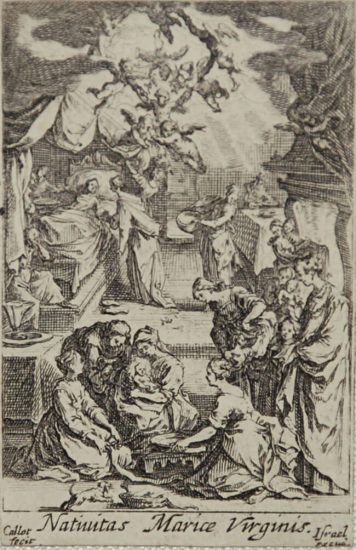
  • Callot, Birth of the Virgin from Life of the Virgin, c. 1632 - 1633
  • Callot, The Martyrdom of Saint Sebastian, c. 1634
  • Callot, The Martyrdom of Saint Sebastian, c. 1634

Do you own a similar Callot to sell? We offer free evaluations.

Biography of Jacques Callot

French engraver and draughtsman. Jacques Callot went to Italy when he was in his teens and, working in Rome and then in Florence at the court of the Grand Duke Cosimc II (1590-1621), he learned to combine the sophisticated techniques and exaggerations of late Mannerism with witty and acute observation into a brilliantly expressive idiom. Returning to France in 1621 he became one of the chief exponents of the bizarre and grotesque which came into vogue in the reign of Louis XIII (1601-43). Most of the remainder of his career was spent in his native Nancy, but he also worked in Paris and the Low Countries. He made a specialty of beggars and deformities, characters from the picaresque novel and the Italian commedia dell'arte. In this respect he comes close to Bellange, also active in Nancy, but Callot's style was more realistic. His last great work, the series of etchings entitled the Grandes Miséres de la Guerre followed the invasion of Lorraine by Car Richelieu in 1633, and is a harrowing depiction the atrocities of war; its themes and imagery were used as a source by Goya. His output was prodigious; more than a thousand Callot etchings and drawings by him are extant, and some of his plates are large, featuring scores of brilliantly arranged figures. Jacques Callot was one of the greatest of all etchers and one of the first major creative artists to work exclusively in the graphic arts.

Callot Engraving Signed, The Martyrdom of Saint Sebastian, c. 1634