Braque Etching | Poissons (Fish)
Signed original prints, drawings, paintings, and sculptures for sale

Braque, Georges, Poissons (Fish)


Signed Georges Braque, Etching, Poissons (Fish)

Braque Etching Signed,  Poissons (Fish)

Place your cursor over the thumbnails below to view the full-size image:

Braque Etching Signed,  Poissons (Fish) (thumbnail 1) Braque Etching Signed,  Poissons (Fish) (thumbnail 2) Braque Etching Signed,  Poissons (Fish) (thumbnail 3) Braque Etching Signed,  Poissons (Fish) (thumbnail 4)

Click each room to better visualize its scale and beauty in different contexts.:


Braque Etching Signed,  Poissons (Fish) (thumbnail room-view)
Artist: Braque, Georges (1882 - 1963), After
Title: Poissons (Fish)
Medium:
Color Etching
Image Size: 18 in x 13 1/2 in (45 cm x 34.5 cm)
Framed Size: 38 3/4 in x 34 in (98.4 cm x 86.4 cm)
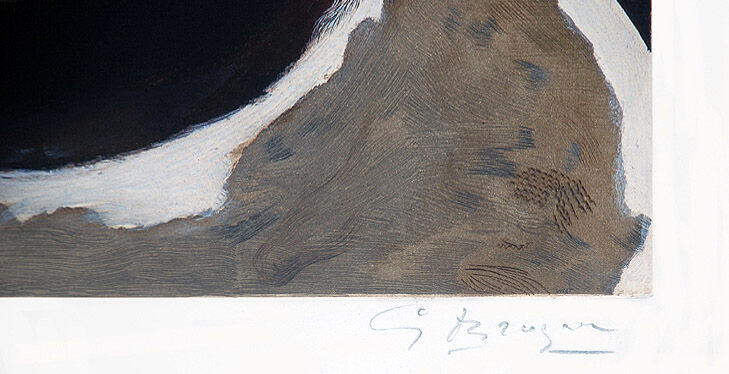
Signed: This work is hand-signed by Georges Braque (Argenteuil-sur-Seine, 1882- Paris, 1963) in pencil in the lower right margin.
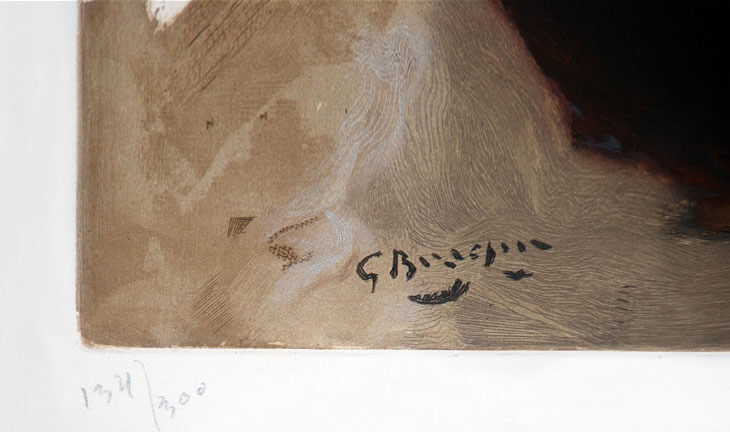
Edition: Numbered from the edition of 300 in pencil in the lower left margin; printed on BFK Rives Block watermarked paper.
Condition: This work is in excellent condition, with bold, vibrant colors.
Gallery Price 
$12,000
Item# 3049
MFA SALE 50% Off: $6,000 
  Submit Best Offer Purchase Now

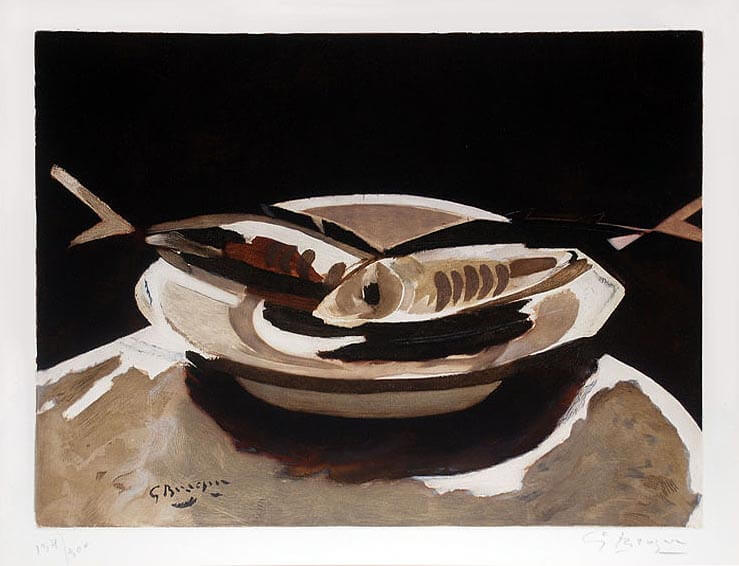
Addressing an often lesser acknowledged subject, Braque gives life to the fish that we buy at the store and put on our plates. Using bold lines and strong tonal contrasts, Braque offers us a platter of fish for visual consumption.


Read more about our pricing
Gallery Price: This is a common gallery retail price
Read more about our pricing
 

Request Invitation:

We have openings for a few new members each day. Members receive exclusive offers on our entire inventory.

Historical Description:
Often seen as a minor accessory in a larger painting, few artists have thought fish worthy of depiction in their own right. In this piece, Braque (Argenteuil-sur-Seine, 1882- Paris, 1963) finds a way to expertly animate not the fish themselves, but the idea of fish. That is, he has given life to fish as the object that we buy in the store and put on our plates. How does one set about such a task? Focusing on the negative space surrounding the fish, and using that as a means to delineate the fish themselves Braque demands our attention to the almost geometrical outline of the subject. His expert use of monotones, placing darks directly next to lights, and allowing the medium browns to mediate the tension between the two further enhances the excitement of the piece. Braque's spontaneity in his handling of the fish combines with his exacting and deliberate use of a small range of colors to create an alarming if not charming composition.

Created c. 1956, this color etching is hand signed by Georges Braque (Argenteuil-sur-Seine, 1882- Paris, 1963) in pencil in the lower right margin and numbered from the edition of 300 in pencil in the lower left margin. This work was published by Maeght, Paris and printed on BFK Rives Block watermarked paper.

Documented and Illustrated in:
1. Vallier, Dora. Braque: The Complete Graphics, Catalogue Raisonné, W.H. Smith Publishers: New York, 1982. Listed and illustrated as catalogue raisonné Maeght, no. 1001 on pg. 292.

About the Framing:
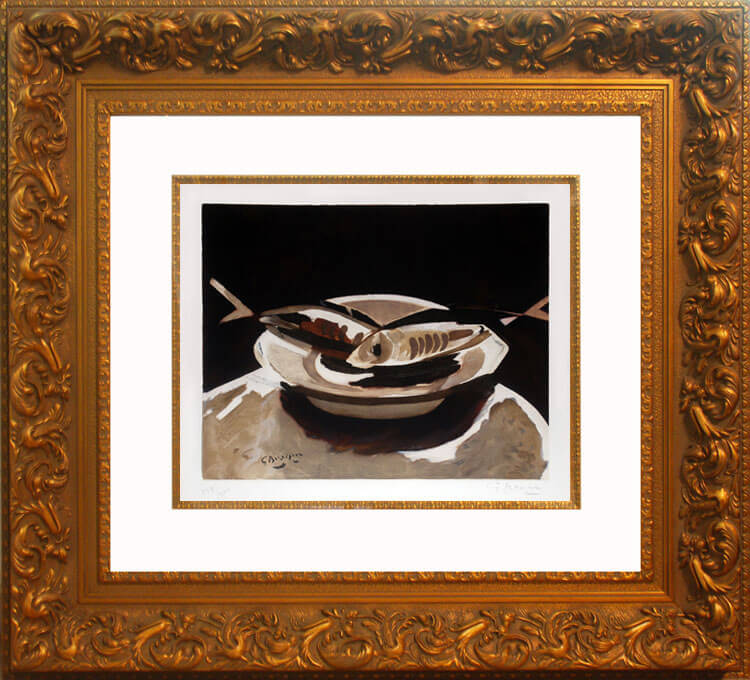
A beautiful, Renaissance-style gold scalloped moulding compliments this unique piece. The bright gold further highlights the color contrasts found within this work. Framing is completed with a matching inner fillet, a white, silk-wrapped mat, and archival Plexiglas® cover. All materials are of museum quality and archival to properly preserve and protect your piece.

Style: Picasso Cubism, Cubist 20th Century French Modern Master
 

About Us: Masterworks Fine Art strives to be the best source of fine art for our clients and collectors all over the world. We believe the most direct way to accomplish this is by establishing a lifetime of personal and professional relationships with our clients. More About Us »

  • Braque, La Charrue (The Plough), 1960
  • Braque, Le tir à l'arc (Archery), 1961
  • Braque, Le char de Médée, c. 1960
  • Braque, Still Life with Apples, 1956
  • Braque, Les Étoiles (Stars)
  • Braque, Nature Morte à la Pipe (Still Life with Pipe), 1959
  • Braque,  Poissons (Fish)

Do you own a similar Braque to sell? We offer free evaluations.

Biography of Georges Braque

Georges BraqueGeorges Braque (1882 - 1963)

Georges Braque was born on May 13, 1882, in Argenteuil-sur-Seine, France. He grew up in Le Havre and studied evenings at the Ecole des Beaux-Arts there from about 1897 to 1899. He left for Paris to study under a master decorator to receive his craftsman certificate in 1901. From 1902 to 1904, he painted at the Académie Humbert in Paris, where he met Marie Laurencin and Francis Picabia. By 1906, Braque's work was no longer Impressionist but Fauve in style; after spending that summer in Antwerp with Othon Friesz, he showed his Fauve work the following year in the Salon des Indépendants in Paris. His first solo show was at Daniel-Henri Kahnweiler's gallery in 1908. From 1909, Pablo Picasso and Braque worked together in developing Cubism; by 1911, their styles were extremely similar. In 1912, they started to incorporate collage elements into their paintings and to experiment with the papier collé (pasted paper) technique. Their artistic collaboration lasted until 1914. Braque served in the French army during World War I and was wounded; upon his recovery in 1917, he began a close friendship with Juan Gris.

After World War I, Braque's work became freer and less schematic. His fame grew in 1922 as a result of an exhibition at the Salon d'Automne in Paris. In the mid-1920s, Braque designed the decor for two Sergei Diaghilev ballets. By the end of the decade, he had returned to a more realistic interpretation of nature, although certain aspects of Braque's Cubism always remained present in his work. In 1931, Braque made his first engraved plasters and began to portray mythological subjects. His first important retrospective took place in 1933 at the Kunsthalle Basel. He won First Prize at the Carnegie International, Pittsburgh, in 1937.

During World War II, Braque remained in Paris. His paintings at that time, primarily still lifes and interiors, became more somber. In addition to paintings, he also made Braque etchings, lithographs, engravings, prints and sculpture. From the late 1940s, he treated various recurring themes, such as birds, ateliers, landscapes, and seascapes. In 1954, he designed stained-glass windows for the church of Varengeville. During the last few years of his life, Braque's ill health prevented him from undertaking further large-scale commissions, but he continued to paint, make lithographs, and design jewelry. He died on August 31, 1963, in Paris.

Braque Etching Signed,  Poissons (Fish)
