BETA USA Flag, English translation English - Spain Flag, traducción al español Español - France Flag, Traduction en français Français
Signed original prints, drawings, paintings, and sculptures for sale
fine art home > BUY ORIGINALS > VICTOR VASARELY > Acrylic Gouache


Search artists…

Vasarely, Victor, Duo-2, 1967


Previous artwork
Next artwork
Print this page Email to a friend

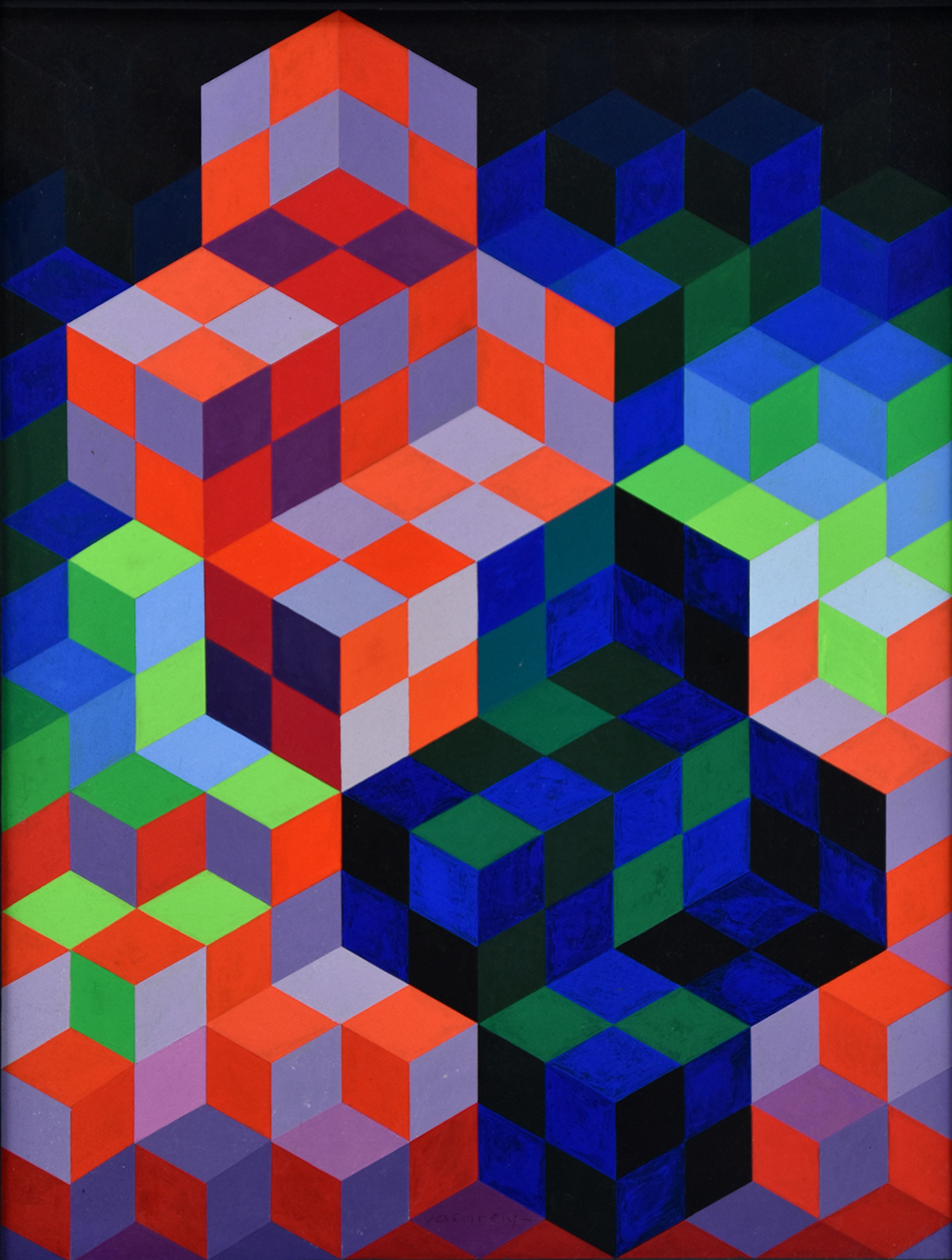
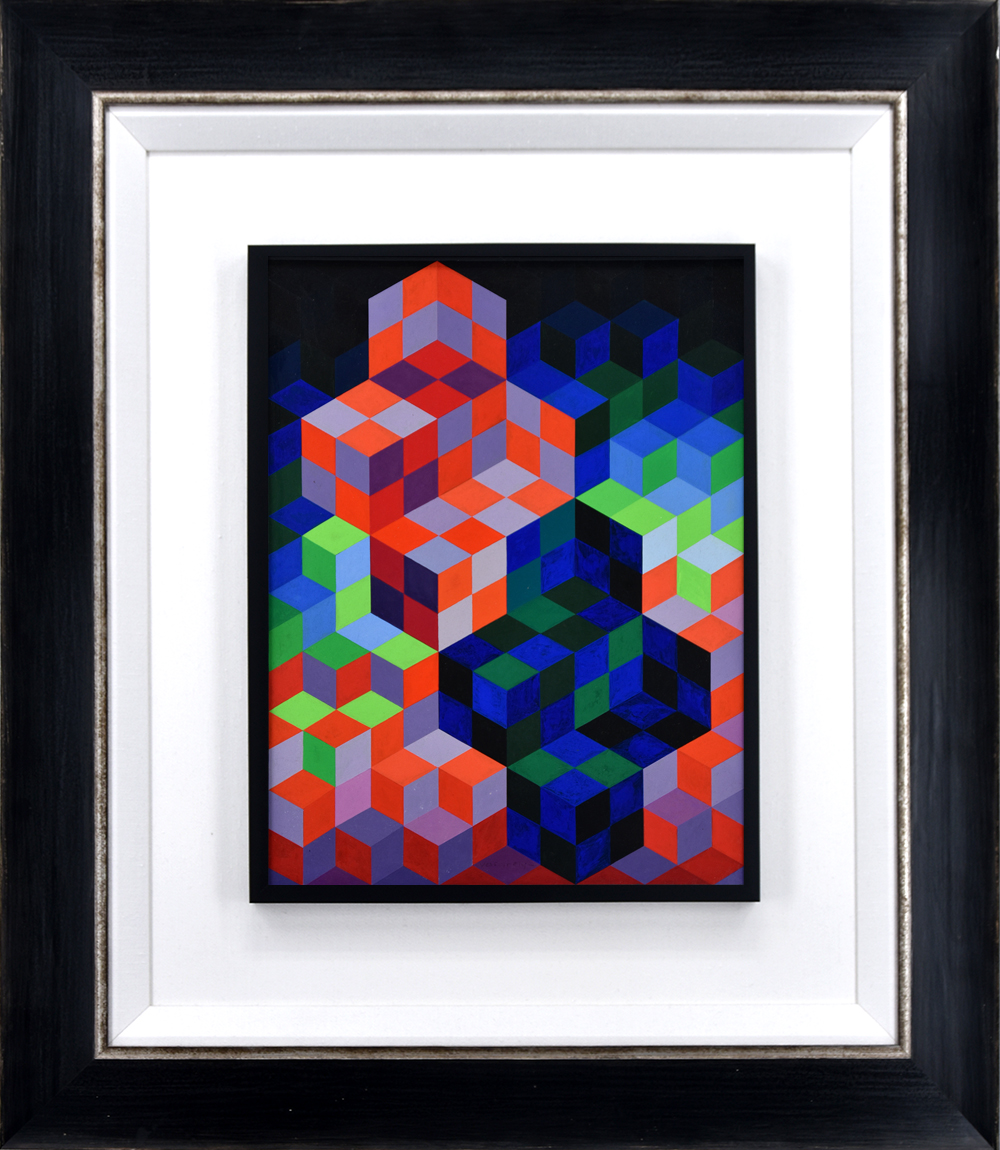
Signed Victor Vasarely, Acrylic Gouache, Duo-2, 1967

Vasarely Acrylic Gouache Signed, Duo-2, 1967

Place your cursor over the thumbnails below to view the full-size image:

Vasarely Acrylic Gouache Signed, Duo-2, 1967 (thumbnail 1)Vasarely Acrylic Gouache Signed, Duo-2, 1967 (thumbnail 2)
Artist: Vasarely, Victor (1906 - 1997)
Title: Duo-2, 1967
Medium: gouache/acrylic on Board
Image Size: 12 1/4 in x 16 in (31 cm x 40.6 cm)
Sheet Size: 12 1/4 in x 16 in (31 cm x 40.6 cm)
Framed Size: 22 in x 26 in (56 cm x 66 cm)
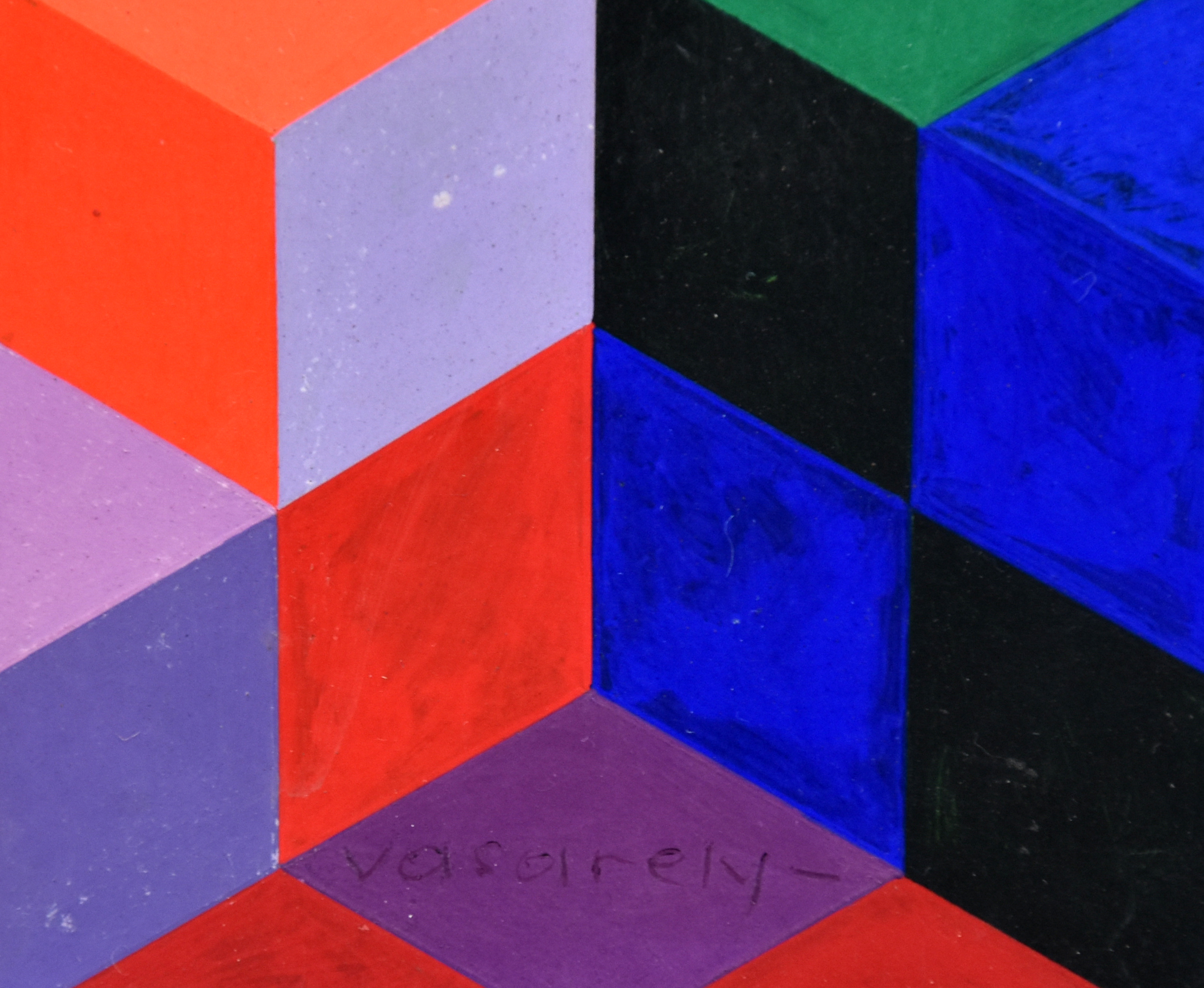
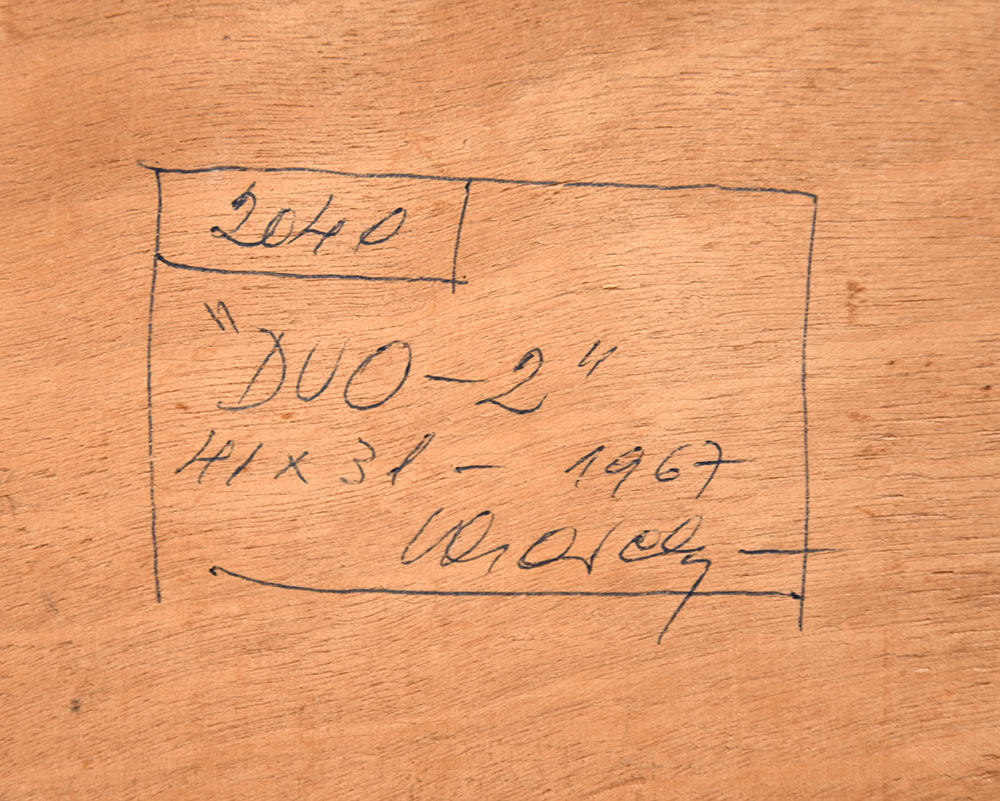
Signed: This work has a guaranteed authentic signature by Victor Vasarely (1906 -1997) in pen on the front and also on the reverse side of the work with the title
Edition: Unique
Condition: This work is in pristine condition with vibrant clear colors
Price 
:

Item# 295
$150,000
   Submit best offer
No reasonable offer will be refused!
(Sales not combinable and not available on prior sales or trade ups)

To speak directly with the Director, Alex Adelman, please call (510) 777-9970 / 1-800-805-7060.
 Purchase NowEmail to a friend
Historical Description:

Gallery Retail Value: $100,000 - $110,000

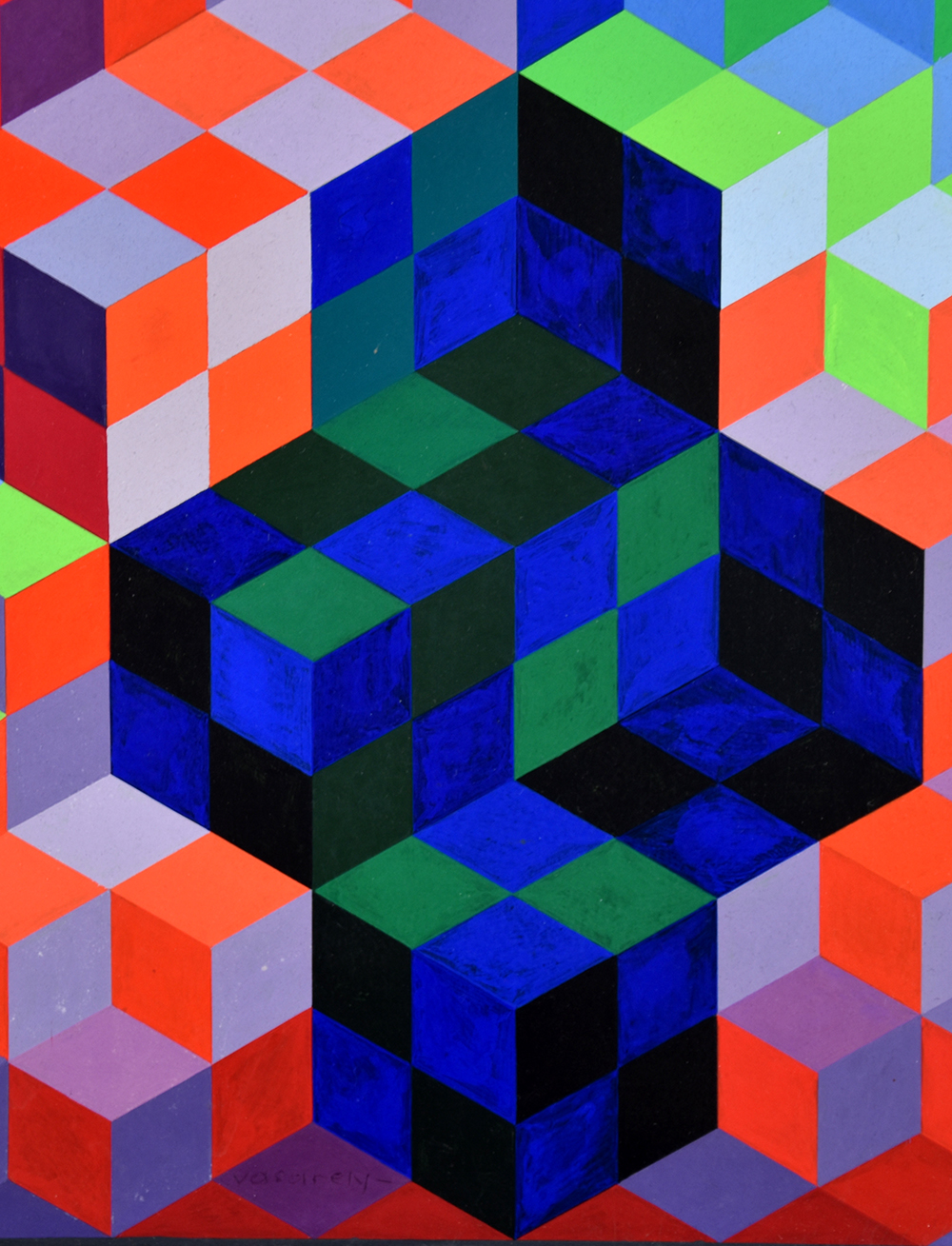
Rendered in alternating tones of blue, green, orange and purple, this image offers a fascinating study of spatial representation. Focusing on the complexities of the hexagon, the Vasarely visually contracts and expands the visual plain.

Created and painted in 1967, it is dated 1967 on the reverse of the board, this image is a rare vintage work. The work is also signed and titled on the reverse and is marked by the stamp of Studio Bellini, Milan.

Tonally dividing the picture plain, Vasarely creates an image that shifts from warm tones along the lower region of the image to cool tones along the upper portion. This progression of tonal variation is complicated by the artist's insertion of orange and purple hexagons at the top and blue and green at the bottom. Continually fluctuating the artist's creates a highly complex and mathematical sense of motion.

Of the hexagon series Vasarely states, "the structure immediately became more dynamic, but also highly unstable, visually speaking. What we actually have is a montage of perceptual hypotheses. Each element functions through its own ambiguity; consequently, the kinetics here reach a very high level of complexity. One could say that I created the optical illusion of perpetual motion."

PROVENANCE:

Vasarely, Collection of the Artist

Studio Bellini, Milano

Robert Lee, New Orleans, LA (purchased in the 1960’s)

The Estate of Robert Lee

Spencer Lee, Phoenix, AZ (by descent)

About the Framing:
This work is displayed in a modern tiered frame. A simple inner frame consists of a dark gray matte and thin metal molding. The outer frame is comprised of a matching metallic molding and light gray linen matte. This presentation compliments the strict structuring of the image while complimenting the artist's use of color.

Catalogue Raisonné & COA:
It is fully documented and referenced in (copies will be enclosed as added documentation with the invoices that I will accompany the final sale of the work) :

1) Recorded in the Vasarely archives as #2040

Style: Optical Art, Abstract Art, Contemporary Art
 Purchase NowEmail to a friend

About Us: Masterworks Fine Art strives to be the best source of fine art for our clients and collectors all over the world. We believe the most direct way to accomplish this is by establishing a lifetime of personal and professional relationships with our clients. More About Us »

Do you own a similar Vasarely to sell? We offer free evaluations.

Biography of Victor Vasarely

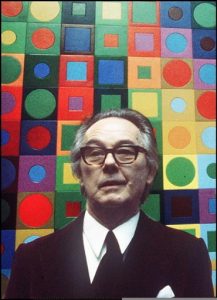
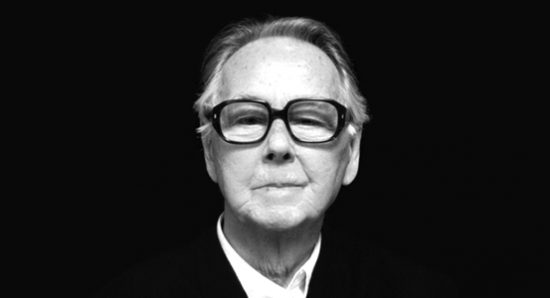
Victor VasarelyVictor Vasarely (1906 - 1997)

A personal recollection (by Alex Adelman): I was very fortunate to have met Victor Vasarely several times and will always remember him as a very warm, funny, charming, intelligent man. However, what struck me most about him was that he had a child-like innocence and wonderment toward both people and the world around him. The last time I saw him, a year or so ago, I remember fondly watching him play Yvaral several games of chess. Needless to say, he beat Yvaral each time! We shared a glass of wine, chocolates and then he entertained us with Hungarian folk songs. It was a truly fun and memorable occasion!

Internationally recognized as one of the most important artists of the 20th century. Victor Vasarely is the acknowledged leader of the Op Art movement, and his innovations in color and optical illusion have had a strong influence on many modern artists.

In 1947, Vasarely discovered his place in abstract art. Influenced by his experiences at Breton Beach of Belle Isle, he concluded that "internal geometry" could be seen below the surface of the entire world. He conceived that form and color are inseparable. "Every form is a base for color, every color is the attribute of a form." Forms from nature were thus transposed into purely abstract elements in his paintings. Recognizing the inner geometry of nature, Vasarely wrote, "the ellipsoid form...will slowly, but tenaciously, take hold of the surface, and become its raison d'etre. Henceforth, this ovoid form will signify in all my works of this period, the 'oceanic feeling'...I can no longer admit an inner world and another, an outer world, apart. The within and the without communicate by osmosis, or, one might rather say: the spatial-material universe, energetic-living, feeling-thinking, form a whole, indivisible... The languages of the spirit are but the supervibrations of the great physical nature."

Victor Vasarely was born in Pecs, Hungary in 1906. After receiving his baccalaureate degree in 1925, he began studying art at the Podolini-Volkmann Academy in Budapest. In 1928, he transferred to the Muhely Academy, also known as the Budapest Bauhaus, where he studied with Alexander Bortnijik. At the Academy, he became familiar with the contemporary research in color and optics by Jaohannes Itten, Josef Albers, and the Constructivists Malevich and Kandinsky.

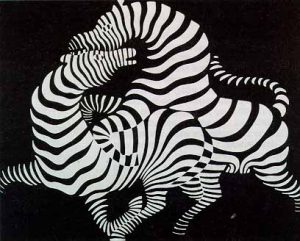
After his first one-man show in 1930, at the Kovacs Akos Gallery in Budapest, Vasarely moved to Paris. For the next thirteen years, he devoted himself to graphic studies. His lifelong fascination with linear patterning led him to draw figurative and abstract patterned subjects, such as his series of harlequins, checkers, tigers, and zebras. During this period, Vasarely also created multi-dimensional works of art by super-imposing patterned layers of cellophane on one another to attain the illusion of depth.

In 1943, Vasarely began to work extensively in oils, creating both abstract and figurative canvases. His first Parisian exhibition was the following year at the Galerie Denise Rene which he helped found. Vasarely became the recognized leader of the avant-garde group of artists affiliated with the gallery.

In 1955, Galerie Denise Rene hosted a major group exhibition in connection with Vasarely's painting experiments with movement. This was the first important exhibition of kinetic art and included works by Yaacov Agam, Pol Bury, Soto, and Jean Tinguely, among others.

During the 1950's, Vasarely wrote a series of manifestos on the use of optical phenomena for artistic purposes. Together with his paintings and Vasarely prints, these were a significant influence on younger artists. According to the artist, "In the last analysis, the picture-object in pure composition appears to me as the last link in the family 'paintings,' still possessing by its shining beauty, an end in itself. But it is already more than a painting, the forms and colors which compose it are still situated on the plane, but the plastic event which they trigger fuses in front of and in the plane. It is thereby an end, but also a beginning, a kind of launching pad for future achievements."

Today, Victor Vasarely's prints, paintings, collages and sculptures are celebrated in numerous exhibits all around the world.

Read more about Victor Vasarely's historic styles

Read more about Victor Vasarely's shows and exhibitions

Back to top

RELATED CONTEMPORARY ARTISTS:
Agam | Arman | Butterfield horse | Calder | Chia | Fischl | Francis | Lichtenstein | Shemi | Soong | Vasarely | Warhol | Yvaral