Braque Etching | La Nappe Jaune (The Yellow Tablecloth), c.1956
Signed original prints, drawings, paintings, and sculptures for sale

Braque, Georges, La Nappe Jaune (The Yellow Tablecloth), c.1956


Georges Braque, Etching, La Nappe Jaune (The Yellow Tablecloth), c.1956

Braque Etching Signed, La Nappe Jaune (The Yellow Tablecloth), c.1956

Place your cursor over the thumbnails below to view the full-size image:

Braque Etching Signed, La Nappe Jaune (The Yellow Tablecloth), c.1956 (thumbnail 1) Braque Etching Signed, La Nappe Jaune (The Yellow Tablecloth), c.1956 (thumbnail 2) Braque Etching Signed, La Nappe Jaune (The Yellow Tablecloth), c.1956 (thumbnail 3) Braque Etching Signed, La Nappe Jaune (The Yellow Tablecloth), c.1956 (thumbnail 4)
Artist: Braque, Georges (1882 - 1963)
Title: La Nappe Jaune (The Yellow Tablecloth), c.1956
Medium:
Original Color Etching
Image Size: 17 in x 10 in (43 cm x 25.5 cm)
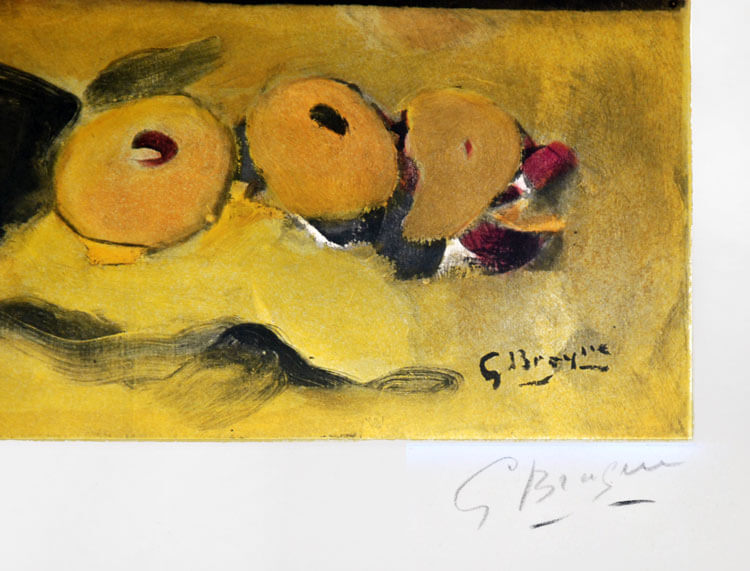
Signed: Hand signed by Georges Braque (1882 - 1963) in pencil in the lower right margin; also signed in the plate in black, 'G. Braque' in the lower right.
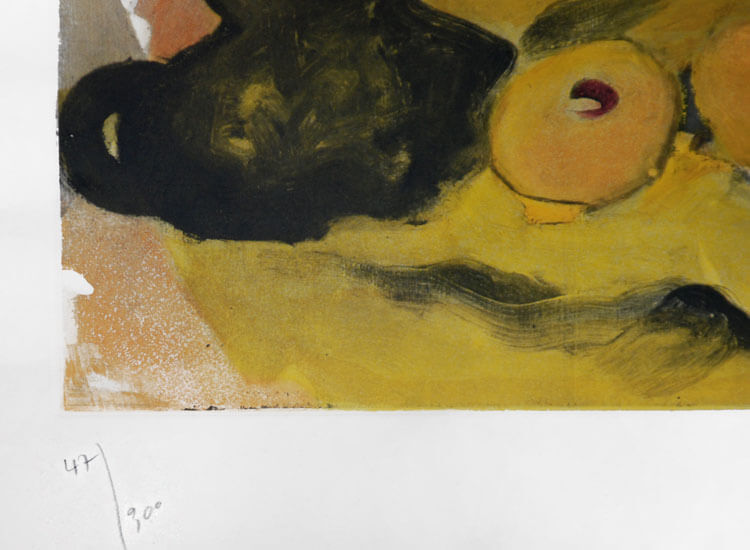
Edition: Numbered 47/300 in pencil in the lower left margin; published by Maeght.
Condition: This work is in excellent condition, the colors are bold, bright and fresh.
Illustrated In: Vallier, D. (1982). Braque: The Complete Graphics, Catalogue Raisonn
Gallery Price 
$16,000
Item# 2906
MFA SALE 50% Off: $8,000 
  Submit Best Offer Purchase Now

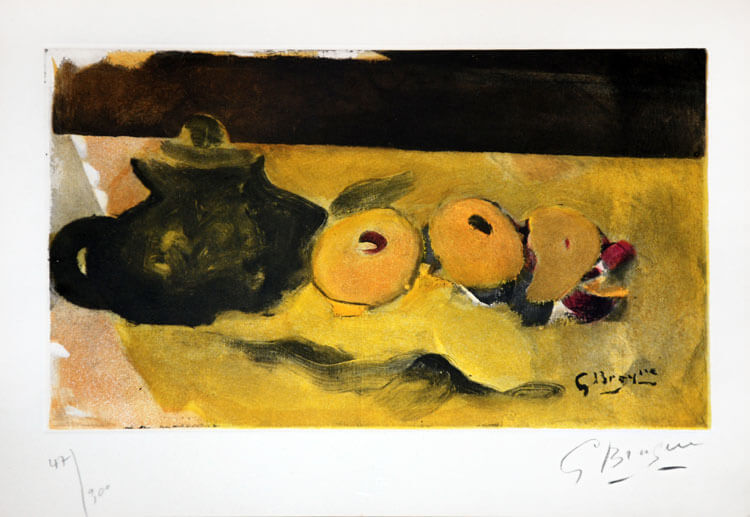
A teapot and several pieces of round fruit line occupy the center of this lush still life. One of Braque's most beautiful graphic works, this piece has texture and depth that are best appreciated in person.


Read more about our pricing
Gallery Price: This is a common gallery retail price
Read more about our pricing
 

Request Invitation:

We have openings for a few new members each day. Members receive exclusive offers on our entire inventory.

Historical Description:

Published by Maeght, circa 1956, this color etching is part of a series of lithographs and etchings that were based upon Braque's original watercolors, gouaches and paintings. Braque was very involved in the printing process, overseeing either the engraver or lithographer, correcting the proofs when necessary. This particular image can be related to Still Life With Green Cloth of 1943 as well as Still Life of 1948. Hand signed by Georges Braque (1882 - 1963) in pencil in the lower right margin; also signed in the plate in black, 'G. Braque' in the lower right. Numbered 47/300 in pencil in the lower left margin; published by Maeght éditeur, Paris.

Offering a stunning impression, this image represents the evolution of the still life within Braque's career. With this image, the artist replaces the cubist formality of his early compositions with a fluid organic quality which would come to characterize the artist's later works.
Much of the success of this composition hinges upon the tonal brilliancy of the piece which has been exquisitely preserved. The artist's intense use of yellows and browns creates a sense of warmth that is further echoed in the iron tea pot seen at the left hand portion of the image. Braque contrast's the yellow foreground of the image with the dense brown of the background, further enhancing the luminous quality of the work. The coloristic rendering of the fruit is also remarkable for the artist adds tonal variations which create a sense of palpable succulents.

Catalogue Raisonné & COA:

It is fully documented and referenced in the below catalogue raisonnés and texts (copies will be enclosed as added documentation with the invoices that will accompany the final sale of the work).

1) Vallier, D. (1982). Braque: The Complete Graphics, Catalogue Raisonné. Gallery Books: NY. Listed and illustrated as a limited and numbered edition, issued by Maeght on pg. 295 (M.1038).

About the Framing:
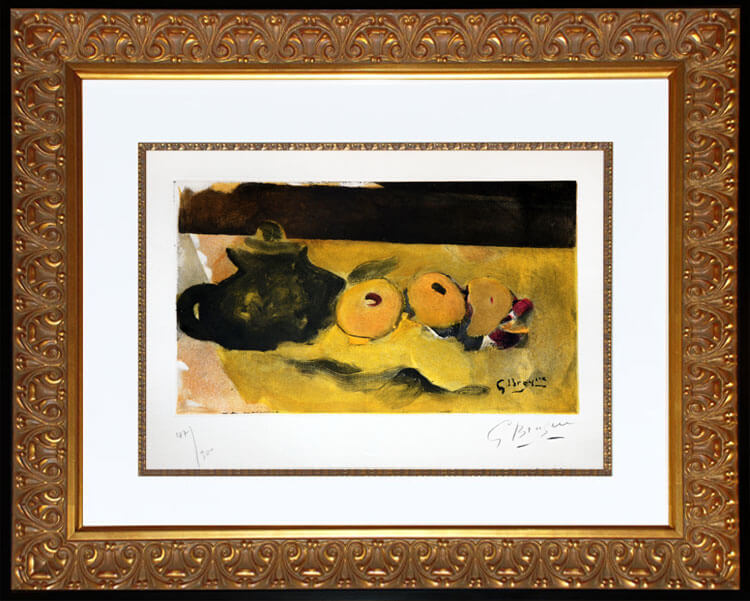
Conservation framed with museum quality archival materials, this piece is displayed in a beautiful Art Nouveau inspired gilt frame. In addition to providing a dramatic presentation, the gold tones of the frame compliment the warmth of the imagery. The repetition of organic shapes in the moulding compliments the natural forms in this work. Completed with beautiful white, linen-wrapped mats and a delicate matching gold inner fillet, this work is set behind archival Plexiglas® cover.

Style: Picasso Cubism, Cubist 20th Century French Modern Master
 

About Us: Masterworks Fine Art strives to be the best source of fine art for our clients and collectors all over the world. We believe the most direct way to accomplish this is by establishing a lifetime of personal and professional relationships with our clients. More About Us »

  • Braque, La Charrue (The Plough), 1960
  • Braque, Le tir à l'arc (Archery), 1961
  • Braque, Le char de Médée, c. 1960
  • Braque, Still Life with Apples, 1956
  • Braque, Les Étoiles (Stars)
  • Braque, Nature Morte à la Pipe (Still Life with Pipe), 1959
  • Braque,  Poissons (Fish)
  • Braque, La Forêt (The Forest) from Lettera amorosa, 1963
  • Braque,  Lithograph from Le tir à l'arc (The Archery), 1960
  • Braque, La barque sur la grève (The Boat on the Shore), 1960
  • Braque, Nature morte aux citrons (Still Life with Lemons), c. 1960
  • Braque, Bouquet Fleurs à L'aquarelle
  • Braque, Personnage sur Fond Rose, c. 1960
  • Braque, L'oiseau et son nid (The Bird and Its Nest)
  • Braque, Les Champs, 1962
  • Braque, Les Marguerites (Daisies)
  • Braque, La Barque de Pêche (Fishing Boat), c.1960
  • Braque, Nature morte aux fruits, 1950
  • Braque, Le coq, 1952
  • Braque, Théière et Raisin (Teapot and Grape), 1950
  • Braque, La Nappe Jaune (The Yellow Tablecloth), c.1956

Do you own a similar Braque to sell? We offer free evaluations.

Biography of Georges Braque

Georges BraqueGeorges Braque (1882 - 1963)

Georges Braque was born on May 13, 1882, in Argenteuil-sur-Seine, France. He grew up in Le Havre and studied evenings at the Ecole des Beaux-Arts there from about 1897 to 1899. He left for Paris to study under a master decorator to receive his craftsman certificate in 1901. From 1902 to 1904, he painted at the Académie Humbert in Paris, where he met Marie Laurencin and Francis Picabia. By 1906, Braque's work was no longer Impressionist but Fauve in style; after spending that summer in Antwerp with Othon Friesz, he showed his Fauve work the following year in the Salon des Indépendants in Paris. His first solo show was at Daniel-Henri Kahnweiler's gallery in 1908. From 1909, Pablo Picasso and Braque worked together in developing Cubism; by 1911, their styles were extremely similar. In 1912, they started to incorporate collage elements into their paintings and to experiment with the papier collé (pasted paper) technique. Their artistic collaboration lasted until 1914. Braque served in the French army during World War I and was wounded; upon his recovery in 1917, he began a close friendship with Juan Gris.

After World War I, Braque's work became freer and less schematic. His fame grew in 1922 as a result of an exhibition at the Salon d'Automne in Paris. In the mid-1920s, Braque designed the decor for two Sergei Diaghilev ballets. By the end of the decade, he had returned to a more realistic interpretation of nature, although certain aspects of Braque's Cubism always remained present in his work. In 1931, Braque made his first engraved plasters and began to portray mythological subjects. His first important retrospective took place in 1933 at the Kunsthalle Basel. He won First Prize at the Carnegie International, Pittsburgh, in 1937.

During World War II, Braque remained in Paris. His paintings at that time, primarily still lifes and interiors, became more somber. In addition to paintings, he also made Braque etchings, lithographs, engravings, prints and sculpture. From the late 1940s, he treated various recurring themes, such as birds, ateliers, landscapes, and seascapes. In 1954, he designed stained-glass windows for the church of Varengeville. During the last few years of his life, Braque's ill health prevented him from undertaking further large-scale commissions, but he continued to paint, make lithographs, and design jewelry. He died on August 31, 1963, in Paris.

Braque Etching Signed, La Nappe Jaune (The Yellow Tablecloth), c.1956
