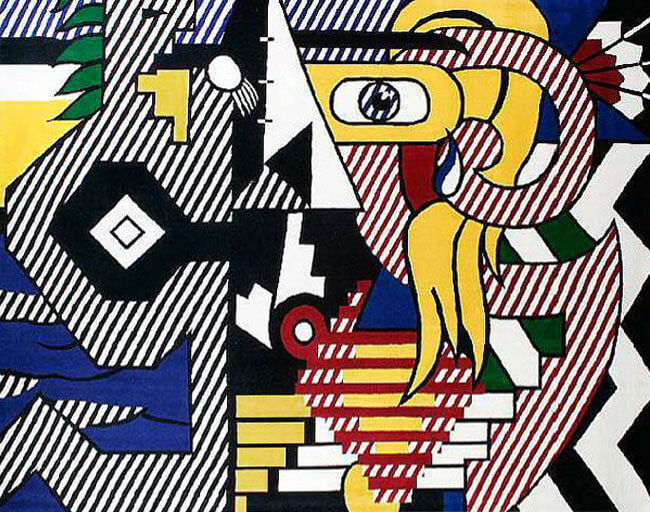
Roy Lichtenstein, Hand-woven Tapestry, Amerind Landscape, 1979 ![]() |
| Artist: | Lichtenstein, Roy (1923 - 1997) |
|---|---|
| Title: | Amerind Landscape, 1979 |
| Medium: | 100% wool hand-woven tapestry |
| Image Size: | 143 11/16 in x 110 1/4 in or approx. 12 ft by 9 ft. (3.7 m x 2.8 m) |
| Signed: | Embroidered signature by Roy Lichtenstein (1923 - 1997) in wool on the reverse, 'Lichtenstein ©' |
| Edition: | Out of the total edition of 20 and published by Modern Masters Tapestries, NY. |
| Condition: | Excellent |
| Price: Item# 2490 | $SOLD! |
| Historical Description: | |
|---|---|
This incredibly large scale and stunning tapestry is a brilliant display of
Lichtenstein's visually iconic style. Modern Masters Tapestries has celebrated
his original drawing (of the same title) by creating a hand-woven 100% wool
tapestry under his direction. This 12 ft. by 9 ft. piece transforms this stunning
display of primary color and geometric pattern into a sculptural and transcendent
art piece; the abstraction of line and space gives way to a landscape that can
is hinted at by the wavy blue areas in the lower left and even the blades of
"grass" in the upper left. It has undertones of American Indian sensibilities
and a distinctly southwestern American feel; the black and white zig-zag pattern
coupled with four feathers in the upper right make way for a whimsical and deeply
layered composition that is able to brighten any art collection. |
About Us: Masterworks Fine Art strives to be the best source of fine art for our clients and collectors all over the world. We believe the most direct way to accomplish this is by establishing a lifetime of personal and professional relationships with our clients. More About Us »
Do you own a similar Lichtenstein to sell? We offer free evaluations.
Biography of Roy Lichtenstein
Roy Lichtenstein (1923 - 1997)
American painter and sculptor, born in New York. He studied under Reginald Marsh at the Art Students' League (1939), served in the Army, then completed an MFA degree at Ohio State University in 1949. While painting in Cleveland (1951-7) he worked as a freelance designer, then taught at the State College in Oswego after moving to New York. Later he instructed at Rutgers University in New Jersey, Lichtenstein worked in a non-figurative Abstract Expressionist mode before 1957; then he began to use loosely handled cartoon images from bubble-gum wrappers, also re Interpreting paintings of the old West by Frederick Remington and others. His changeover to stylistic preoccupations with vulgar cartoon or pulp-magazine images, and to commercial subject matter and techniques, was complete by 1961. Conscious of the 'happenings' initiated in the early 1960s by Claes Oldenburg, Jim Dine and his Rutgers colleague Allan Kaprow, Lichtenstein shared their concern with making art from the materials and products of the industrial environment. He was particularly interested in the lack of sensitivity in mass-produced, often perishable images and merchandizing art, which prompted him to mimic such aspects of the public landscape in his own work. Rejecting the personal and romantic subjectivism of the Abstract Expressionists, Lichtenstein substituted the conventions of a crass contemporary art form, creating a kind of instant nostalgia.
Comicstrip characters are extracted from their narrative context, blown up in size and reproduced with the same typographic screen techniques (Ben Day dots) with which they were printed, thus becoming an emblematic parody of the original (Good Morning, Darling, 1964, New York, Leo Castelli Gallery). But the simulation is not meant to bear a message of social commentary, ironic as it may seem. just as the Pop subject matter dictates the use of a commercial technique for an aesthetic end, the message itself becomes an aesthetic one.
In his reproductions of corny popular romance characters, travel-poster vulgarizations of Classical ruins (Temple of Apollo, 1964, Pasadena, California, s Coll. Mr. and Mrs. Robert A. Rowan), comic-book s war heroes, advertising fragments (Girl with Ball, 1961, New York, Coll. Philip Johnson) or stylized landscapes, Lichtenstein contrasts what is already a s travesty of emotion, scene or object with his unemotionally banal rendition.
He oversimplifies and extracts from the artifacts of mass culture, creating new psychological overtones that reveal, but do not directly comment upon, the sensibility of an era. Lichtenstein also uses the discredited styles and mannerisms of earlier periods, such as his paintings and sculptures (1967-8) based on the once popular 1930s 'modern', a corrupt and ornamental version of Cubism. Modern Painting With, Yellow Interweave (1968, Leo Castelli Gallery) and the curved brass or chrome, tinted glass and marble slabs of his elegant sculptures evoke the taste and style of that period. The subjects of Lichtenstein's 'Pop' paintings, ceramics, sculptures and posters are quoted from an anonymous idiom; with selective mechanical methods he transforms this source material into a personal style offering new sensations and terms for viewing and understanding art.
English
Español
Français


