Pieter Brueghel the Elder, The Parable of the Wise & Foolish Virgins, c. 1560-63 |
|
| Artist: | Pieter Brueghel the Elder (1525 - 1569) |
|---|---|
| Title: | The Parable of the Wise & Foolish Virgins, c. 1560-63 |
| Reference: | Bastelaer 123; Sellink 100 |
| Medium: | Original engraving on fine laid, watermarked paper |
| Image Size: | 11 5/8 in x 8 7/8 in (29.5 cm x 22.6 cm) |
| Sheet Size: | 12 5/8 in x 9 7/8 in (32 cm x 25 cm) |
| Framed Size: | approx. 31 1/4 in x 26 in (79.5 cm x 66 cm) |
| Signature: | Engraved, ‘BRVEGEL. INV.’ in blank cartouche in the lower right; ‘H. Cock excu.’ in the lower left |
| Condition: | This work is in good condition |
| ID # | w-2399 |
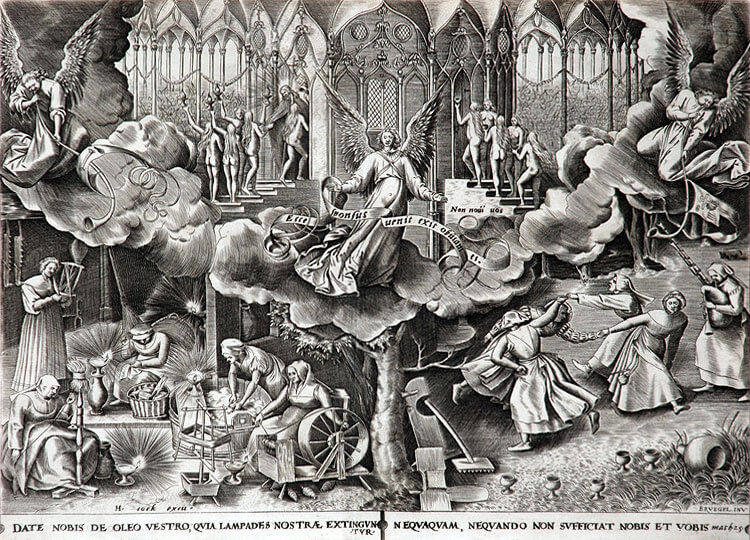
Created in c. 1560-63, this original engraving by Philip Galle is after an original drawing by Pieter Bruegel (Breda, 1525 - Brussels, 1569). Published by Hieronymus Cock, the work has the inscriptions, ‘BRVEGEL. INV.’ in blank cartouche in the lower right; ‘H. Cock excu.’ in the lower left. Engraved from the only state on SB watermarked paper.
The angel in the center of the composition holds a banner that reads: “Ecce sponsus eunit exit obuiam ei [Behold, the bridegroom comes; She goes out to meet him].” On the stairway with the foolish virgins in the upper right, the doors to heaven remain closed; beneath it reads, “Non noui uos [I do not know you].” The inscription along the lower margin is in Latin, which reads: “DATE NOBIS DE OLEO VESTRO, QVIA LAMPADES NOSTRAE EXTINGVNTVR. NEQVAQVAM, NEQVANDO NO SUFFICIAT NOBIS ET VOBIS. [Give us some of your oil, for our lamps are going out. Certainly not, lest there not be enough for us and you. Matthew 25].”
According to M. Sellink (2007), “The moral of the story is plain: we must live our lives in readiness of the Second Coming of Christ and the Judgment of our souls after the Resurrection…Whereas the device of dividing the print into four quarters and the distinctly Gothic architecture echo the visual idiom of the Middle Ages, in the realistic, non-biblical scenes in the lower half Bruegel emerges as a representative of his own time and of the urban mercantile class for whom the work ethic and a spirit of enterprise were increasingly important values” (159).
Catalogue Raisonné & COA:
It is fully documented and referenced in the below catalogue raisonnés and texts (copies will be enclosed as added documentation with the invoices that will accompany the final sale of the work):
1. Bastelaer, René van. The Prints of Peter Bruegel the Elder, Catalogue Raisonné New Edition, Alan Wofsy Fine Arts: San Francisco, 1992. Listed and illustrated as catalogue raisonné no. 123 on pgs. 157-8.
2. Orenstein, Nadine M., ed. for the Metropolitan Museum of Art, New York. Pieter Bruegel the Elder: Drawings and Prints, Yale University Press: New Haven, 2001. Listed and illustrated as catalogue raisonné no. 86 on pg. 208-9.
3. Sellink, M. Pieter Bruegel: The Complete Paintings, Drawings and Prints. Ludion: NY, 2007. Listed and illustrated as catalogue raisonné no. 100 on pg. 159.
About The Framing:
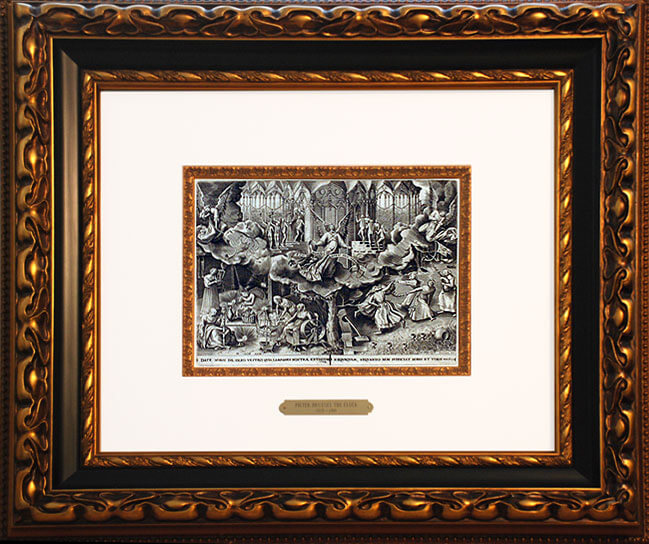
Set in a Spanish-style gold and black frame, the ribbon detailing and carved, organic elements of the moulding complements the four little vignettes within the work. Decorative detail of the framing evoke a classical aura to the work. Completed with white, linen-wrapped mats with a matching gold inner fillet, The Parable of the Wise & Foolish Virgins is set behind an archival Plexiglas® cover and also features a custom-made brass plate with the artist’s name and dates mounted to the mat.
