Renoir Etching | Claude Renoir, de Trois-Quarts à Droite (Claude Renoir, Three-Quarters to the Right), 1908
Signed original prints, drawings, paintings, and sculptures for sale

Fine art sale

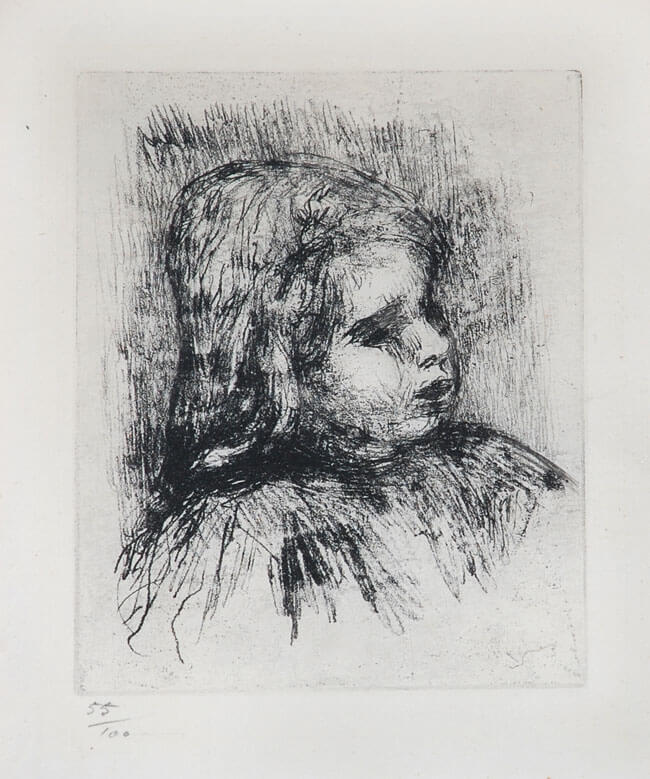
Pierre-Auguste Renoir, Claude Renoir, de Trois-Quarts à Droite (Claude Renoir, Three-Quarters to the Right), 1908


Pierre-Auguste Renoir, Etching, Claude Renoir, de Trois-Quarts à Droite (Claude Renoir, Three-Quarters to the Right), 1908

Renoir, Etching, Claude Renoir, de Trois-Quarts à Droite (Claude Renoir, Three-Quarters to the Right), 1908

Place your cursor over the thumbnails below to view the full-size image:

Renoir, Etching, Claude Renoir, de Trois-Quarts à Droite (Claude Renoir, Three-Quarters to the Right), 1908 (thumbnail 1) Renoir, Etching, Claude Renoir, de Trois-Quarts à Droite (Claude Renoir, Three-Quarters to the Right), 1908 (thumbnail 2) Renoir, Etching, Claude Renoir, de Trois-Quarts à Droite (Claude Renoir, Three-Quarters to the Right), 1908 (thumbnail 3)

Click each room to better visualize its scale and beauty in different contexts.:


 (thumbnail room-view)
 (thumbnail room-view)
 (thumbnail room-view)
 (thumbnail room-view)
 (thumbnail room-view)
Artist: Renoir, Pierre-Auguste (1841 - 1919)
Title: Claude Renoir, de Trois-Quarts à Droite (Claude Renoir, Three-Quarters to the Right), 1908
Medium:
Original Renoir Etching
Image Size: 6 1/2 in x 5 1/4 in (16.5 cm x 13.3 cm)
Sheet Size: 8 5/8 in x 7 1/4 in (21.9 cm x 18.4 cm)
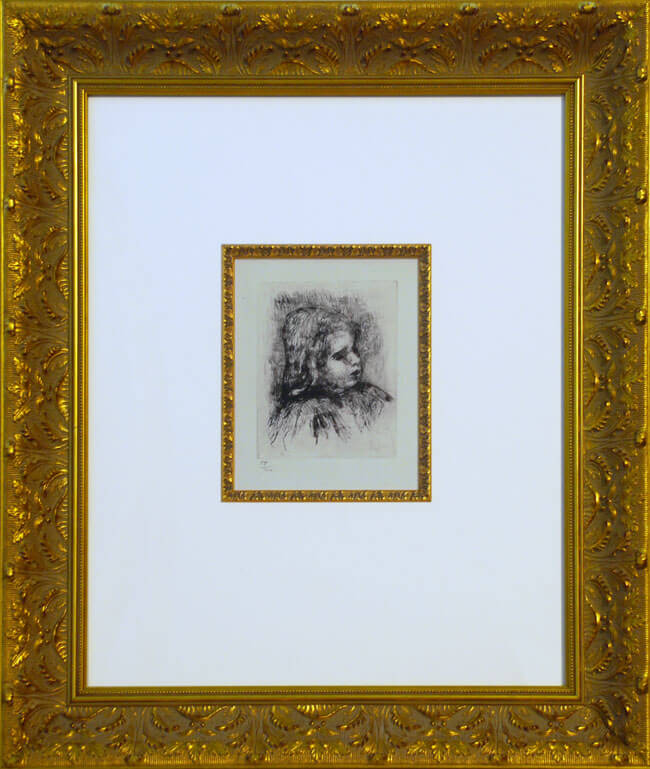
Framed Size: 27 1/2 in x 23 1/2 in (69.9 cm x 59.7 cm)
Edition: Numbered 55/100 in pencil in the lower left margin. From the second state in black and white before the cancelled plate featuring a plate mark all around with wide margins
Condition: This work is in very good condition, a wonderful, elaborate impression
Gallery Price 
$12,000
Item# 2136
MFA SALE $4,000 
  Submit Best Offer Purchase Now

Upon first look this work appears to be of a female child, but the child is in fact Claude Renoir, Renoir's son. Renoir's style was to feminize his sons by focusing on their long girlish hair, which was a representation of his bourgeois family lifestyle. Renoir presents quite an intimate rendering of his son, relaying a sense of familial care and devotion. This work is executed in a gestural fashion, as Renoir manipulates light and form to capture the triumphal youth of his child.


Read more about our pricing
Gallery Price: This is a common gallery retail price
Read more about our pricing
 

Request Invitation:

We have openings for a few new members each day. Members receive exclusive offers on our entire inventory.

Historical Description:

Turning frequently to his family for inspiration, this intimate image is a notional rendering of the artist's youngest son, Claude, who frequently served as one of Renoir’s favored subjects. Executed in a gestural fashion, the artist manipulates light and form to capture the jubilant contours of the child's face.

Created in 1908, this original etching is from the second state in black and white before the canceled plate.  Numbered 55/100 in pencil in the lower left margin, this work was printed on fine, laid paper with wide margins and a faint plate mark all around.

Claude Renoir, son of the artist, was born in 1901 when Pierre-Auguste Renoir was already 60 years of age. Michel Ferloni and Dominique Spies state, "it must have been a great joy for the nearly helpless Renoir to follow the smile or the games of this marvelous little being with chubby cheeks, still free as the air and bouncing with life, who was his son" (Ferloni, 56). This sense of fascination with his son is evident in the artist's delicate rendering of the petit nose and delicate lips. The child appears to be studying something just beyond the picture plane with an intent glare of childish curiosity.

Catalogue Raisonné & COA:
It is fully documented and referenced in the below catalogue raisonnés and texts (copies will be enclosed as added documentation with the invoices that will accompany the final sale of the work):

   1. Delteil, L. (1999). Pierre-Auguste Renoir, L’œuvre grave et lithographié, Catalogue Raisonné. Hyman, A. (Ed.). Alan Wofsy Fine Arts: San Francisco. Listed and illustrated as catalogue raisonné no. 18 on pgs. 36-7.

   2. Stella, J.G. The Graphic Work of Renoir, Catalogue Raisonné. Listed and illustrated as catalogue raisonné no. 18.

About the Framing:
This work is displayed in a robust, Baroque-inspired frame with dramatic contrasting tones of gold. The intricate moulding adds a sense of luminosity to the painting while the highlights of the leafy carving enhances the overall appearance of the image. The framing is completed with white, linen-wrapped mats and a matching gold inner fillet and set behind an archival Plexiglas® cover.


About Us: Masterworks Fine Art strives to be the best source of fine art for our clients and collectors all over the world. We believe the most direct way to accomplish this is by establishing a lifetime of personal and professional relationships with our clients. More About Us »

  • Renoir, Femme Nue Couchée (Tournée à Droite), 1906
  • Renoir, Jeune fille en buste et etudes de têtes (ou Gabrielle) [Three Sketches of Faces, Gabrielle]
  • Renoir, Claude Renoir, de Trois-Quarts à Droite (Claude Renoir, Three-Quarters to the Right), 1908

Do you own a similar Renoir to sell? We offer free evaluations.

Biography of Pierre-Auguste Renoir

Pierre-Auguste RenoirPierre-Auguste Renoir (1841 - 1919)

French painter born in Limoges, died in Cagnes.  He was the son of a tailor.  In 1845 his family moved to Paris.  Between 1856 and 1859 he took an apprenticeship and then worked as a porcelain painter, also taking evening classes in drawing. Renoir then studied at the Ecole des Beaux-Arts, Paris. He was a fellow student of Monet, Sisley and Bazille; he went on summer painting trips with them to Chailly and Fountainbleau.  He studied the eighteenth century paintings in the Louvre and also met Corot, Millet and Diaz.   In 1864 his work was first accepted at the Salon. During the 1870s he painted with Monet at Argenteuil and elsewhere, and came to know Cezanne, Degas, and Pissarro. In 1874 his work was included in the first Impressionist exhibition (and in three of the subsequent seven.)  He had little public success but was patronized by Caillebotte, Chocquet and others.  From the late 1870s on he enjoyed increased success at the Salons, especially with portraiture. Eventually, he became dissatisfied with Impressionism and felt renewed admiration for Ingres, Raphael and eighteenth-century art.  During the 1880s he worked increasingly in the south of France.  Renoir's early work as a porcelain painter reflects two constant characteristics of his art: an enormous natural facility and a dedication to eighteenth century standards of decoration and craftsmanship.  Apart from the personality of his brushwork, the main distinction of his 1870s Impressionism was his preoccupation with the figure as subject matter and particularly with the gay vitality of Parisian life.  Less rigorously introspective than Monet, he made his reputation at the Salons from the late 1870s with a series of fashionable portraits.  Here his dexterity was combined with anecdotal charm.   many of the sculptures he made at the end of his life are direct transpositions of painted motifs.  These were largely made by an assistant (a pupil of Maillol), Renoir's own hands being almost crippled with arthritis. ¹

¹ Phaidon Dictionary of Twentieth Century Art.

RELATED IMPRESSIONISTS:
Cassatt | Cezanne | Corot | Degas | Manet | Monet | Renoir | Rodin | Signac | Toulouse-Lautrec | Whistler

Renoir, Etching, Claude Renoir, de Trois-Quarts à Droite (Claude Renoir, Three-Quarters to the Right), 1908