Miro Woodcut | À Toute Épreuve, 1958
Signed original prints, drawings, paintings, and sculptures for sale
fine art home > BUY ORIGINALS > JOAN MIRO > Woodcut

Fine art sale

Joan Miro, À Toute Épreuve, 1958


Signed Joan Miro, Woodcut, À Toute Épreuve, 1958

Miro Woodcut Signed, À Toute Épreuve, 1958

Place your cursor over the thumbnails below to view the full-size image:

Miro Woodcut Signed, À Toute Épreuve, 1958 (thumbnail 1) Miro Woodcut Signed, À Toute Épreuve, 1958 (thumbnail 2)

Click each room to better visualize its scale and beauty in different contexts.:


Miro Woodcut Signed, À Toute Épreuve, 1958 (thumbnail room-view)
Artist: Miro, Joan (1893 - 1983)
Title: À Toute Épreuve, 1958
Medium:
Original Color Woodcut
Image Size: 14 1/2 in x 13 in (36.8 cm x 33 cm)
Sheet Size: 20 1/2 in x 15 in (52 cm x 38 cm)
Framed Size: 37 in x 32 in (93.98 cm x 81.28 cm)
Signed: Hand signed by Joan Miró (1893 - 1983) in pencil in the lower right margin
Edition: Marked H.C. (Hors d'Commerce or artist's proof), in pencil in the lower left
Condition: This work is in excellent condition, a fine dark impression!
Gallery Price 
$12,000
Item# 2119
MFA SALE 50% Off: $6,000 
  Submit Best Offer Purchase Now

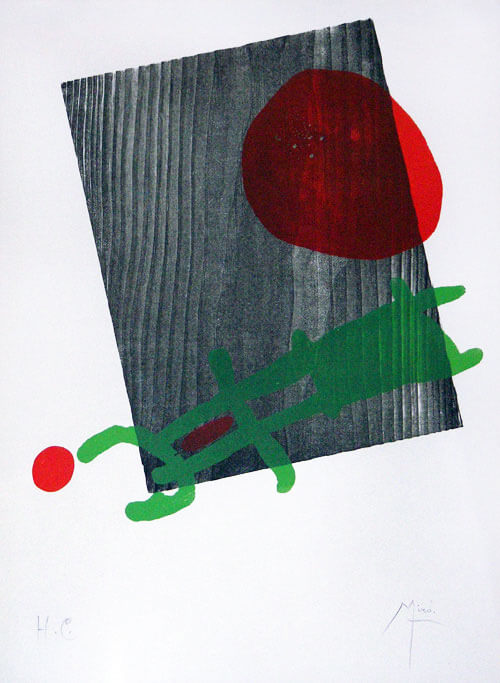
Boldly designed with accents of vibrant red and green, Miró's playful use of shape and color are highlighted in this work. Utilizing the texture of the wood for this image, the askew positioning of the elements in this piece relays a sense of motion and activity.


Read more about our pricing
Gallery Price: This is a common gallery retail price
Read more about our pricing
 

Request Invitation:

We have openings for a few new members each day. Members receive exclusive offers on our entire inventory.

Historical Description:

Created in 1958, this original color woodcut was printed for the exhibition of Miró’s book ‘A toute épreuve’ at the Galerie Berggruen, Paris.  Published by Gérald Cramer, Geneva and the Galerie Berggruen, Paris, this work was printed by Fequet et Baudier, Paris.  Marked H.C. (Hors d'Commerce or artist's proof) in pencil in the lower left, this work is a proof impression aside from the edition of 125 without the text on Arches vellum paper.  Signed by Miró in pencil in the lower right, this work is in excellent condition with bright fresh colors; printed on RIVES watermarked paper with deckle edges on two sides.

Used to present the artist’s exhibition of 80 woodcuts illustrating the book by Paul Eluard, this work embodies the spirit and thematic elements of all the works combined.  Utilizing a dark grey block of wood grain texture in the background, bold hues of red and green overlap the rectangle in an even translucent layer.  The bright edges of the red circle and green form jump off the page with their vibrancy, while the overlapping areas recede into space with the darker tone the grey background gives them.  Appearing like a bright red sunset over a brilliant green meadow, there are endless possibilities to the meaning behind this work.  Miró exhibits his skill in breaking the barriers and boundaries in printmaking with this piece, showing us an art uniquely his own with a joy for illustrating poetry.  

Catalogue Raisonné & COA:
It is fully documented and referenced in the below catalogue raisonnés and texts (copies will be enclosed as added documentation with the invoices that will accompany the final sale of the work) :

1) Corredor-Matheos, J., Los Carteles de Miró, listed as cat no 9 on pgs 42 and 43.

2) Dupin, Jacques, Miró Engraver, Vol I. 1928-1960, 1989, listed as cat no 235 on pg 154.

About the Framing:
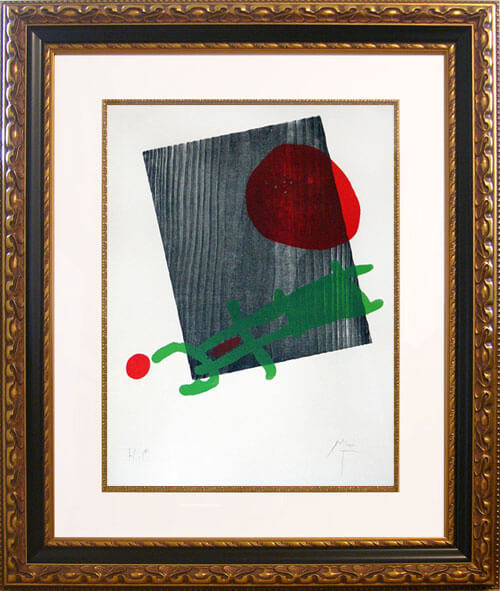
Conservation framed with archival materials and museum quality, this work is set in a black and gold Spanish style frame.  The dazzling tone of the moulding compliments the contrasting hues in this work.  Ornate sculptural elements offset the solid bold forms in this work, and accentuate the wood grain detail in the background.  Completed with white, linen-wrapped mats and a matching gold inner fillet, this work is set behind an archival Plexiglas® cover.

Style: 20th Century Modern Master, Surrealism
 

About Us: Masterworks Fine Art strives to be the best source of fine art for our clients and collectors all over the world. We believe the most direct way to accomplish this is by establishing a lifetime of personal and professional relationships with our clients. More About Us »

  • Miro, Flux de l'Aimant VII (Magnetic Flow No. 7), 1964
  • Miro, Flux de l'Aimant VI (Magnetic Flow No. 6), 1964
  • Miro, Flux de l'Aimant V (Magnetic Flow No. 5), 1964
  • Miro, Lithograph VI from Miró, Obra Inedita Recent, 1964, M. 424
  • Miro, Lithograph VII from Miró, Obra Inedita Recent, 1964, M. 424
  • Miro, Lithograph VIII from Miró, Obra Inedita Recent, 1964, M. 424
  • Miro,  L'enfance d'Ubu, 1975
  • Miro, L'enfance d'Ubu, 1975
  • Miro, L'enfance d'Ubu, 1975
  • Miro, Flux de l'aimant (The Magnet's Flow), 1964
  • Miro, El Sobreviviente Visita Los Pájaros I (The Survivor Visits the Birds I)
  • Miro, El Sobreviviente Visita Los Pájaros II (The Survivor Visits the Birds II)
  • Miro, À Toute Épreuve, 1958

Do you own a similar Miro to sell? We offer free evaluations.

Biography of Joan Miro

Joan MiroJoan Miro (1893 - 1983)

Joan Miró Ferra was born April 20, 1893, in Barcelona. At the age of 14, he went to business school in Barcelona and also attended La Lonja’s Escuela Superior de Artes Industriales y Bellas Artes in the same city. Upon completing three years of art studies, he took a position as a clerk. After suffering a nervous breakdown, he abandoned business and resumed his art studies, attending Francesc Galí’s Escola d’Art in Barcelona from 1912 to 1915. Miró received early encouragement from the dealer José Dalmau, who gave him his first solo show at his gallery in Barcelona in 1918. In 1917, he met Francis Picabia.

In 1920, Miró made his first trip to Paris, where he met Pablo Picasso. From this time, Miró divided his time between Paris and Montroig, Spain. In Paris, he associated with the poets Max Jacob, Pierre Reverdy, and Tristan Tzara and participated in Dada activities. Dalmau organized Miró’s first solo show in Paris, at the Galerie la Licorne in 1921. His work was included in the Salon d’Automne of 1923. In 1924, Miró joined the Surrealist group. His solo show at the Galerie Pierre, Paris, in 1925 was a major Surrealist event; Miró was included in the first Surrealist exhibition at the Galerie Pierre that same year. He visited the Netherlands in 1928 and began a series of paintings inspired by Dutch masters. This year he also executed his first papiers collés and collages. In 1929, he started his experiments in lithography. Miro's first etchings date from 1933. During the early 1930s, he made Surrealist sculptures incorporating painted stones and found objects. In 1936, Miró left Spain because of the civil war; he returned in 1941. Also in 1936, Miró was included in the exhibitions Cubism and Abstract Art and Fantastic Art, Dada, Surrealism at the Museum of Modern Art, New York. The following year, he was commissioned to create a monumental work for the Paris World’s Fair.

Miró’s first major museum retrospective was held at the Museum of Modern Art, New York, in 1941. That year, Miró began working in ceramics with Josep Lloréns y Artigas and started to concentrate on prints; from 1954 to 1958, he worked almost exclusively in Miro prints and ceramics. He received the Grand Prize for Graphic Work at the Venice Biennale in 1954, and his work was included in the first Documenta exhibition in Kassel the following year. In 1958, he was given a Guggenheim International Award for murals for the UNESCO building in Paris. The following year, he resumed painting, initiating a series of mural-sized canvases. During the 1960s, he began to work intensively in sculpture. Miró retrospectives took place at the Musée National d’Art Moderne, Paris, in 1962, and the Grand Palais, Paris, in 1974. He also worked with carborundum around this time. In 1978, the Musée National d’Art Moderne exhibited over 500 works in a major retrospective of Miro original drawings. Joan Miro died December 25, 1983, in Palma de Mallorca, Spain.

Joan Miro prints and unique original works are commonly seen in museums and art galleries in USA and Europe.

Joan Miró created a large wool and hemp tapestry titled "The World Trade Center Tapestry" that adorned the lobby of 2 World Trade Center. It was destroyed by the collapse of the tower on September 11, 2001. ¹

¹ Lives and Treasures Taken. Library of Congress.

Miro Woodcut Signed, À Toute Épreuve, 1958
