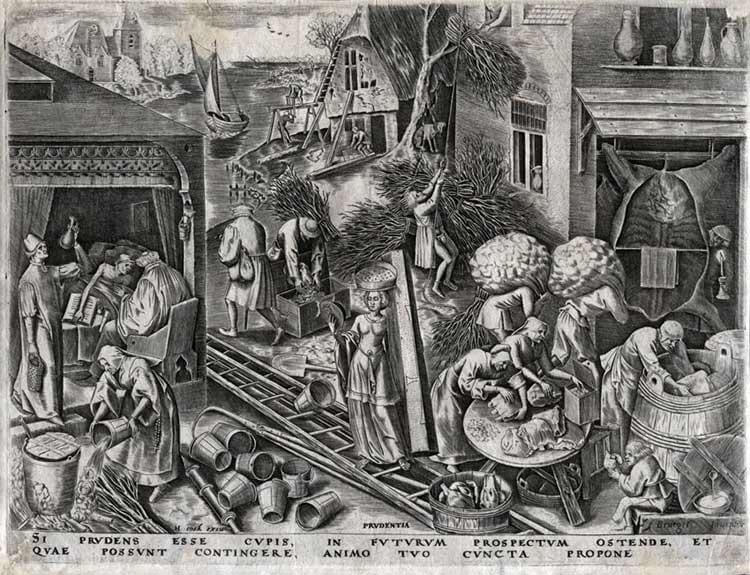

Pieter Brueghel the Elder, Prudence from The World of Seven Virtues, c.1559 |
|
| Artist: | Pieter Brueghel the Elder (1525 - 1569) |
|---|---|
| Title: | Prudence from The World of Seven Virtues, c.1559 |
| Medium: | Original Engraving |
| Image Size: | 11 1/2 in x 8 7/8 in (29.2 cm x 22.6 cm) |
| Sheet Size: | 11 5/8 in x 9 in (29.5 cm x 22.9 cm) |
| Framed Size: | 28 3/4 in x 26 1/8 in (73 cm x 66.4 cm) |
| Edition: | A lifetime impression from the only state of two by Philips Galle based on an original work by Pieter Bruegel |
| Signature: | The signature of Bruegel (Breda, 1525 - Brussels, 1569) is inscribed in the lower right: 'Bruegel Inuentor.' |
| Condition: | This work is in excellent condition - a fine, dark impression. With large margins all around |
| ID # | w-2094 |
Pieter Brueghel the Elder Prudence from The World of Seven Virtues, c.1559; According to H. Arthur Klein:
Prudence stands on, under, and next to objects symbolizing various kinds of such desirable wisdom: On her head she carries a sieve or colander; in her hand she holds a mirror; against her shoulder leans a long slender coffin. Each of these objects suggests a different aspect of prudence: the sieve or colander – the sifting out of good from evil, rejecting the bad, retaining that which makes for a life of virtue; the coffin – the inevitable death that awaits all men, in awareness of which they should live each day prudently; the mirror – self-knowledge. (128)
Created c. 1559, Prudence features the following inscription in the lower margin: SI PRVDENS ESSE CVPIS, IN FVTVRVM PROSPECTVM IN OSTENDE, ET | QVAE POSSVNT CONTINGERE, ANIMO TVO CVNCTA PROPONE (If you wish to be prudent, thin always of the future and keep everything in the forefront of your mind) . The signature of Bruegel (Breda, 1525 - Brussels, 1569) is inscribed in cartouche in the lower right: ‘Bruegel Inuentor’ with PRVDENTIA (Prudence) in the lower center, with ‘H. cock excu’ in the lower left. A lifetime impression from the only state of two by Philips Galle based on an original work by Pieter Bruegel featuring the inscribed text plate along the lower margin on watermarked paper dating the piece to c. 1559 – 1591 (Gothic P with Flower, Br. 8715 - 8723) .
Catalogue Raisonné & COA:
Pieter Brueghel the Elder Prudence from The World of Seven Virtues, c.1559 is fully documented and referenced in the below catalogue raisonnés and texts (copies will be enclosed as added documentation with the invoices that will accompany the final sale of the work) :
1. Bastelaer, René van. The Prints of Peter Bruegel the Elder, Catalogue Raisonné New Edition, Alan Wofsy Fine Arts: San Francisco, 1992. Listed and illustrated as catalogue raisonné no. 136 on pgs. 182-3.
2. Briquet, C.M. Les Filigranes, Dictionnaire Historique des Marques du Papier, Tome III L-O. Verlag: Leipzig, 1923. Watermark listed and illustrated as catalogue raisonné no. 8715 – 8723 on pg. 468.
3. Klein, H. Arthur. Graphic Worlds of Peter Bruegel the Elder, Dover Publications: New York, 1963. Listed and illustrated as catalogue raisonné no. 52 on pgs. 128-9.
4. Orenstein, Nadine M., ed. for the Metropolitan Museum of Art, New York. Pieter Bruegel the Elder: Drawings and Prints, Yale University Press: New Haven, 2001. Listed and illustrated as catalogue raisonné nos. 68-9 on pgs. 182-3 with further footnote reference on pg. 193.
5. Sellink, M. Pieter Bruegel: The Complete Paintings, Drawings and Prints. Ludion: NY, 2007. Listed and illustrated as catalogue raisonné no. 91 on pg. 149. Detail on preparatory drawing for Prudence is listed and illustrated as catalogue raisonné no. 82 on pg. 140.
6. A Certificate of Authenticity will accompany Pieter Brueghel the Elder Prudence from The World of Seven Virtues, c.1559.
About the Framing:
Set in a Spanish style black and gold frame, the ribbon detailing of the moulding compliments the meandering curved shapes within the image. The black and gold coloration of the work also serves to enhance the contrasting colors within the frame as well. Completed with white, linen-wrapped mats with a matching gold inner fillet, Prudence is set behind an archival Plexiglas® cover.
