Pablo Picasso, Maternité |
|
| Artist: | Pablo Picasso (1881 - 1973) |
|---|---|
| Title: | Maternité |
| Medium: | Color Picasso Aquatint with Etching |
| Image Size: | 25 1/2 in x 16 3/8 in (65 x 42.5 cm) |
| Sheet Size: | 30 in x 20 in (76.2 cm x 50.8 cm) |
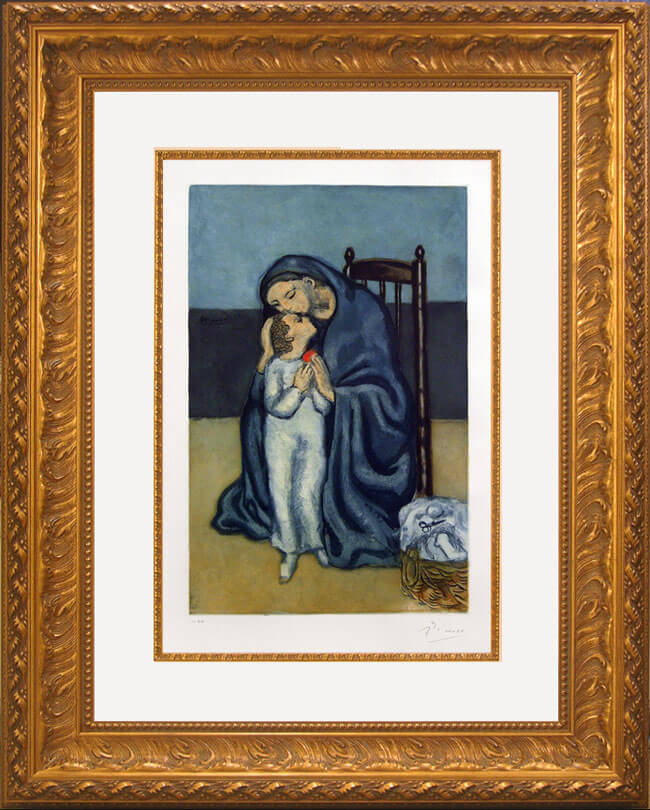
| Framed Size: | 43 in x 35 in (109.22 cm x 88.9 cm) |
| Signature: | This work is hand signed by Picasso in pencil in the lower right, and in the plate middle left |
| Condition: | This work is in excellent condition, with vibrant coloration and a strong impression |
| ID # | w-1989 |
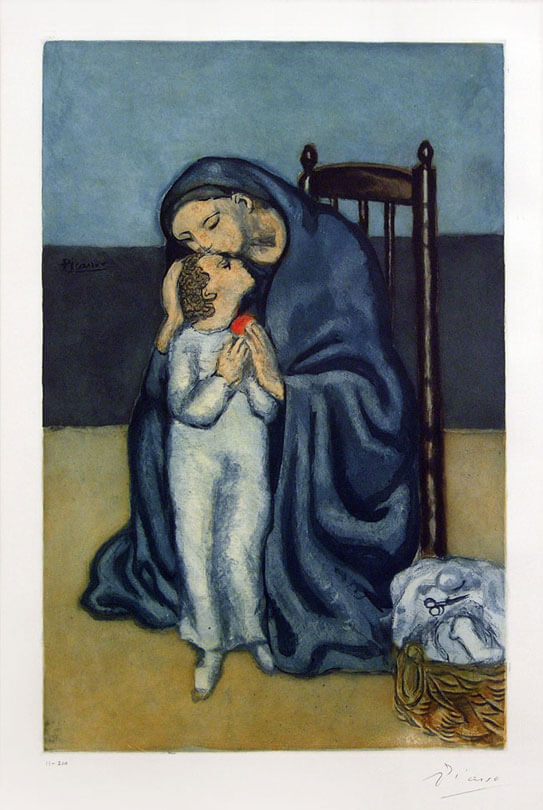
Infused with rich tones of blues, greens, creams, browns and red, Picasso uses both form and color to accentuate the tender exchange of affection between mother and child with a universal appeal. One in a series of Blue Period works created between 1901 and 1903, this work employs remarkable aquatint technique, which, united with subject matter combines to create a meditative and masterful lamentation on motherhood.
Collaboratively executed by Picasso and master printer and artist Jacques Willon, this work was adapted from the 1901 oil on canvas, using color etching and aquatint. Printed in 1930 by Willon and published by Bernheim-Jeune, this work is hand signed by Picasso in pencil in the lower right, and in the plate middle left. The piece has been numbered 121/200 in pencil in the lower left.
While the fine detailed etching creates a warm and inviting effect, it is the remarkable aquatint printing technique that generates the powerful textured appearance in this work. Upon close inspection, we see the subtle fingerprints of the printer, captured directly in the aquatint material. While initially these prints appear to be soft etchings, they are in fact the hand of the artist, and their delicate presence both softens the work and adds a wealth of texture. This remarkable textural quality is most evident in the mother's clothing, particularly around the base of her brilliant blue cloak.
The mother's cloak is a beautiful and harmonious blending of rich and deeply saturated blue tones. As the blue pigment hues vary seamlessly across the cloak, these blue shades merge together to create a brilliant and shimmering lapis-lazuli color. Lapis-lazuli is an extremely valuable and historic pigment, perhaps most famously used to depict Madonna and Holy Family images by fourteenth century masters like Giotto, as seen in his work, Madonna Enthroned, 1310. While Giotto's piece is specifically religious, Picasso has re-envisioned this traditional subject matter to be more accessible to a larger audience, reflecting the intimate relationship between mothers and children of all religious and ethnic backgrounds. This universal approach is further intensified by Picasso's decisive choice of background. The background is comprised of three simplified bands of color: beige and two shades of blue. These colors create an environment that reads as a flat plain prohibiting the viewer's investigation of the surrounding environment, and thereby focusing our attention on the mother and child.
Reflective of Picasso's Blue Period, this work adopts a rich blue palate; simultaneously, it provides a hopeful yet somber image. Picasso's selected palate produces a quieting and meditative effect for us as viewers. The range of detail, expert manipulation of color, large scale, and thoughtful subject matter combine to make this piece an overall tour-de-force work of art.
Catalogue Raisonné & COA:
It is fully documented and referenced in (copies will be enclosed as added documentation with the invoices that I will accompany the final sale of the work) :
1) Ginestet, Colette de and Pouillon, Catherine, Jacques Willon: Les Estampes et Les Illustrations Catalogue Raisonné, 1979 listed on page 394 - 395 listed as image E 634.
2) Daix, Pierre and Boudaille, Georges, Picasso: The Blue and Rose Periods, 1967, page 202.
3) Masterworks Fine Art, Inc. Certificate of Authenticity will accompany this work.
About the Framing:
Conservation framed in a richly intricate aged-gold moulding. The peaceful vegetal elements of the moulding perfectly compliment Picasso's gentle scene of mother and child. Framing is complimented with white linen wrapped mattes and matching gold inner fillet. All materials are archival and museum quality. This custom frame is finished with a Plexiglas cover.
NOTE: Our master framer custom frames all our works specifically for our company. If our selection of framing is not to your taste, we can easily custom frame the work to meet your needs.