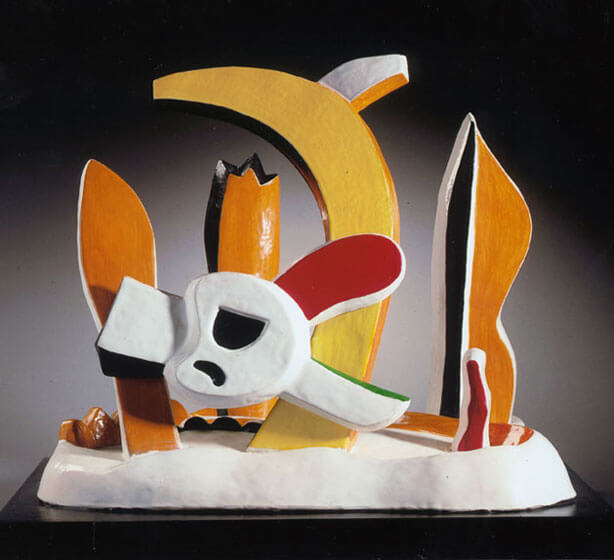
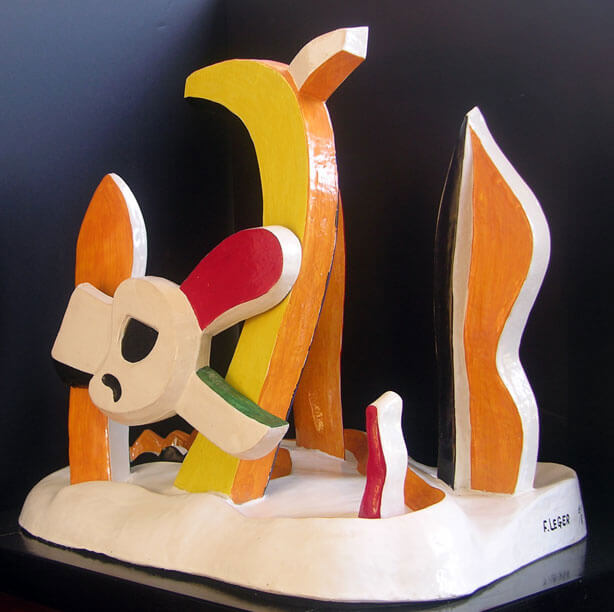
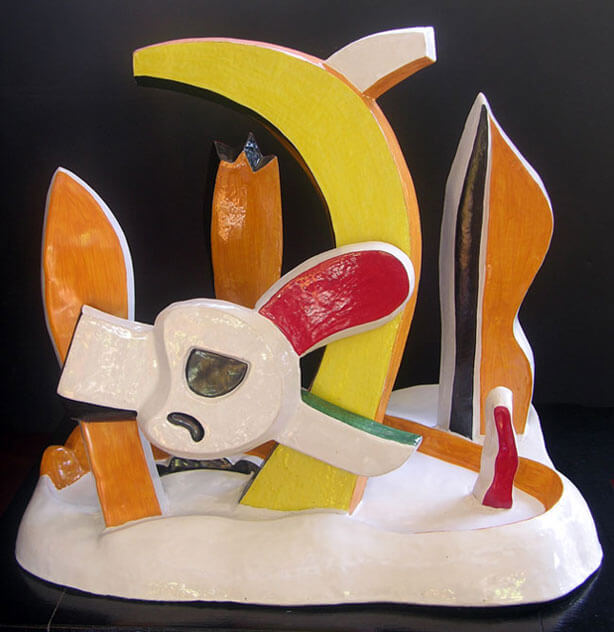
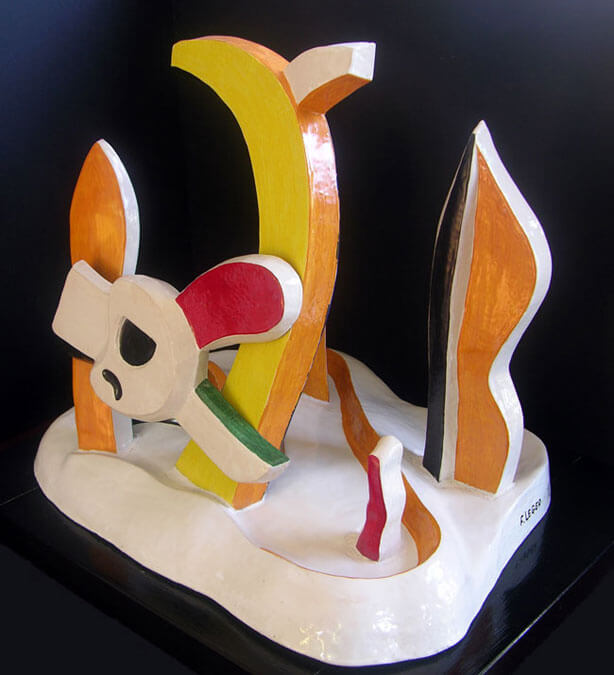
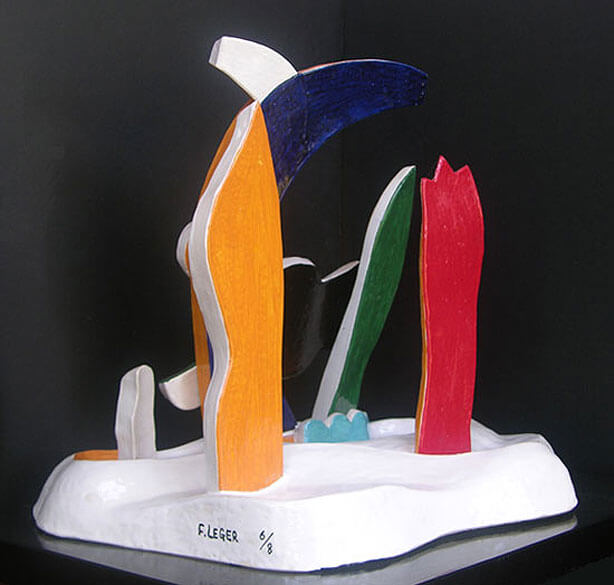
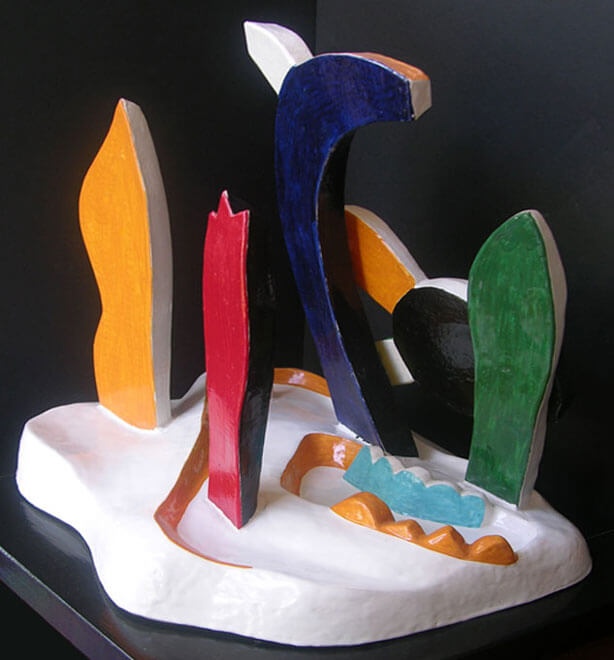
Leger, Fernand, The Children's Garden, or Kindergarten
French painter and designer. From c.1909 he participated in the Cubist movement. He is generally considered one of its major masters but his curvil… [Read biography »]
![]() |
![]() |
Signed Fernand Leger, Ceramic Sculpture, The Children's Garden, or Kindergarten ![]() |
| Artist: | Leger, Fernand (1881 - 1955) |
|---|---|
| Title: | The Children's Garden, or Kindergarten |
| Medium: | Ceramic Sculpture |
| Image Size: | Approx 25 in x 20 in (63.5 x 50.8 cm) |
| Sheet Size: | With base: 8.25 in x 23 in (71.6 x 58.42 cm) |
| Framed Size: | Height: 25 in (63.5 cm) + 2 in base |
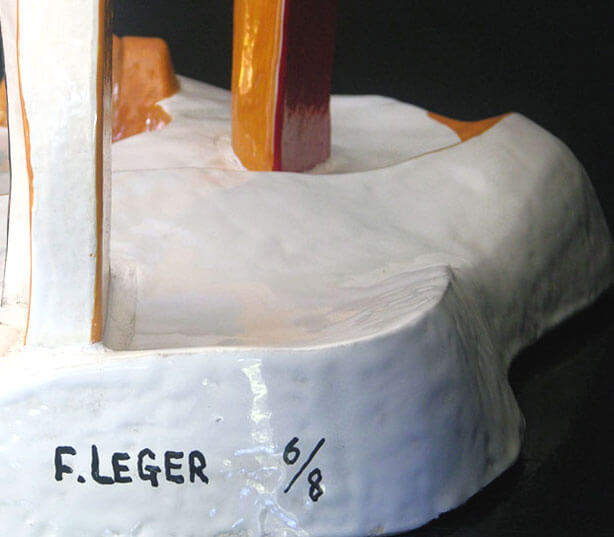
| Signed: | Signed 'F. Leger' in black on the right side of the base |
| Edition: | From the very rare and limited edition of only eight (plus 1 artist proof), this piece is numbered 6/8 in black on the right side of the base |
| Condition: | Excellent |
Price :Item# 1982 | $85,000 ![]() To speak directly with the Director, Alex Adelman, please call (510) 777-9970 / 1-800-805-7060. |
| Description: | |
Remarkable for its grand size, vibrant color, and delightfully intriguing compositional elements, this is a rare and wonderful example of Leger's creative and dynamic style in the ceramic medium. Created in 1952 and cast at a later date, this fantastic ceramic sculpture is from the very rare and limited edition of only eight. The piece is numbered 6/8 in black on the right side of the base. The work contains a guaranteed authentic signature by Leger, 'F. Leger' in black, also on the right side of the base. This work is published in Y. Brunhammer, Fernand Leger: The Monumental Art, Milan 2005, illustrated on page 164. THE ILLUSTRATED CAST SHOWN HERE IS THE ACTUALLY CAST WE ARE SELLING. Brilliant shades of red, yellow, orange, and green define this image creating a lustrous jeweled aesthetic. Exhibiting Leger's mature style, the Children's Garden is wonderfully expressive and infused with an exuberant sense of curiosity and imagination. The three-dimensional elements are perfectly balanced and create complex interactions through the use of shape, color, and environment. The magical garden possesses a sense of self contained energy that invites us to enter into this bright and colorful world, while simultaneously emitting a mild caution that adventurers who enter, may not want to leave. Just as we interact with the sculpture, there is also the dynamic interaction between the ceramic and its environment. The upright elements merge with their environment, radiating their innate energy into the room. This work is in overall great condition-glaze remains bright and fresh with a few very minor chips to the glaze on some of the standing elements, and conservation to these elements that does not interfere with the image or overall composition. Leger scholar Yvonne Brunhammer wrote of Leger's ceramic sculpture: "Leger's ceramics are the tranquil assertion of the exuberance of life. Their healthy coloring, the weight of their flesh, their tactile qualities, their orderliness, the confidence that emanates from them, all that makes us see them as real objects d'art that have a beneficial utility in the time and space allotted us." PROVENANCE: Private Collection, London Catalogue Raisonné & COA: 1) deFrancia, Fernand Leger, new Yaven, 1983, monumental version illustrated as plate 58. 2) G. Bauquier, Fernand Leger, Vivre dans La Vrai, Paris 1987, monumental version illustrated on p. 338-39. 3) Y. Brunhammer, Fernand Leger: The Monumental Art, Milan 2005, illustrated on page 164 (THE illustrated cast shown here IS the actually cast we are selling) . 4) Masterworks Fine Art, Inc. Certificate of Authenticity accompanies this work. | |

| Style: | Modern Master, Cubism |
About Us: Masterworks Fine Art, Inc. strives to be the best source of fine art for our clients and collectors all over the world. We believe the most direct way to accomplish this is by establishing a lifetime of personal and professional relationships with our clients. More About Us »
Do you own a similar Leger Ceramic Sculpture to sell? We offer free evaluations.
Biography of Fernand Leger
Fernand Leger (1881 - 1955)
French painter and designer. From c.1909 he participated in the Cubist movement. He is generally considered one of its major masters but his curvilinear and tubular forms (he was for a time called a 'tubist') contrasted with the fragmented forms preferred by Picasso and Braque. The First World War, during which he was gassed whilst serving as a stretcher-bearer, had a profound effect on Leger. His contact with men of different social classes and different walks of life came as a revelation: 'I was abruptly thrust into a reality which was both blinding and new,' he said. Henceforward he made it his ambition to create an art which should be accessible to all ranks of modem society.
In 1920 he met Le Corbusier and Ozenfant and in the early 1920s he was associated with their Purist movement. His paintings were static, with the precise and polished facture of machinery, and he had a fondness for including representations of mechanical parts.During the late 1920s and 1930s he also painted single objects isolated in space and sometimes blown up to gigantic size, In the inter-war years he expanded his range beyond easel painting, with murals and designs for the theatre and cinema. He was also busy as a teacher, notably at his own school, the Academie de I'Art Contemporain, and he traveled widely, making three visits to the USA in the 1930s. The connections he had made there stood him in good stead when he lived in America. During the Second World War he lived in the USA, teaching at Yale University, and at Mills College, California. Acrobats and cyclists were favorite subjects in his paintings of this time. From his return to France in 1945 his painting reflected more prominentlyhis political interest in the working classes. But its static, monumental style remained, with flat, unmodulated colours, heavy black contours, and a continuing concern with the contrast between cylindrical and rectilinear forms. in his later career Leger worked much on large decorative commissions, notably the windows and tapestries for the church at Audincourt (1951). Many honours came to him late in life, and a museum dedicated to him opened at Biot in France in 1957. In the catalogue of the exhibition Leger and Purist Paris' (Tate Gallery, London, 1970), John Golding wrote of Leger: 'No other major twentieth-century artist was to react to, and to reflect, such a wide range of artistic currents and movements . . . And yet he was to remain supremely independent as an artistic personality. Never at any moment in his career could he be described as a follower ... But his originality lay basically in his ability to adapt the ideas and to a certain extent even the visual discoveries of others to his own ends.' He saw the poetic value that lies in the clear delineation of everyday objects, the in trinsic beauty of modem machinery and the things which are mass-produced by machinery, and he favoured proletarian subjects, depicting them with the same clarity and precision as the themes taken from machine culture.


