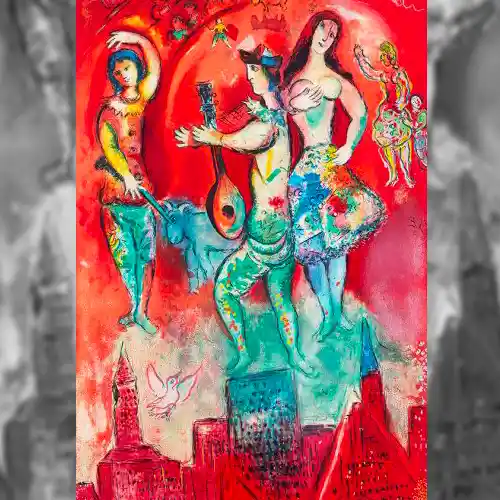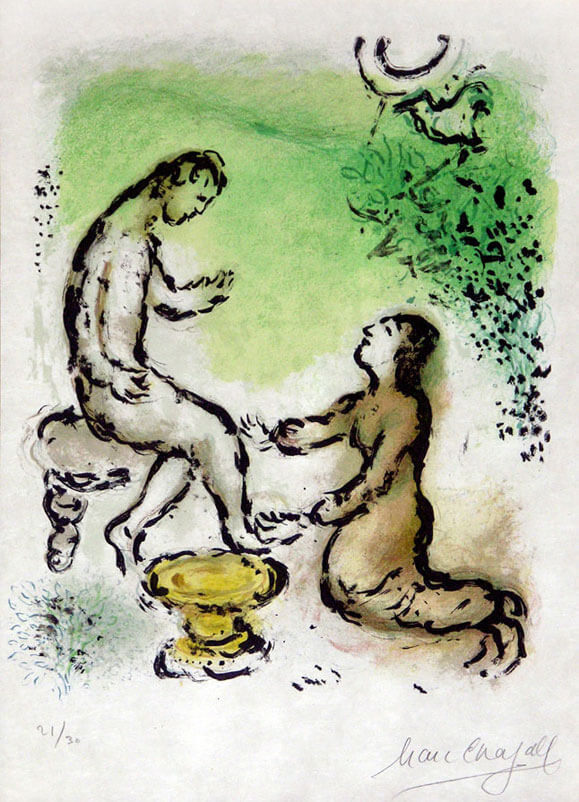


Marc Chagall, L'Odyssée II: Ulysse et Euryclée (Odyssey II – Ulysses and Euryclea), 1975 |
|
| Artist: | Marc Chagall (1887 - 1985) |
|---|---|
| Title: | L’Odyssée II: Ulysse et Euryclée (Odyssey II – Ulysses and Euryclea), 1975 |
| Reference: | CS 811 |
| Medium: | Original Color Chagall Lithograph |
| Image Size: | 15 1/2 in x 12 in (39.37 cm x 30.48 cm) |
| Sheet Size: | 21.3 in x 15.2 in (54 cm x 38.5 cm) |
| Framed Size: | 30 1/2 in x 24 1/2 in (77.47 cm x 62.23 cm) |
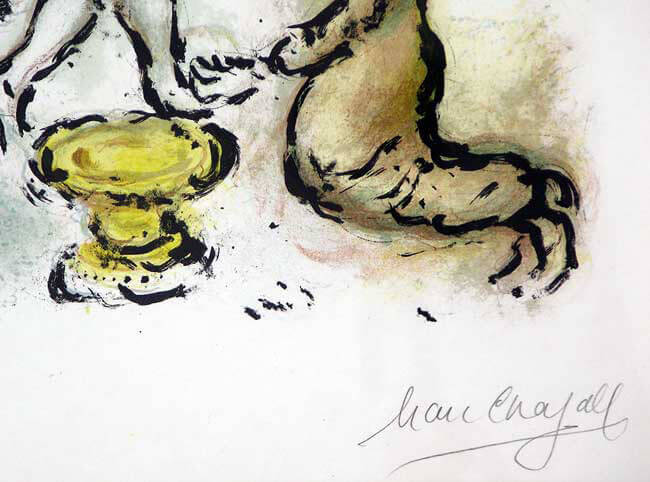
| Signature: | Hand signed by Marc Chagall (Vitebsk, 1887- Saint-Paul, 1985) in pencil in the lower right margin |
| Condition: | This work is in excellent condition, a wonderful impression with vibrant, saturated colors |
| ID # | w-1977 |
This bold and colorful scene, illustrated by Chagall (Vitebsk, 1887- Saint-Paul, 1985), tells the tale of a mother and son who are reunited again after years apart. Its passionate and animated qualities of the characters give this piece a whole new meaning and lively quality usually attributed to the mythical tales of the Odyssey.
This work was created on June 20, 1975 as part of a series of illustrations done by Chagall (Vitebsk, 1887- Saint-Paul, 1985) for the second volume of Homer's The Odyssey. In addition to the book illustrations, there were 30 numbered and signed proofs printed by Mourlot of all the color plates featured in the volume. This piece is numbered 21/30 in pencil in the lower left margin and hand-signed by Marc Chagall (Vitebsk, 1887- Saint-Paul, 1985) in the lower right margin. Published by Mourlot, Paris.
The joyous reunion featured here between Mother and Son is depicted in a heartfelt and emotional scene, full of color and warmth. Euryclea is knelt down before Ulysses and begins to wash his feet and only to recognizes her son by a childhood scar she notices at the crook of his knee. What ensues is a fulfilling and wondrous drama recounted by Homer in his epic, The Odyssey. Chagall (Vitebsk, 1887- Saint-Paul, 1985) recreates this imagery perfectly as he is able to capture both the essence and spirit of each of the characters with his use of muted browns and bright, lime greens which radiate a glowing hues of yellow and shimmering white.
Catalogue Raisonné & COA:
It is fully documented and referenced in (copies will be enclosed as added documentation with the invoices that I will enclose with the sale of the work) :
1. Cramer, Patrick. Marc Chagall, The Illustrated Books: Catalogue Raisonné, Geneva, 1995. Listed as cat. no. 96 on pg. 276 and illustrated on pg. 283.
2. Gauss, Ulrike ed. Marc Chagall - The Lithographs, Frankfurt, 1960. Listed and illustrated as cat. no. 811 on pg. 336.
3. Sorlier, Charles. Chagall Lithographs, 1974-1979, New York, 1984. Listed and illustrated as cat. no. 811 on pg. 87. Detailed on pg. 61.
About the Framing:
This work is set in a lovely, gold-leaf frame with ornate, floral detail on each of the four corners. The brilliancy of the gold in the moulding enhances the bright hues in this work while the floral elements and detail compliment the subject matter of this piece. Complete with white, linen-wrapped mats and a matching gold inner fillet, Ulysses & Euryclea is set behind an archival Plexiglas cover to ensure lasting quality.